Vibe Coder Raises a Paw in the System Design Meeting
Why is this DesignPatterns Architecture meme funny?
Level 1: Raising Your Hand in the Wrong Class
This is the feeling of a kid who learned to make amazing toy castles by following a robot's instructions, sitting in a meeting where real builders are arguing about how to keep an actual bridge from falling down — and slowly raising his hand anyway. The sleepy-eyed lemur is that moment: relaxed, confident, completely unbothered by the fact that he has no idea how bridges work. It's funny because everyone has been in a conversation slightly over their head, and most of us know the wise move is to listen. The lemur does not listen. The lemur has thoughts.
Level 2: What a System Design Meeting Actually Is
A system design meeting is where a team decides how software will be structured before (or while) building it: which services exist, how data flows between them, what happens under load, and what breaks first. It deals in concepts like scalability (can it handle 100x the users?), reliability (what happens when a server dies mid-request?), and architecture patterns (monolith vs. microservices, sync vs. async messaging).
A vibe coder is recent slang for a developer who builds primarily by describing what they want to an AI assistant and accepting whatever it produces, without necessarily understanding the internals. The term isn't purely an insult — it describes a real and sometimes effective workflow — but it becomes one in contexts where understanding is the whole job. Design meetings are exactly that context: the LLM isn't in the room, and the questions ("why this database?", "what's the failure mode?") demand reasoning you can't autocomplete.
The lemur photo itself is a long-running meme template: the animal's glazed eyes and lazily raised hand read as someone half-present, about to contribute something deeply unhelpful with total calm. If you're early in your career, you've likely been the lemur once — raising a hand in a planning meeting to suggest something a senior gently dismantles. That's normal and good. The meme's bite is aimed at doing it without ever planning to close the gap.
Level 3: The Architecture of Not Knowing
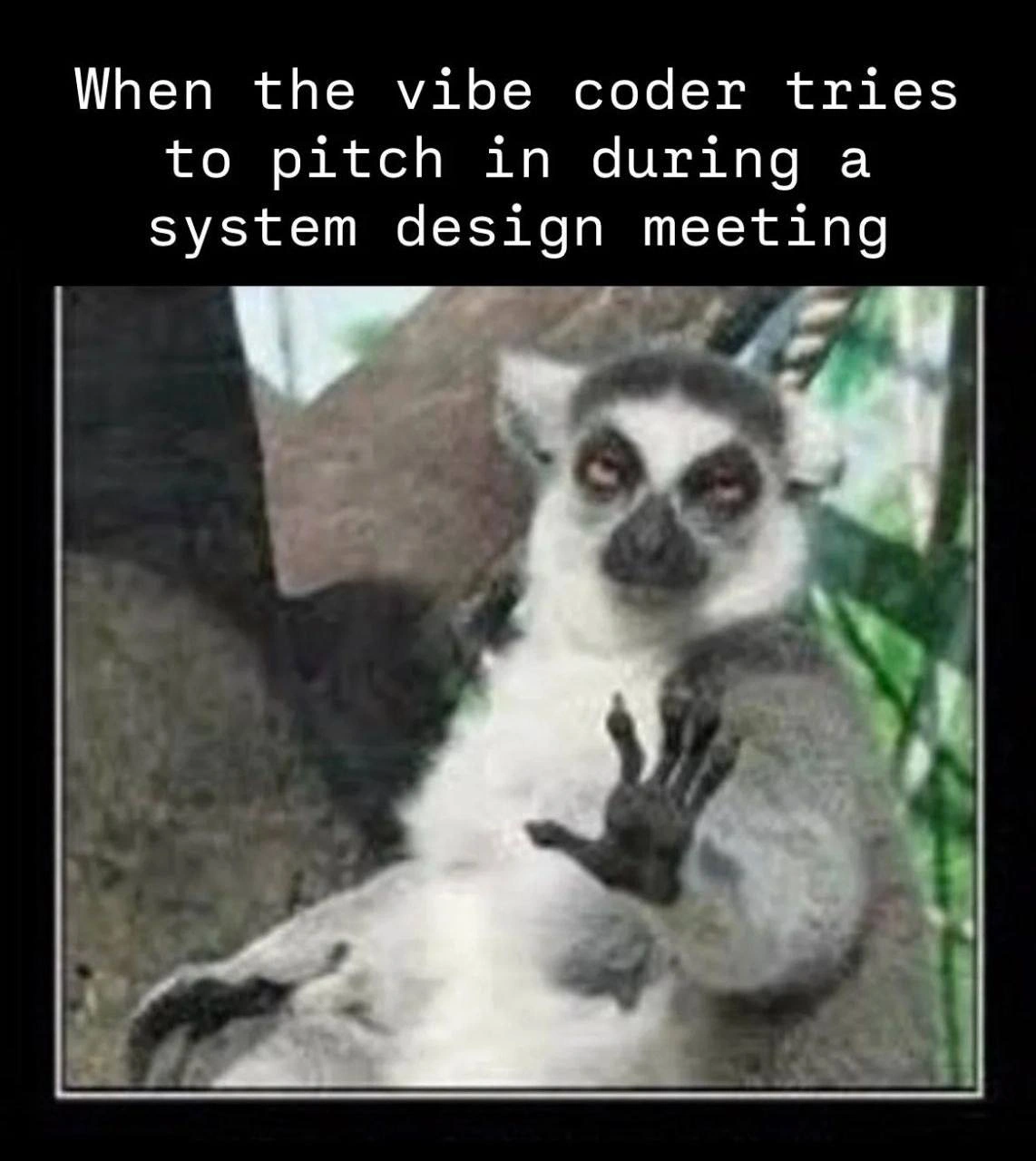
"When the vibe coder tries to pitch in during a system design meeting"
The stoned lemur — heavy-lidded, reclined, one black-fingered paw raised with the conviction of someone who has absolutely nothing load-bearing to say — is doing a lot of work here. System design meetings are where the industry's newest fault line becomes visible: the gap between producing code and understanding systems. Vibe coding — shipping features by iteratively prompting an LLM until the output runs — genuinely works for a shocking percentage of day-to-day tasks. CRUD endpoints, UI glue, test scaffolding: the model has seen ten million of them. What it does not give you is the ability to reason about trade-offs, because trade-offs are exactly the part that doesn't compile.
A system design discussion is adversarial reasoning about failure: What happens when this queue backs up? Do we accept eventual consistency here or pay for coordination? Is this cache an optimization or a correctness hazard? These questions have no green checkmark. You can't vibe your way through "what's our idempotency story when the payment webhook retries," because the answer depends on your business invariants, not on the statistical average of every Medium post ever written. The lemur's raised hand is the moment pattern-matching meets a problem that requires a model of the world rather than a model of text.
The deeper satire is organizational. Teams that hired for velocity during the AI tooling boom now discover that design review is their only remaining line of defense — and it's staffed by people who can confidently propose "we could just use Kafka for that" with the same sedated certainty the lemur projects. The senior engineers in the room face an awkward asymmetry: refuting a vibed proposal takes ten times longer than generating it. That's not a personality problem, it's an incentive structure — when the cost of producing plausible-sounding architecture drops to zero, the meeting becomes a denial-of-service attack on the people who can actually evaluate it. Half the room is doing prompt engineering; the other half is doing damage engineering.
And yet — the lemur isn't malicious. He's participating. That's the part that stings. Everyone in that meeting was once the person raising a hand to suggest something that violated the laws of distributed systems. The difference is that the old path forced you to debug your own bad idea at 3 AM until the fundamentals were beaten into you. The new path lets the bad idea ship.
Description
A meme with white monospace text on a black background reading: 'When the vibe coder tries to pitch in during a system design meeting.' Below, in a white-bordered frame, is the classic photo of a ring-tailed lemur lounging back with heavy-lidded, stoned-looking eyes, lazily raising one black-fingered hand as if to make a point or ask to speak. The meme mocks AI-dependent 'vibe coders' - developers who ship by prompting LLMs without understanding fundamentals - attempting to contribute to a system design discussion involving trade-offs, scalability, and architecture they cannot reason about, their raised hand carrying all the authority of a sedated lemur
Comments
4Comment deleted
His proposal cleared every design review gate except the one where someone asked what happens when the API rate limit hits - his, not the service's
Choose your battles Comment deleted
no fucking way lemur "uzbagoysya" in 2026 Comment deleted
It's funny because like I wanted to go into the systems team but no they dropped me in the weird vibe coding team anyway and now they're just like "maybe you should have been a junior systems person" yep Comment deleted