Skip to content
DevMeme
6586 of 7435
Vertebrae C6 Is Happy to Literally Support You Every Day
MentalHealth Post #7219, on Oct 6, 2025 in TG

Vertebrae C6 Is Happy to Literally Support You Every Day

Why is this MentalHealth meme funny?

Level 1: Got Your Back

Imagine you’re carrying something heavy, and a good friend comes over to help hold it with you. Feels nice to have that help, right? This meme is basically saying you already have a little friend like that inside you – one of the bones in your neck! Every day, that neck bone (called C6) happily holds up your heavy head. So when you feel sad, it’s reminding you that you’re not alone: even a part of your own body is always there supporting you (literally holding your head up so you can face the world). It’s a funny, friendly way to say “someone’s got your back.” In other words, you have support with you all the time, even if it’s just your trusty backbone. So chin up – your C6 is on the job, and it loves helping you out!

Level 2: Posture and Productivity

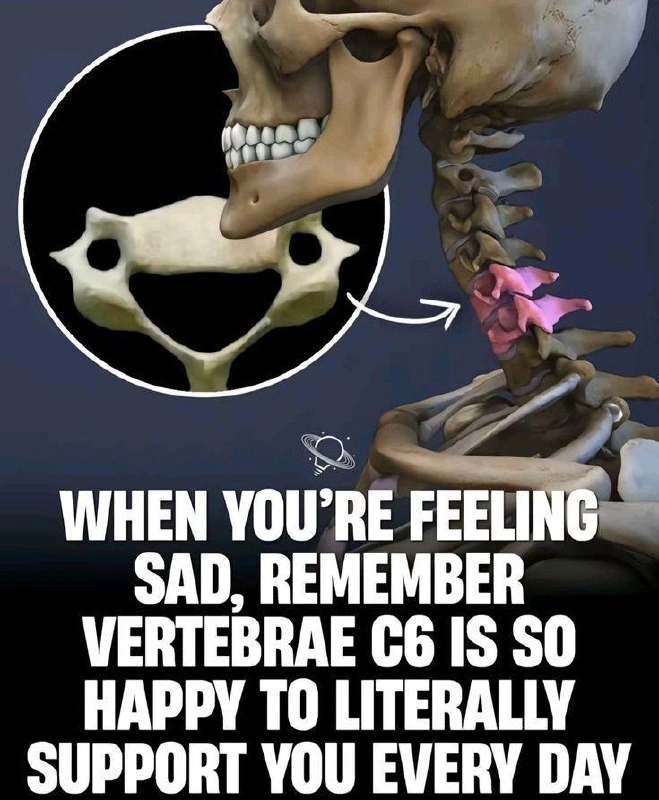
Let’s break down the meme in simpler terms. First, C6 is the name of one bone in your neck, specifically the sixth cervical vertebra. The cervical vertebrae are the stack of seven bones (C1 through C7) that form your neck and support your head. If you place your hand on the back of your neck, you’re feeling those little bony bumps – that’s your cervical spine. These bones are part of your skeleton and work together like a team to hold up your head (which is actually quite heavy!). In the image, C6 is colored bright pink to draw attention to it. The meme text says, “When you’re feeling sad, remember vertebrae C6 is so happy to literally support you every day.” In other words, one of your neck bones is being personified as a tiny cheerleader that’s always supporting you (literally holding your head up). It’s a cute way to make you smile and maybe adjust your posture. 😄

Now, why call it a “high-availability load balancer”? Those are tech terms:

  • A load balancer in computing is like a smart traffic cop for the internet. Imagine you have a popular website running on several servers. The load balancer’s job is to distribute user requests across those servers so none of them gets overloaded. If one server goes down or is too busy, the load balancer directs traffic to another server. This ensures no single server has to handle everything alone.
  • High availability means designing systems to be reliable and up almost all the time. For example, if a service is 99.9% available, it means it’s only down for at most ~8 hours a year. Achieving high availability often involves redundancy – having backups or multiple components (like extra servers, or two load balancers in case one fails) so that there’s no single point of failure. The goal is to avoid downtime, so users can always connect.

So, the meme jokingly calls the C6 vertebra “the original high-availability load balancer” because your neck bones share the load of your head’s weight, and they do it continuously (your “uptime” is basically whenever you’re not lying down). In a sense, evolution gave us a redundant system in our necks: multiple small bones with cushioning disks and various muscles all working together to support and move your head. If one part gets hurt (say you strain a neck muscle or one disc is a bit degenerated), you usually can still hold your head up because the other parts compensate. That’s a bit like how if one server in a cluster fails, the others pick up the slack so the website stays up. It’s a playful analogy: your vertebrae are the “servers,” your neck muscles and reflexes are like the balancing algorithm, and your head is the important “application” that needs to stay online (upright).

For a junior developer or anyone new to these terms, the meme is also sneaking in a lesson about ergonomics and self-care. Ergonomics is about arranging your workspace and posture in a healthy way. You’ve probably heard tips like “keep your monitor at eye level,” “support your lower back,” or “take breaks to stretch.” All that is to maintain good posture so that bones like C6 aren’t under undue stress. Early in our careers (or during intense project sprints), many of us ignore these tips – we might spend hours crouched over a laptop on the couch or craning our neck forward while coding. The result? Pain and fatigue. This meme highlights posture in a humorous way: it’s essentially your neck bone saying, “I’m always here holding you up, buddy, but you gotta meet me halfway!” Developers sometimes jokingly call these aches and pains “posture-related bugs.” Just like bugs in code, if you don’t address the cause (poor posture), the “symptom” (neck pain) keeps recurring. The fix might be as simple as adjusting your chair height or taking a 5-minute stretch every hour.

The tags MentalHealth and DeveloperProductivity are attached because physical well-being and mental well-being are connected, especially in sedentary jobs like programming. If you’ve ever pulled an all-nighter, you know the next day you feel awful both in body and mind. Here, the meme’s message “remember C6 is happy to support you” is a little boost for your mood. It’s saying: even if you’re having a rough day, something as basic as your own backbone is still loyally doing its job – and that’s kind of heartwarming in a goofy way. This relates to developer burnout and fatigue: when you’re burnt out or extremely tired, you often feel like you have no support and everything is going wrong. The meme counters that by pointing out you do have support (literally from your spine!). It encourages a bit of positivity and maybe a laugh, which can help break a negative thought cycle.

Also, from a work-life balance perspective, it’s a reminder not to neglect self-care. Taking care of your health is actually a smart productivity strategy. A developer who has an ergonomic setup and takes care of their neck/back will likely code more comfortably and with fewer distracting aches. On the flip side, if you’re constantly in pain or discomfort, it’s hard to concentrate and easy to get irritable or sad. So, consider this meme a light-hearted work-life balance tip: treat your body as the valuable support system it is. Maybe adjust that monitor height, or do a quick posture check right now (shoulders down and back, not hunched, ears above your shoulders – there you go!). In essence, a happy C6 vertebra (and happy neck overall) can contribute to a happier, more productive developer. And the happier you are, the more likely you’ll have the energy and focus to solve that tricky bug or implement that new feature.

So if it’s a Monday morning and you’re feeling a bit low – perhaps dreading a tough coding task or still tired from the weekend – this meme wants you to start the week with a smile. “Good morning and have a magnificent week,” the post says. Picture a tiny pink bone in your neck giving you a thumbs-up (if it had thumbs) and saying “I’ve got your back!” It’s silly, it’s science-y, but it might just make you straighten your neck, smile, and remember to appreciate the little supportive things – both in software and in yourself.

Level 3: Biological Load Balancer

In this meme, the title and caption proclaim vertebra C6 as “the original high-availability load balancer keeping your head online.” This sets up a playful comparison between our skeleton anatomy and tech infrastructure. Specifically, C6 is one of the cervical vertebrae (the neck bones labeled C1 through C7) that form a supportive architecture for the most important “server” in your body – your brain. The meme draws a musculoskeletal metaphor: the stacked vertebrae in your neck share the load of your heavy head, much like multiple servers share traffic behind a load balancer. Calling C6 high-availability is geeky humor: in IT, a High Availability (HA) system has no single point of failure and aims for near-zero downtime. Similarly, your neck has multiple redundant parts working in concert – if one vertebra or disc is under stress, adjacent ones and supportive muscles compensate (at least for a while), so your “head stays online” (upright and functioning) almost 24/7.

The joke shines through by personifying C6 as a cheerful system component that’s “happy to literally support you every day.” It’s a supportive architecture analogy in the purest sense. Seasoned engineers chuckle because it reminds us of those unsung infrastructure heroes in tech (like the HAProxy load balancer, or you know DNS 🙃): the pieces quietly doing their job in the background. You typically don’t notice your vertebra C6 support (or your load balancer) until something goes wrong. Ever had a stiff neck that forced you to swivel your whole torso? That’s like an outage of one node in a cluster – the system (your body) enters a degraded mode. We only truly appreciate unseen infrastructure when it fails, whether it’s a downed server that makes your app unreachable or a pinched nerve that makes turning your head agony. This meme winks at that reality: C6 (and its fellow vertebrae) are the reliable “uptime” providers of your personal biological network.

For developers, there’s a poignant truth here about health-first dev practices. We spend hours hunched over keyboards, and it’s easy to treat our body’s support systems with the same obliviousness as a newbie treats a singleton bug – until it crashes. The average human head weighs ~5kg (about 11 lbs). If you’re stooping forward to peek at your screen, the effective force on your neck can triple, dumping a crazy load on C6 and friends. (Fun fact: a 30-degree head tilt feels like ~18kg to your neck!). That poor vertebra has been doing 24/7 support with no pager rotation. 😅 Seasoned devs recognize the pattern: ignoring ergonomic workstation setup is like ignoring a memory leak in production. Eventually, you’re going to pay for it. Many have experienced these posture-related bugs: tension headaches, neck stiffness, or even a herniated disc from years of slouching – the human equivalent of severe technical debt building up. Just as we refactor code to prevent system failure, we need to “refactor” our posture and work habits to avoid a literal backbone failure. It’s both a productivity concern (hard to code with a throbbing neck) and a serious mental health concern, since chronic pain can really drag your mood and focus down. The senior engineers reading this might nod (carefully, to spare C6) and recall that one colleague who ended up in physio because they treated chairs and monitors as an afterthought during crunch time.

On an even nerdier note, think of your cervical spine as a tiny cluster with load distribution algorithms. Each vertebra from C1 to C7 is like a node in a distributed system, cooperating to balance the weight of your skull. There’s even a form of “round-robin scheduling” happening as you move your head — different angles shift load to different parts of the cervical stack, so no single bone gets the full brunt continuously. And high-availability? Barring injury, your neck provides something like five-nines reliability for keeping your head up (99.999% uptime during waking hours 😉). Nature implemented redundancy and failover in your spine long before we did in cloud architectures! If one disc slips or a vertebra has an issue, others take on extra load (a bit like a failover node kicking in). Granted, performance degrades (you feel pain and have limited motion, akin to reduced throughput), but outright failure is rare. The system is robust by design. This bio-engineering marvel resonates with devs who architect systems for resiliency: it’s both absurd and awe-inspiring to compare a load balancer appliance to a musculoskeletal design evolved over millennia.

Beyond the technical analogy, the meme carries an emotional API call for developer mental health. The caption essentially says “Feeling down? Don’t forget, someone’s got your back — even if it’s just your C6 vertebra.” It’s a quirky, wholesome reminder that support literally exists within you. In the grind of deployments and on-call rotations, developers can feel isolated or overwhelmed — classic ingredients for burnout and developer exhaustion. Here, a fluorescent-pink bone in a skeleton is offering morale support, which is so absurd it’s actually comforting. It encourages you to appreciate small, fundamental things (hey, at least my head is still held high) when you’re stressed. Seasoned devs often cope with dark humor; this meme instead delivers encouraging humor. It’s the skeleton equivalent of a teammate poking you and saying “hang in there, you’re supported!” A simple pun bridges physical wellness and emotional wellness: straighten your back, lift your mood. In high-stress tech culture, this gentle nudge is refreshing. It reminds even the most battle-hardened coder that we’re human, built on bones and nerves, and we need to care for that foundation. After all, if C6 can handle the pressure day in and day out with a smile (imaginary, of course), maybe we can find ways to lighten our load and prioritize our well-being, too.

Description

An anatomical meme showing a 3D render of a human skull and spine, with a zoomed-in circular inset highlighting the C6 vertebra. The C6 vertebra's shape naturally resembles a smiling face when viewed from above. The text reads: 'WHEN YOU'RE FEELING SAD, REMEMBER VERTEBRAE C6 IS SO HAPPY TO LITERALLY SUPPORT YOU EVERY DAY.' This is a wholesome/uplifting meme that plays on the word 'support' -- both physical (the vertebra supports the head) and emotional

Comments

8
Anonymous ★ Top Pick C6 vertebra has better SLA for support than most cloud providers -- 100% uptime since birth, zero tickets escalated, and it never pages you at 3 AM
  1. Anonymous ★ Top Pick

    C6 vertebra has better SLA for support than most cloud providers -- 100% uptime since birth, zero tickets escalated, and it never pages you at 3 AM

  2. Anonymous

    The C6 vertebra is the original legacy system: it provides critical, non-negotiable support, you have no idea how it really works, and you'd be completely broken without it

  3. Anonymous

    C6 delivers five-nines neck uptime - if only our Kubernetes ingress could match that SLA

  4. Anonymous

    Just like that one microservice in your architecture that's been running flawlessly for 5 years while everything else burns around it - C6 is the unsung hero of your stack, providing critical support while maintaining a positive attitude despite carrying the weight of all your technical debt on its shoulders

  5. Anonymous

    Just like C6 provides structural integrity to your neck, that one senior engineer who's been with the company for 15 years provides structural integrity to your entire legacy codebase - silently supporting critical systems, never complaining, and if they ever left, everything would literally collapse. They're the load-bearing vertebra of your architecture, and you don't appreciate them until you try to refactor something and realize they're the only reason the whole system hasn't fallen apart

  6. Anonymous

    C6: the spine's ultimate SRE, delivering flawless 24/7 support for your heaviest load - your head - with zero incidents since the Cambrian

  7. Anonymous

    Reminder: C6 is the happiest support engineer in your stack - load‑balancing a 2 kg monolith with five‑nines while product keeps shipping “tech neck” as an unplanned feature

  8. Anonymous

    Most orgs talk about fault tolerance; ours is anatomical - one C6-shaped SRE holds the head up, giving us 99.9% SLA and a bus factor of 1

Use J and K for navigation