Unix Time Explains Late Computing
Why is this TechHistory meme funny?
Level 1: Calendar Box Too Small
This meme is like saying old clocks did not work because their calendars could not show dates before 1901, even though those clocks were made long before that calendar system existed. It is funny because it uses a real computer date problem as a silly explanation for something from the past.
Level 2: The Unix Time Joke
Unix time is a common way computers represent time as a number: how many seconds have passed since January 1, 1970. That starting point is called the Unix epoch.
A signed 32-bit integer is a number stored using 32 bits, with room for both positive and negative values. If a system uses that kind of number for seconds since 1970, it can only represent a limited date range. Dates before late 1901 and after early 2038 do not fit in that exact representation.
The meme jokes that old computers could not work before 1901 because their dates were too early for a signed 32-bit Unix timestamp. That is intentionally backwards. Unix did not exist yet, and mechanical computers were not failing because of Unix time. The joke is funny because it uses a real programming limitation to explain history in a completely fake way.
Level 3: Epoch Before Its Time
At the senior level, the funny part is the straight-faced explanation of an impossible root cause. The image uses a visibly old mechanical machine to imply that the long path to functional computers was blocked by a modern Unix timestamp constraint. It is the same comedic pattern as blaming a medieval bridge collapse on a missing Kubernetes health check: beautifully specific, completely anachronistic, and somehow still spiritually familiar.
The satire works because software engineers really do live with ancient decisions. The Unix epoch, 32-bit integer ranges, date APIs, legacy file formats, and database schemas all become invisible assumptions until a boundary is hit. Then everyone suddenly becomes a historian while production asks why the birthday field cannot handle 1899. The 2038 problem is the forward-looking sibling of the 1901 lower-bound detail: a reminder that "we will replace this before it matters" is not an engineering plan; it is a ritual offering to future maintainers.
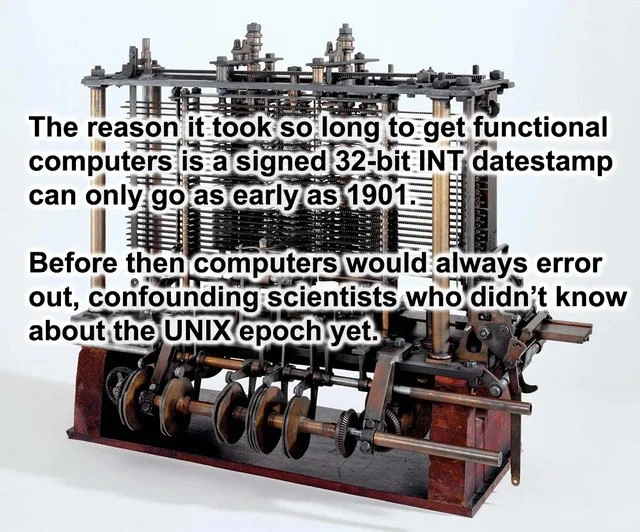
The antique machine matters visually because it exaggerates the time mismatch. The hardware in the image suggests gears, shafts, rods, and physical computation. The text talks about signed 32-bit INT, datestamp, and the UNIX epoch, which belong to a much later software world. The collision turns a real concept into fake archaeology: early scientists supposedly could not build computers because their imaginary runtime kept throwing date errors.
Real systems still produce less ridiculous versions of this:
- old dates fail because a database column expects Unix seconds
- imports break because one system uses local time and another uses UTC
- files sort incorrectly because timestamps are strings
- APIs disagree on seconds versus milliseconds
- signed and unsigned conversions turn time into garbage
- long-lived embedded systems keep 32-bit assumptions far past their welcome
The meme's brilliance is that it frames a modern compatibility bug as the reason computing itself was delayed. That is obviously false, but any engineer who has lost a day to date handling understands the emotional truth: time is where confidence goes to become an incident.
Level 4: Negative Time Budget
The image shows an antique mechanical computing machine covered by the claim:
The reason it took so long to get functional computers is a signed 32-bit INT datestamp can only go as early as 1901.
Before then computers would always error out, confounding scientists who didn't know about the UNIX epoch yet.
The deep joke is a deliberate causality crime. A signed 32-bit integer can represent values from -2147483648 to 2147483647. If those values are interpreted as seconds offset from the Unix epoch, 1970-01-01 00:00:00 UTC, the negative end reaches back to December 13, 1901, and the positive end reaches January 19, 2038. That is the classic 32-bit time_t problem: time is stored as a number, and eventually the number runs out of room.
The meme absurdly projects that software representation backward onto pre-Unix computing history. It pretends early mechanical computers failed because they were trying to run before their own timestamp type could represent the current date. That is not how history works, which is exactly why the joke works. Mechanical calculation, relay machines, vacuum tubes, stored-program architecture, semiconductor memory, operating systems, and Unix all arrived through separate historical steps. The Unix epoch did not secretly govern Babbage-era machinery like a stern kernel scheduler in a waistcoat.
The real technical lesson is that data representation becomes reality inside a system. A date is not just "a date" to software. It is an encoding: integer seconds, milliseconds, nanoseconds, calendar fields, time zones, leap-second policies, locale rules, database column types, serialization formats, and API contracts. Once a representation is chosen, it creates boundaries. Cross a boundary and history turns into an overflow, underflow, parse error, or support ticket with the phrase "only happens for old customers."
That is why this meme sits comfortably in LowLevelProgramming, OperatingSystems, and IntegerOverflow territory. It is nonsense historically, but technically fluent nonsense: the best kind, because the wrong conclusion requires knowing the right machinery.
Description
The image shows an antique mechanical computing machine with gears, rods, and stacked mechanisms, overlaid with large black text. The text reads: "The reason it took so long to get functional computers is a signed 32-bit INT datestamp can only go as early as 1901. Before then computers would always error out, confounding scientists who didn't know about the UNIX epoch yet." The joke retroactively applies Unix timestamp limitations to pre-computer history, pretending early computers failed because dates before 1901 underflowed a signed 32-bit integer. It blends retro-computing imagery, Unix epoch trivia, and absurd causality.
Comments
1Comment deleted
The first failed boot log was probably just `time_t` discovering history and refusing the migration.