Unicode Characters vs. String Length
Why is this DataFormats meme funny?
Level 1: One Symbol, Many Words
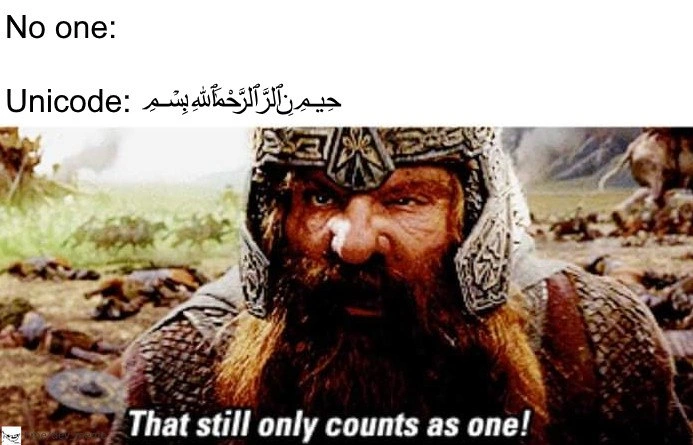
Imagine you have a special stamp that, with one push, prints a whole sentence instead of just a single letter. You stamp it on paper and suddenly there’s a long fancy phrase there, all from one stamp. Pretty cool, right? That’s essentially what happened in this joke. Unicode is like a huge library of stamps (symbols) that computers use to print text. Usually, one stamp makes one letter or character. But Unicode has a crazy stamp that prints a whole Arabic sentence in one go! In the meme, nobody asked for such a wild stamp (the “No one: ...” part), but Unicode proudly shows it off anyway. Then a character from a movie (Gimli the dwarf from Lord of the Rings) yells, “That still only counts as one!” – meaning no matter how big or ornate that printed phrase looks, the computer sees it as just one character, one stamp. It’s funny because it’s like a little loophole: a huge phrase hiding inside a single symbol. It’s as if you played a game where you’re allowed one word answers, and someone uses one “word” that secretly contains a whole sentence – you might protest, “Hey, that’s cheating, it’s still just one word!” Here, the one Unicode symbol contains many words’ worth of meaning, and our friend Gimli is playfully calling it out. The humor comes from the surprise that one tiny thing can hold so much, and the playful way the meme tells that story with a mix of tech and a movie quote.
Level 2: One Codepoint Wonder
Let’s break down what’s going on here in simpler terms. Unicode is essentially the master key for text in computers — it’s a standard that assigns a unique number (a code point) to almost every character in every language, plus tons of symbols and even emoji. For example, the letter "A" is U+0041, the emoji 😀 is U+1F600, and the Arabic letter ب (beh) is U+0628. Normally, you’d expect one code point for one letter or symbol. But Unicode also includes something unusual called ligatures for certain languages. A ligature is when multiple characters are stylistically joined together as a single symbol. In everyday writing, you might have seen how in Arabic script letters connect, or in fancy typography sometimes “fi” can be a single fused shape. Usually, these ligatures don’t need their own code — they’re formed automatically when rendering text. However, for historical and compatibility reasons, Unicode has some ligatures encoded as their own characters.
The meme is specifically showing one of these: an Arabic phrase "Bismillah al-Rahman al-Raheem" (translated roughly as "In the name of God, the Most Gracious, the Most Merciful"). This phrase is often written in a beautiful calligraphic style as one big connected piece. Unicode actually has a single code point for that entire phrase: U+FDFD, which renders as the ornate symbol "﷽". So, if you put "﷽" in a text string, the computer treats it as one character, even though it represents 15+ letters worth of Arabic when read aloud! That’s why in the meme, under "Unicode:", you see that long Arabic phrase squished into one character slot.
Now, why is that funny to developers? Because it’s unexpected! We’re used to thinking about text as a sequence of characters that roughly correspond to letters. Seeing a whole sentence as one character feels like a magic trick. The meme pairs this with the ”No one: ... Unicode: ...” format. No one: (blank) implies nobody asked for this or saw it coming. Unicode: (followed by the ligature) shows Unicode doing something crazy on its own initiative. It’s a playful dig that Unicode sometimes includes very elaborate or quirky things just to be super thorough with language support.
The bottom part with Gimli (the dwarf from The Lord of the Rings) shouting "That still only counts as one!" is both a pop culture reference and the punchline. In the movie, his friend Legolas did something huge (took down a giant creature), and Gimli insists it’s just one point in their game of who has more kills. The meme repurposes that line to hammer the point: even though that Unicode character looks like a lot of text, it still only counts as one character in the string. You could have a 50-letter sentence, but if it’s encoded as one of these special ligature code points, a computer’s length or character counter would say “1”.
For a concrete example, consider these two ways of writing the phrase:
normal = "بسم الله الرحمن الرحيم" # each word written out with individual Arabic letters
ligature = "\uFDFD" # the one-codepoint ligature for the entire phrase
print(len(normal), len(ligature)) # outputs: 22 1
In this Python snippet, normal contains the phrase written with separate characters (and spaces), while ligature contains the single combined character "﷽". The len() function (which tells us how many characters are in the string) returns 22 for the fully written-out version and 1 for the ligature version! So, the computer literally counts that huge phrase as a single character. Unicode support in programming languages is generally good these days, but it has to handle all sorts of things like this. If you’ve ever heard of issues where, say, an emoji is treated strangely in a string, it’s similar principles at work. Some emojis are actually multiple code points combined (like a family emoji is made of several people emojis joined together), whereas here we have the opposite: multiple letters combined into one code point. Both can confuse a naive character count.
Let’s clarify some terms that were in the tags:
- Character Encoding: This is how text is stored in bytes. Unicode is a character encoding standard (often used via implementations like UTF-8 or UTF-16). Older encodings like ASCII had only 127 characters (just English letters, numbers, etc.), whereas Unicode has over a million code points defined (though “only” ~143k are assigned so far), covering multiple languages and symbols.
- Unicode Ligature: A ligature in Unicode is a single character that represents a combination of letters. The one in the meme is an Arabic ligature. Unicode has a whole section called Arabic Presentation Forms where a lot of these are listed, mostly for compatibility with older typesetting systems.
- Grapheme vs Code Point: A grapheme is what a user thinks of as a character (like one visual letter or symbol on screen). A code point is the technical ID for a unit in Unicode. Sometimes one grapheme is made of several code points (like "🇺🇸" is actually two letter code points U+1F1FA + U+1F1F8 for U and S, plus some magic to display as a flag), and sometimes (like our Arabic ligature example) one code point contains what looks like several graphemes’ worth of content. It’s a nuance that can trip up new programmers. For example, if you tried to limit an input to 5 characters, you have to decide if that means 5 code points or 5 user-visible characters – not always the same thing!
Now back to the meme: essentially, it humorously highlights one of those “gotcha” moments in programming. Many of us remember the first time we encountered a string issue and someone wiser said, “Remember, not every character is just one byte or one letter. Unicode is tricky!” This meme is a funny reminder of that lesson. It uses Gimli’s comedic outrage to embody our reaction: Wait, an entire phrase is just one character? Come on! 😂. It’s a mix of tech humor and a geeky movie reference, which is why it’s popular in developer circles. After seeing this, you’ll probably never forget that Unicode has some really wild characters out there — including one that packs an entire famous Arabic phrase into a single slot. And you’ll understand why a developer might jokingly protest, “Unicode, you overachiever… that still only counts as one!”
Level 3: Still Only Counts as One
From a seasoned developer’s perspective, this meme hits on a familiar surprise in coding humor: how Unicode can defy our expectations of what a "character" is. The setup "No one: [crickets]" followed by "Unicode: ﷽" is using a popular no one meme format to joke that absolutely nobody asked for this, yet Unicode went ahead and included a single code point for a whole Arabic phrase. This resonates with developers because Unicode is notorious (in a good way) for being extremely comprehensive. It’s the over-achieving colleague in the world of standards – even if nobody explicitly requests a feature (like encoding an entire phrase as one character), somewhere in the vast Unicode tables, you’ll find it. Character encoding is full of these little gems and oddities that catch us off guard.
The punchline is delivered with a Lord of the Rings reference. The image of Gimli shouting "That still only counts as one!" comes from a scene where Legolas performs an outrageous feat (taking down a giant war-elephant and a bunch of enemies with it), and Gimli, keeping score, insists it’s just one kill. In the meme’s context, Unicode’s feat is packing a multi-word phrase into one symbol, and we – like Gimli – exclaim that it still only counts as one character. This is funny to developers because it’s exactly true in computing terms: no matter how much text or meaning that ornate Arabic ligature carries, when you handle it in code, it has a length of 1. It’s a single code point in a string. Any program iterating through the string "﷽" will treat the whole thing as one element. If you were imposing a 10-character limit on a username, someone could use ten of these ligature symbols and visually it would be like writing ten long phrases, but your code would think it’s just 10 characters. Unicode support can lead to such quirky scenarios that break naive assumptions.
This is where the shared tech experience comes in. Every experienced developer has war stories about things like emojis or special characters messing up string logic. We’ve seen issues where a "character" isn’t what it seems. For example:
- You count characters in a tweet and one emoji 😃 ends up counting as 2 because behind the scenes it’s represented by two code units (thanks to UTF-16 surrogate pairs or combined sequences).
- Or you uppercase a Turkish “i” and get unexpected results due to locale rules.
- Or you try to substring a flag emoji 🇦🇷 and accidentally get half of it, because that flag is actually two letters combined with a special joiner.
In this meme’s case, it’s the reverse situation – something that looks like a whole sentence is actually a single char. It’s a comedic exaggeration of a real phenomenon: Unicode contains ligatures and pre-composed sequences from various languages (especially in the Arabic Presentation Forms and other compatibility blocks) that behave as one unit. The particular Arabic ligature shown, often called the Basmala (the phrase that begins chapters of the Quran), is officially one character in Unicode (U+FDFD). Many developers are startled to learn this fact. It’s a bit of “Did you know?” trivia in programming circles, and exactly the kind of thing you might see on a coding humor forum: “Hey guys, check out this one Unicode character that literally spells an entire prayer!” The meme captures the reaction: as developers, we’re half amused and half incredulous — No way, unicode has that!? — and then we double-check: yep, length is 1… "Gimli face".
The Lord of the Rings quote ties it together because Gimli’s comedic frustration mirrors a developer’s perspective: Sure, it’s visually a lot of text, but under the hood it’s one unit. Rules are rules! It’s a clever crossover of pop culture with a nerdy inside joke about text encoding. The developer humor here also hints at the absurd breadth of Unicode. We chuckle because it’s a little absurd: millions of code points available, and Unicode didn’t stop at individual letters — it went as far as including whole phrases (and weird symbols, from <HOLY> characters to 📜 emojis and beyond). This commitment to covering all of human writing leads to scenarios both awesome and headache-inducing for us coding folks.
From an engineering angle, memes like this remind us of real issues: string length miscounts, database column limits, or UI text overflows that occur because not all "characters" are created equal. If you assumed each character is one byte or one 16-bit value, Unicode laughs in your face with cases like this unicode ligature. And if you try to naively split or truncate strings, you might cut a multi-byte character in half or, say, split this ligature in the middle of what is conceptually one word – if it were possible at all. In fact, if you normalize text (to separate combined forms), ﷽ would expand into multiple characters. But if you don’t, it stays as one. So this meme is a lighthearted jab at how Unicode’s richness can be both wondrous and perplexing. Every senior dev knows that “It’s a Unicode issue” is the modern equivalent of “It’s always DNS” – a humorous scapegoat for bugs. Here, the surprise of a one-code-point sentence is exactly that kind of Unicode quirk that would make you do a double-take in a code review. It’s funny because it’s real: the string really is length 1. Gimli’s emphatic line — "It still only counts as one!" — could be seen as the software enforcing the rule that one code point = one count, no matter how much is visually going on.
By blending a coding gotcha with a LOTR meme, the post appeals to our inner nerd on two levels. We laugh because we recognize the Lord of the Rings reference (a beloved Gimli quote meme among geeks) and because we’ve felt that mix of surprise and exasperation when encountering Unicode surprises in our own projects. It’s a camaraderie moment: all those in favor of counting “﷽” as one, say aye. We’ve been there, scratching our heads over why a string length doesn’t match what we see on screen. So the meme lands as a perfect bit of developer humor — exaggerating a niche technical detail to the point of absurdity, and using pop culture to hammer the joke home. In practice, no one is really upset at Unicode for supporting this ligature (it’s actually pretty cool), but we perform the mock protest through Gimli’s voice for comedic effect. After all, as Gandalf might say in defense of Unicode’s decision: "All we have to decide is what to do with the characters that are given to us." 😉
Level 4: One Codepoint to Rule Them All
At the deepest technical level, this meme is poking at the fundamentals of Unicode and how text is represented in computers. Unicode is a universal character encoding standard that aims to include every symbol in every writing system (and then some). Internally, each symbol is assigned a unique number called a code point (like U+0633 for the Arabic letter س or U+1F600 for 😀). Normally, one code point corresponds to one basic character or symbol. But Unicode also has some surprises: it can pack entire words or phrases into a single code point. The example here, U+FDFD, is an Arabic ligature for the phrase "Bismillah al-Rahman al-Raheem" (﷽) – a 15-letter phrase in Arabic calligraphy rendered as one glyph. Why would Unicode do this? Part of it is historical compatibility. Early text systems and data formats for languages like Arabic included decorative ligature symbols for common religious phrases (so publishers could easily print them as one unit). When Unicode unified all these systems, it inherited such special cases to ensure no content was lost. In Unicode’s design philosophy, “One code to represent them all” is a real thing – it will even encode entire phrases as single points if needed for legacy or completeness.
This leads to fascinating technical puzzles about what a "character" really is. In text processing, we have the concept of grapheme clusters vs. code points. A grapheme cluster is what a reader perceives as one character, which might consist of multiple code points in sequence (for example, the letter á could be an "a" + a combining accent code point). Conversely – and this is the twist showcased by the meme – sometimes one code point represents what looks like multiple characters. The Arabic “Basmala” ligature is an extreme case: it visually contains many Arabic letters, but as far as Unicode is concerned, it still counts as one code point. This duality is why text handling in software can be tricky. Imagine writing a loop to iterate over “characters” in a string – depending on whether you’re looping over code points or user-perceived characters, you might get very different results. Most modern languages and libraries use Unicode under the hood, but not all treat these extended cases the same. For instance, in a language using UTF-16 encoding internally, a single symbol beyond the Basic Multilingual Plane (i.e., code points above U+FFFF) might be composed of two 16-bit units called surrogate pairs, causing naive string.length checks to miscount. In our case, U+FDFD is within the Basic Multilingual Plane, so it doesn’t even need a surrogate pair – it’s truly one code unit in UTF-16 and three bytes in UTF-8. The deeper point (no pun intended) is that text encoding is full of edge cases: from UTF-16 surrogate pairs to multi-code-point emoji sequences, and yes, even whole phrases encoded as one entity. This meme humorously exposes that theoretical quirk: the tension between human language complexity and the binary rules computers use to encode it. It’s a nod to the intricate lore of Unicode — a bit like discovering a secret “one ring” in the world of text that can bind many letters into one. The grapheme cluster vs code point distinction and text rendering gotchas behind this meme are topics you’d find in the fine print of Unicode’s standard (e.g., Unicode Normalization, which would break that fancy ligature into its component letters for consistency). Seasoned developers know that these nuances are why things like string length, indexing, or text wrapping can become non-trivial problems. In summary, on a theoretical level, the meme underscores a beautiful oddity of Unicode’s design: sometimes one code point can carry the semantic weight (and visual form) of an entire phrase, uniting what we’d normally think of as many characters into a single monolithic glyph. It’s a reminder that Unicode support in software means dealing with a lot more than just simple one-to-one mappings — there’s history, culture, and clever encoding tricks all packed in there.
Description
This is a two-part meme. The top part has a white background with black text that reads 'No one:' and below it 'Unicode:' followed by a complex string of Arabic characters with many diacritics (specifically, it's the Basmala: 'bism illāhi r-raḥmāni r-raḥīm'). The bottom part of the image is a still from the movie 'The Lord of the Rings: The Return of the King,' featuring the character Gimli (a dwarf warrior) looking intensely. The subtitle at the bottom reads, 'That still only counts as one!'. The meme humorously applies Gimli's famous line - said after Legolas takes down a giant oliphaunt and Gimli insists it's a single kill - to the concept of Unicode. The joke is that a visually complex and long string, formed by multiple combining characters and ligatures, can be interpreted by a system as a single grapheme cluster or unit, making string length and iteration surprisingly complex for developers who aren't familiar with the intricacies of character encoding
Comments
7Comment deleted
Python's len() on that string is 39, JavaScript's .length is 39, but a user sees one phrase. This is why asking 'what's the length of this string?' is the start of a philosophy debate, not a technical question
Architect’s horror story: PM caps the headline at 10 chars, UX pastes ﷽, and the sprint turns into a crash course on why LEN() lies and grapheme clusters don’t care about your constraints
After 20 years in the industry, I've learned that the only thing more complex than distributed consensus is explaining to a PM why their 'simple' emoji counter is off by a factor of three because of zero-width joiners and skin tone modifiers
Ah yes, the classic Unicode trap: when your string.length() returns 47 but the user sees exactly one character. Nothing quite like explaining to a PM why their 'simple' character limit validation is actually a graduate-level computer science problem involving normalization forms, grapheme cluster boundaries, and the subtle distinction between code points, code units, and user-perceived characters. Bonus points when it breaks your carefully crafted database column width assumptions
NFC turns that Basmala's 23 codepoints into one grapheme - until your JS String#length exposes the Balrog
Spec: “max 10 characters”; DB enforces 10 bytes, JavaScript counts UTF-16 units, ICU counts grapheme clusters - Unicode stacks ZWJ + diacritics and says it’s still one
Product: "10-character limit." Unicode: ships one grapheme made of five code points and a ZWJ; JS .length disagrees, VARCHAR(10) resigns