Skip to content
DevMeme
6530 of 7435
Uber Driver Reviews and Merges PR While Driving in San Francisco
CodeReviews Post #7158, on Sep 22, 2025 in TG

Uber Driver Reviews and Merges PR While Driving in San Francisco

Why is this CodeReviews meme funny?

Level 1: Homework While Driving

Imagine you’re riding in a car, and the person driving is trying to do their homework at the same time – sounds crazy, right? This meme is basically showing that kind of silly situation. The driver isn’t literally doing school homework, but he’s doing his computer work (programming stuff) on his phone while he’s supposed to be focusing on the road. It’s funny because grown-ups know that when you drive a car, you should only drive and not be distracted. If your bus driver or parent started reading emails or writing code while taking you somewhere, you’d probably feel scared and think, “Hey, pay attention to the road!” In this picture, the Uber driver just couldn’t wait to finish his job of checking some code. San Francisco (SF) is a city famous for tech jobs, and people there are often super busy with coding and apps. So the joke is that in SF, even an Uber driver might also be a tech worker who is so eager and busy that he’s merging his code at the same time as he’s merging the car into another lane. It’s a bit like if a taxi driver were taking a math test on his phone while driving you – it’s both impressive in a wacky way and definitely not safe. The reason it’s humorous is that it’s such an extreme example of multitasking that everyone can see it’s a bad idea. It makes us laugh and shake our heads, saying, “Only in a place obsessed with tech would you see something this over-the-top!”

Level 2: Pull Requests on the Go

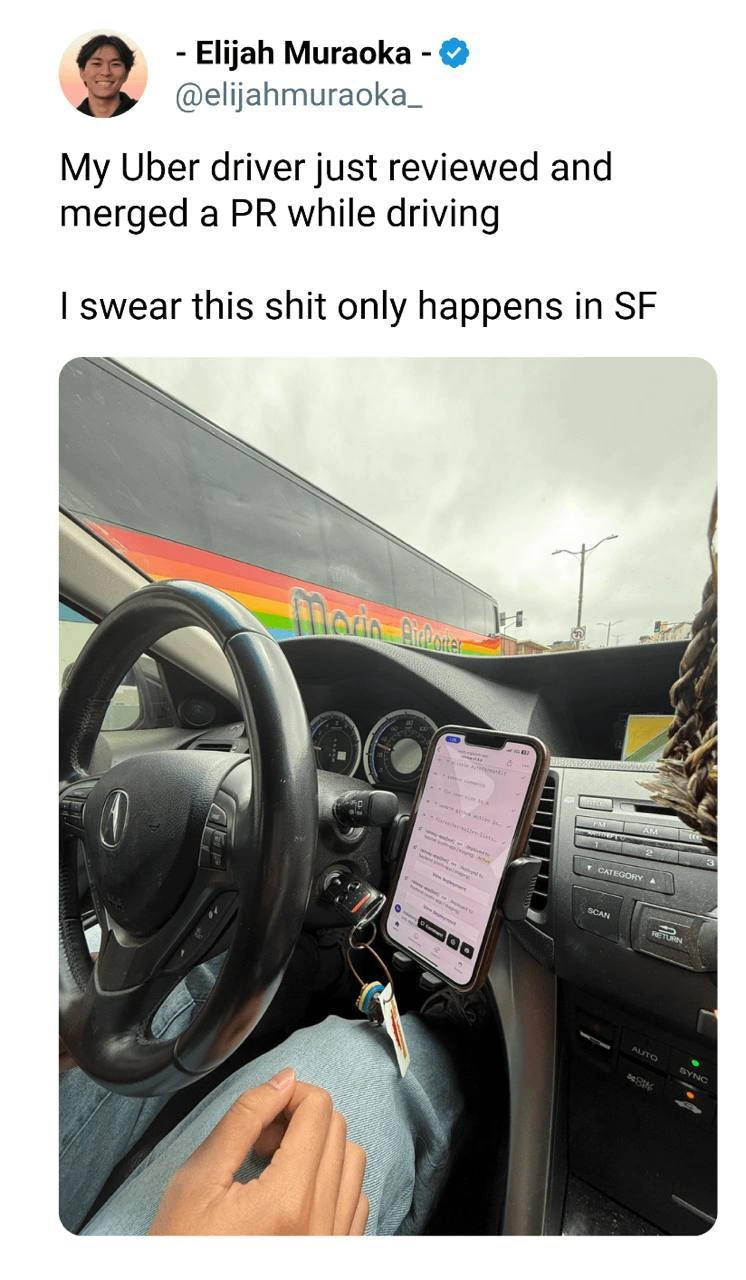
Let’s break down what’s happening in this meme in more straightforward terms. The driver in the photo is using his phone to look at a GitHub Pull Request. A Pull Request (PR) is a way for developers to propose changes to code and request that those changes be reviewed and then merged (integrated) into the main codebase. Think of it like saying, “Hey team, I wrote some new code. Can you check it and add it to our project?” The process of checking each other’s code is called a code review. In a code review, another developer will read through the code changes (the diff, which highlights what was added or removed) to catch mistakes or suggest improvements. Once everything looks good, they press the merge button (or run a git merge command) to combine the new code into the project. In this scenario, the Uber driver is the one doing that review-and-merge task. The phone’s screen even shows the GitHub interface with lines of code and a “Merge pull request” button – exactly what you’d see when finalizing a PR. Normally, you’d carry out this whole PR review process on a laptop or desktop computer, maybe at your desk or at home, definitely not while operating a vehicle! That’s why this is both shocking and darkly funny. It’s combining two activities that just do not belong together: detailed programming work and driving.

For a junior developer or someone new to these terms, here’s a bit of context on the tools and tags being referenced: Git is the version control system that developers use to keep track of code changes. GitHub is a popular online platform built around Git where teams collaborate on code. It provides a nice visual interface for pull requests and code reviews. When a developer wants to contribute code, they create a branch (a separate line of development), make their changes, and then open a Pull Request on GitHub. This PR shows all the changes and lets others comment or approve. Once approved, merging the PR means integrating those changes into the main branch (often called master or main). After merging, those changes become part of the next release or deployment of the software. GitHub even offers a mobile app and mobile-friendly web pages so you could review code on your phone if needed — for example, if you’re away from your computer and something urgent comes up. It’s intended for convenience, like a quick check or emergency fix when you’re on the go. The idea of a phone-based code review isn’t completely far-fetched in 2025; many developers have the GitHub app installed for quick notifications and might glance at a diff or leave a comment from a phone. But doing a full code review while actively driving is way outside normal or acceptable behavior. In fact, using a phone while driving is illegal in most places due to safety, which is partly why this scene is so jaw-dropping.

Now, the meme specifically calls out “I swear this only happens in SF.” SF here means San Francisco, which is known for its tech industry culture. It’s a place where it feels like everyone’s an engineer, product manager, or founder. There’s a running joke that in San Francisco your Uber or Lyft driver might have a résumé full of startup jobs or could be coding their own app when not picking up fares. So the tweet plays on that stereotype: san_francisco_tech_stereotype is exactly this notion that even the gig workers have gigabytes of code on their mind. The passenger (tweet author) was stunned to see it in action: their driver is quite literally writing software (well, merging code) during the ride. It highlights ride_share_dev_culture, a term capturing how tech and gig-economy overlap in the Bay Area. It’s as if being a developer is so common there that people juggle programming tasks with everyday jobs like ridesharing. For a newcomer to software, it might be surprising to hear that some developers do have second jobs or side projects, and vice versa some folks in service jobs are also learning to code. In big tech hubs, that’s not unimaginable. But reviewing code while driving is an extreme case – it’s presumably done here either because the driver was under intense pressure to merge that PR (maybe an urgent bug fix?) or because they’re so used to multitasking in a hyper-competitive environment that they truly didn’t want to “waste” time sitting in traffic. This is where safety_vs_velocity comes in: in software teams, “velocity” means how quickly you can deliver changes; here the driver chose speed (merging the PR immediately) over the safe choice (waiting until not driving). It’s a tongue-in-cheek example of prioritizing productivity to a ridiculous degree.

Let’s also talk about MergeConflicts – a tag hinting at the word “merge” having double meaning in this meme. In Git, when two people change the same part of code differently, a merge conflict happens. It’s a situation where Git can’t automatically combine the changes, and a developer has to resolve the conflict manually. They’ll open the files and decide which change to keep or how to reconcile them, then finish the merge. It requires careful attention to detail. Now think about merging in the context of driving: when a car merges into another lane, if two drivers try to move into the same spot or don’t coordinate, there’s a conflict (which could mean a honk, a near-miss, or an accident!). Both types of merging demand focus and care, and conflicts in either scenario are undesirable. This meme mashes the two contexts together. The driver is merging code changes on GitHub and presumably merging lanes on the highway. We really hope neither merge leads to a disaster – no failed deployment and no traffic accident. The humor clicks for developers because we see the parallels. To illustrate those parallels clearly:

Merging Code (with Git/GitHub) Merging Lanes (in traffic)
Combining new code changes into the main project. Can result in merge conflicts if changes clash. Moving your car into a different lane on the road. Can result in conflict (accident) if two cars try to merge at the same time.
Requires reading differences in code (the diff) and ensuring nothing will break in the software. Requires checking mirrors, using blinkers, and ensuring you don’t hit another car.
Usually done with full concentration, often at a desk with multiple screens for clarity. Should be done with full concentration on driving, with hands on the wheel (not on a phone!).
Mistake in merge can break the build or introduce a bug in the app (software “crash”). Mistake in merge can cause a physical crash or at least a lot of horn honking and danger.

As you can see, both activities are complex enough on their own. So doing them simultaneously is asking for trouble. That’s why this meme is both funny and cringe-inducing. It exaggerates the DeveloperProductivity ethos to an absurd level: yes, developers strive to be efficient and get things done quickly (especially when working remotely or on flexible schedules), but reviewing code while driving crosses the line. It’s a bit like a student trying to finish their homework while riding a bicycle – technically maybe you could attempt it, but it’s clearly a bad idea! Yet, in this code_review_while_driving scenario, the driver must have felt either extremely confident or extremely pressured. Perhaps they were on an urgent on-call duty where a fix had to be merged ASAP, or maybe they just have a habit of squeezing work into every crevice of their day. Either way, for someone newer to development, the big takeaway is: don’t try this at home (or on the road). Code reviews are important and deserve your full attention, and driving is definitely something that should never share that attention with coding. The meme’s comedic punch comes from taking the idea of remote coding to such an extreme that it highlights how tech work culture can sometimes go too far in blurring the lines between work and personal (or in this case, public road) life.

Level 3: Continuous Integration in Motion

San Francisco developers often joke that everyone in the Bay Area has a side hustle in tech, but this scenario takes it to a new (and highly illegal) extreme. An Uber driver is literally performing a code review and hitting the “Merge pull request” button on GitHub while navigating the highway’s carpool lane. It’s a scene that screams “move fast and break things”—hopefully not breaking traffic laws or, you know, actual cars. The humor (and horror) here comes from an experienced dev recognizing a safety vs. velocity trade-off taken way too literally. In software engineering, we value speed (merging code quickly to deploy features) but not at the expense of sanity or safety. Here, the poor guy’s trying to maximize DeveloperProductivity by merging code in transit, effectively doing RemoteWork from behind the wheel. Only in the Bay Area do you catch your rideshare driver committing code between lane merges.

From a senior developer’s perspective, this image triggers equal parts admiration and alarm. On one hand, the hustle culture in tech (especially in San Francisco) idolizes constant productivity: why waste a 30-minute drive when you could review a teammate’s Pull Request (PR)? On the other hand, code review is a task requiring focus—scrutinizing changes line by line—while driving is, well, an even more focus-intensive task (unless you’ve offloaded it to a Level 5 autonomous vehicle nonexistent self-driving Acura). The absurd juxtaposition is too real for anyone who’s been on-call: we’ve patched servers from family dinners and hot-fixed apps from airport lounges. But reviewing and merging a PR at 65 mph on the US-101 touches a new frontier of “work-life integration.” It’s a darkly funny exaggeration of how RemoteWork has vaporized normal boundaries. In the Bay Area especially, the expectation to be always “on” means your commute might double as a stand-up meeting or, apparently, a continuous integration pipeline on wheels.

Let’s unpack why this particular combination is hilarious to seasoned devs. CodeReviews are a serious quality gate in professional teams: you comb through diffs to catch bugs and ensure standards. It’s something you’d ideally do in a quiet environment, maybe with a nice big monitor. Now picture doing that on an iPhone screen, in stop-and-go traffic, with one hand on the steering wheel. It’s the ultimate context switch nightmare. We preach about minimizing distractions during reviews (so you don’t miss the one line that introduces a nasty bug), yet here distraction is guaranteed. The driver’s “setup” here is a mounted smartphone showing a GitHub diff view with the Merge button temptingly in view. Any veteran engineer can tell at a glance: that’s a GitHub pull request diff UI. The fact you can recognize it instantly is part of the joke—if you’re the kind of person who knows a GitHub PR screen on sight, you’re probably also the kind to facepalm at this misuse of multitasking. It’s like catching a surgeon performing an operation while rollerblading: technically possible with enough skill, but dear lord, why?

Behind the humor is a nod to the “only in SF” tech stereotype. In Silicon Valley culture, it’s not unheard of that your Uber or Lyft driver might also be a laid-off engineer, a startup founder between ventures, or moonlighting to pay astronomic rent. So the tweet’s author quips “I swear this shit only happens in SF,” because the Bay Area is infamous for this kind of overlap between the tech world and everyday services. It’s the same place where coffee baristas have pitch decks for VCs and your lunch delivery courier might be debugging code between stops. A code-reviewing Uber driver is the perfect caricature of that reality. Seasoned devs chuckle because they’ve met that driver or at least know someone who has. It’s both a tongue-in-cheek compliment (SF engineers are so dedicated they’ll ship code from anywhere) and a critique (the work culture here is so over the top that people feel compelled to be coding literally every second).

Technically speaking, merging a PR triggers your Continuous Integration (CI) pipelines and could potentially deploy something to production. The senior engineers reading this are wincing: merging unreviewed or hastily-reviewed code is how merge conflicts and production bugs slip in. We can’t help but imagine what the diff on that phone contained. Did the driver actually read the code or just glance and tap “Merge”? The tweet says “reviewed and merged,” implying he did look it over. Perhaps this driver is a superhuman multitasker, but more likely it was a quick rubber-stamp approval – the sort of superficial review that in an office setting we’d call out as rubber stamping. The difference is, when someone rubber stamps a PR at their desk, the worst outcome is a bad commit. When they do it at 60 mph, worst case includes fender-benders. We’re seeing a literal collision of software development practices with real-life traffic rules. The term “Merge Request” suddenly has a double meaning, and a merge conflict could refer to either git errors or a potential accident on the road. That dual meaning is a rich source of humor for developers: merging code while merging lanes, hoping neither process crashes.

No senior dev can ignore the safety aspect either. We’ve all heard (or given) talks on minimizing distractions for developers to get “in the zone,” but here the distraction isn’t Slack pings – it’s actively driving a car in rainy SF weather! It underscores an unhealthy expectation sometimes found in fast-paced startups: that engineers must be constantly available, constantly shipping. It’s as if this driver’s manager said, “No excuses, get that PR merged ASAP” and the dev replied, “Roger that, doing it now... never mind that I’m driving.” The truth is, in well-run teams, nobody should be reviewing code in such conditions. If a teammate is literally behind the wheel, you’d hope they’d wait until parked or off duty. The meme exaggerates for comedic effect, but it resonates because many developers have felt pressure to sacrifice personal time, comfort, or in this case safety, for work. It’s a satirical look at the extreme end of DeveloperProductivity culture: when the sprint metrics and Git commit graphs matter more than common sense.

Adding an extra layer to this, look at the photo details. Outside the windshield, a rainbow-striped Marin Airporter bus is cruising by, confirming this is indeed the Bay Area. The sky is grey – a familiar SF foggy morning – and here inside the car, instead of navigation on the phone, it’s a GitHub app screen with a code diff. That visual juxtapositions the mundane (a commute) with the nerdy (code collaboration). It’s visually absurd. The driver’s hand is casually on the wheel, as if merging PRs mid-drive is just another Tuesday. A veteran engineer sees that and might recall their own war stories: deploying hotfixes from a café tethered to a phone, or joining a severity-1 outage call from the back of a taxi. Modern tooling like smartphones, 5G, and GitHub’s mobile interface do allow us to handle emergencies from anywhere. But this scenario playfully illustrates the mission creep of remote work – beyond “work from home” into “work from literally anywhere, even the driver’s seat.” It’s a bit of gallows humor about how far work-life integration (or intrusion) can go.

In summary, from the senior perspective this meme lands because it’s an outrageous synergy of tech obsession and poor judgement: a PullRequest being merged in the carpool lane. You have the literal fast lane meeting the figurative fast pace of software delivery. Experienced devs laugh (and cringe) because it satirizes real pressures we face: the value of rapid iteration colliding with the need for focus and safety. It’s a reminder that just because we can code anywhere doesn’t mean we should. As one might cynically put it: in the race to ship features, we’ve now literally put the pedal to the metal – hopefully without causing a pileup (in code or on the road).

Description

Screenshot of a tweet from Elijah Muraoka (@elijahmuraoka_) reading: 'My Uber driver just reviewed and merged a PR while driving. I swear this shit only happens in SF.' Attached is a photo taken from the passenger seat showing the Uber driver's phone mounted on the dashboard displaying what appears to be a GitHub pull request interface with code diffs visible. The car's interior (Honda/Acura steering wheel visible) is shown while clearly in transit, with a rainbow-painted Marin Airporter bus visible through the windshield. The meme captures the Silicon Valley stereotype where everyone, even gig economy workers, are secretly software engineers multitasking between jobs

Comments

16
Anonymous ★ Top Pick In SF, 'LGTM, merging' is both a code review approval and what your Uber driver says while cutting across three lanes on the 101. Merge conflicts happen in the codebase AND on the freeway
  1. Anonymous ★ Top Pick

    In SF, 'LGTM, merging' is both a code review approval and what your Uber driver says while cutting across three lanes on the 101. Merge conflicts happen in the codebase AND on the freeway

  2. Anonymous

    That's not an Uber; it's a mobile deployment pipeline. The 'check engine' light is just for failed integration tests

  3. Anonymous

    CI/CD has officially become “Cruise Integration / Continuous Driving” - just pray the merge conflict doesn’t pop up at the next red light

  4. Anonymous

    Nothing says 'continuous deployment' quite like merging to main at 65mph. At least if the build fails, you'll know exactly which commit caused the crash

  5. Anonymous

    When your Uber driver's ETA includes both your destination and their sprint velocity - because apparently 'merge conflicts' now applies to both traffic lanes and Git branches. Nothing says 'move fast and break things' quite like literally reviewing code while breaking traffic laws. At least we know their CI/CD pipeline has fewer blockers than the 101 during rush hour

  6. Anonymous

    Branch protection is great - until your final approval gate is a green traffic light; somewhere a postmortem will start with “merge pressed at 35 mph.”

  7. Anonymous

    Nothing says healthy engineering culture like a drive-by review: CI is green, the light is green, and the bus factor is literally in the next lane

  8. Anonymous

    In SF, Uber drivers merge PRs faster than your CI/CD - zero conflicts, full throttle

  9. @azizhakberdiev 9mo

    I can confirm, a driver makes more than 90% of developers

  10. @Algoinde 9mo

    He's a driver developer.

  11. @anivaros 9mo

    Drive-Driven Development

  12. Yuri 9mo

    Uber app for drivers doesn't let you minimize it while with passengers.

    1. @Algoinde 9mo

      2 devices

      1. Yuri 9mo

        Where?

        1. @Algoinde 9mo

          Actually, his clock is blue, so a navigation app is running in the background nonetheless So either he's using nav on his main phone and has a pocket Uber to accept orders, or this is no Uber driver

  13. @hpsaturn 9mo

    Of course, only in SF because is the Capitalism Paradise.. Injustice, inequality and people with "good" salaries can't reach the end of each month.. 🤮

Use J and K for navigation