Skip to content
DevMeme
6696 of 7435
Two Billion FPS Meets Photons
Hardware Post #7340, on Oct 27, 2025 in TG

Two Billion FPS Meets Photons

Why is this Hardware meme funny?

Level 1: Slow-Motion Flashlight

Imagine turning on a flashlight so fast that everyone thinks the whole room lights up at once. Now imagine having a magic camera that can watch the light travel bit by bit from the flashlight to a shiny ball and bounce around. The joke is that someone built a camera setup so fast it makes light, the fastest thing we know, look slow enough to watch.

Level 2: Seeing The Beam

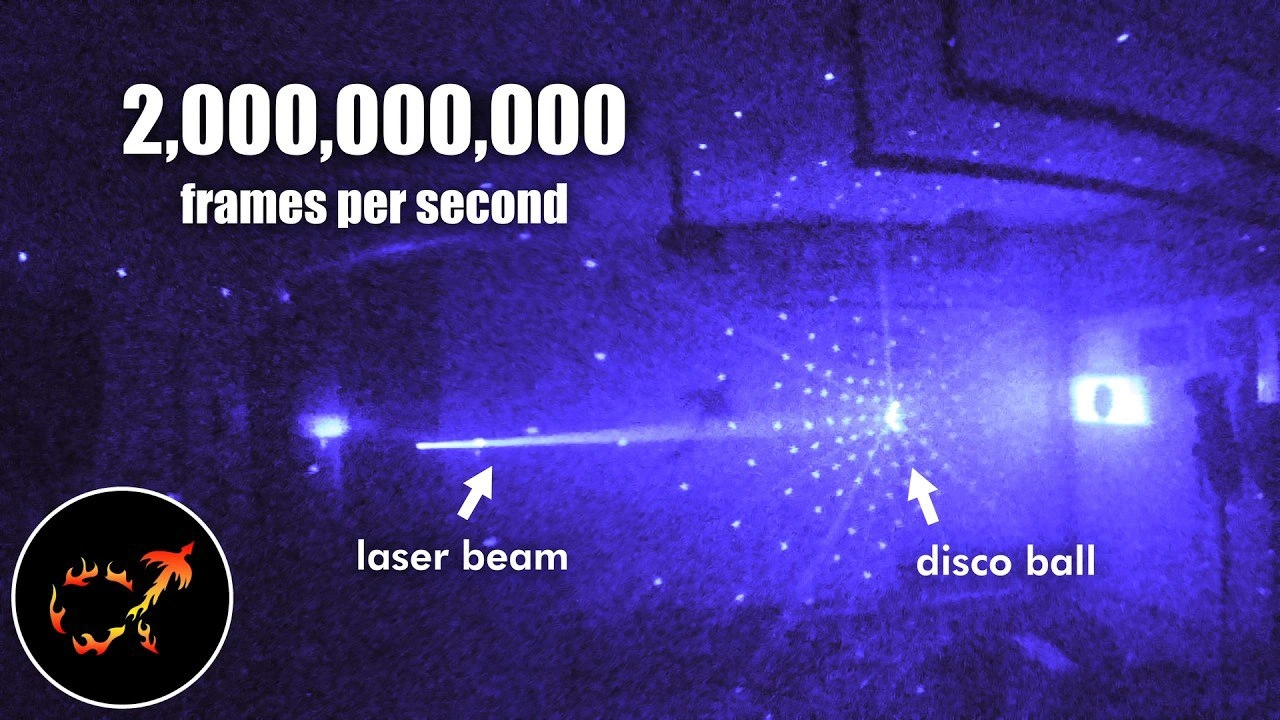
Frames per second means how many separate images a camera records every second. A normal video might be 30 or 60 frames per second. The number in the image, 2,000,000,000, is two billion frames per second, which is wildly beyond everyday video and even beyond most high-speed-camera demos people casually see online.

The laser beam is a narrow, bright path of light. The disco ball is a reflective object covered in small mirrored surfaces. When the beam reaches it, the light scatters in many directions, which is why the right side of the image contains a cluster of bright dots and haze. Those dots make the invisible timing of light easier to visualize because the reflections create visible events in the scene.

For developers, the analogy is debugging. If a bug happens too quickly, logs with poor timestamps make it look like everything occurred at once. Better sampling gives you the order: first this event, then that event, then the weird side effect. High-speed imaging does that for physical light. It turns "the room lit up" into a sequence of observable steps.

The meme lands because the scale is ridiculous in a satisfying way. Most performance work is about shaving milliseconds. This image lives in nanoseconds. It is hardware, graphics, data visualization, and maker culture all colliding in one purple frame where the camera is fast enough to make photons look like they are waiting for the next sprint.

Level 3: Photons Miss Standup

2,000,000,000

frames per second

The image is funny because it treats light, the thing software people use as a metaphor for "instant," as something you can make late to the meeting. The visible setup labels a bright horizontal laser beam heading toward a disco ball, while giant text announces 2,000,000,000 frames per second. At that capture rate, each frame is separated by about 0.5 nanoseconds. In that tiny slice of time, light travels roughly 15 centimeters in air. That is still absurdly fast, but it is now the size of a desk object instead of the size of a planet, which means the propagation can be reconstructed as something humans can watch.

The trick is not that the laser beam is slowed down. Physics did not take a coffee break. The camera system is sampling time so aggressively that motion normally below human perception becomes visible after playback is slowed. This is the same conceptual move as profiling a program at high resolution: the process did not become slower during sampling, but the measurement lets you inspect events that were previously blurred together into "it just happened."

The disco ball label adds the good kind of engineering absurdity. A disco ball is basically a chaotic reflector with many tiny mirrored facets, so it turns a clean beam into scattered points and delayed-looking paths. For computational photography and image processing, that scattering is useful because it gives the camera visible light interactions to capture: direct beam, reflections, bloom, noise, and bright speckles. For the rest of us, it also makes the lab look like someone built a photon debugger in a garage and then invited club lighting to code review.

There is a performance joke hiding in the number. Developers argue about 30 FPS, 60 FPS, 120 Hz monitors, render loops, dropped frames, and whether the UI feels smooth. This image jumps to two billion FPS, so the normal graphics conversation becomes microscopic. A game engine wants enough frames to fool your eyes; this setup wants enough frames to catch light crossing a room. That is not "optimize the render loop" territory. That is "your bottleneck is now relativity's public API."

2,000,000,000 fps = 0.5 ns per frame
light in 0.5 ns  ~= 0.15 m
human takeaway   = the beam can appear to crawl across the scene in playback

Description

A purple-blue high-speed-camera scene shows a bright horizontal laser crossing a dark room toward a cluster of scattered light near a reflective object. Large white text in the upper left reads "2,000,000,000" with "frames per second" underneath. White arrows label the beam as "laser beam" and the reflecting object as "disco ball," and a circular flame-styled logo appears in the lower left. The technical context is ultra-high-speed imaging: at roughly two billion frames per second, the setup can make light propagation and scattering look slow enough for humans to perceive frame by frame.

Comments

7
Anonymous ★ Top Pick Most render loops chase 60 FPS; this one overclocked the camera until the photons started showing up late.
  1. Anonymous ★ Top Pick

    Most render loops chase 60 FPS; this one overclocked the camera until the photons started showing up late.

  2. @Valithor 8mo

    Don't forget to watch the bonus video linked in the description!

  3. @paranoidPhantom 8mo

    Very based watched a few days ago

  4. @NickNirus 8mo

    absolutely excellent video. genius idea to build a 1 pixel camera and just film the same thing as many times as you need

    1. @theodolu 8mo

      Can just use a regular camera and shine light as many times as you need

      1. @NickNirus 8mo

        regular camera isn't fast enough to record movement of light, though

      2. _ 8mo

        I guess you could theoretically time-interleave many videos instead, but I think proper synchronisation would be so complicated I doubt it would be doable. Also the delay between two frames would need to be incredibly stable for this to give something usable

Use J and K for navigation