The Imposter Syndrome Interview
Why is this MentalHealth meme funny?
Level 1: Sudden Stage Fright
Imagine you’ve been practicing something you’re really good at — like playing piano or doing a magic trick — all by yourself at home. You feel pretty confident because you’ve done it for years. Now, someone asks you to do it in front of the whole class or a big crowd. The moment you stand up with everyone watching, your hands start shaking and your mind goes blank. You know you can do this thing (you’ve done it so many times before!), but suddenly you get scared and forget because you’re under pressure.
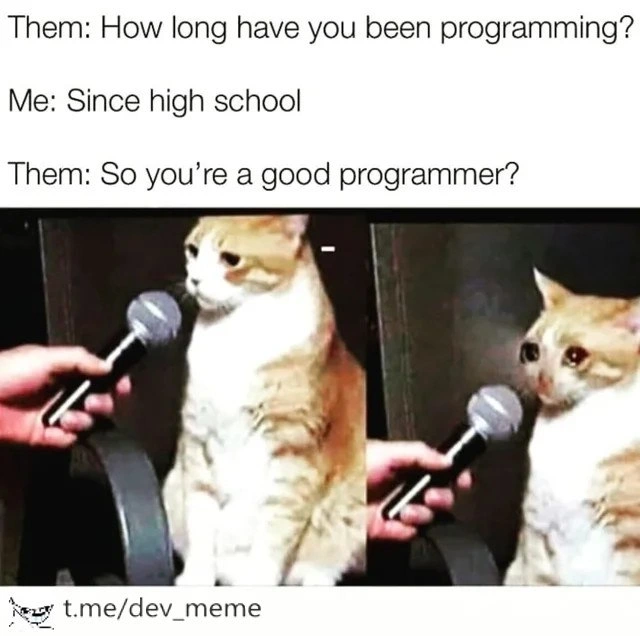
In this meme, that’s exactly what’s happening to the programmer. The cat represents the programmer. At first, the programmer (cat) is calm when saying they have lots of experience — like proudly telling friends, “Yeah, I’ve played piano since I was little.” But then the interviewer basically says, “Oh, so you’re really good, huh? Show me!” That’s like a teacher saying, “Oh, you’ve practiced that song? Play it for us right now.” And just like that, the person gets stage fright. All their confidence disappears and they feel super nervous, just like the wide-eyed, about-to-cry cat in the picture.
It’s funny in a kind of sweet way because we can all relate to that feeling. Even if we’re prepared, being put on the spot can be scary. The meme is showing that even a grown-up programmer with years of coding experience can feel as helpless as a kid forgetting their lines in a school play when they’re asked a tough question. We laugh at the cat’s expression because we recognize ourselves in it — one moment bold, and the next moment “uh oh… what if I mess up?!”
Level 2: Imposter Syndrome 101
Let’s break down the meme and the concepts in simpler terms. The dialogue in the meme goes:
- Interviewer (Them): “How long have you been programming?”
- Developer (Me): “Since high school.”
- Interviewer: “So you’re a good programmer?”
Below this text, we see two images of the same cat side by side with a microphone held up to it. In the first image, the cat looks normal and calm, corresponding to the developer confidently saying they’ve been coding for years. In the second image, the cat’s eyes are big, shiny, and look like it’s about to cry. This represents the developer’s face when they’re asked if they are a good programmer. It’s a funny visual way to show sudden fear or self-doubt.
Now, why would someone who has coded for so long (since high school!) suddenly look afraid when asked if they’re good at it? This comes down to a common feeling among developers called imposter syndrome. Imposter syndrome means feeling like you’re not as smart or capable as people think you are, and worrying that you’ll be exposed as a “fraud” or not knowledgeable enough. Even people who have a lot of experience can feel this way. Developers often joke about it because it’s so widespread in our field – hence it’s a staple of DeveloperHumor.
In a technical interview, a candidate (the person trying to get the job) is asked to prove their skills. This might involve answering questions about programming concepts or solving coding problems in front of the interviewer. For example, you might be asked to write code on a whiteboard or explain how you’d tackle a specific problem. It’s a bit like an oral exam. This situation can be nerve-wracking! Even if you’ve coded every day for 10 years, being put on the spot can make your mind go blank. The term “whiteboard interview” refers to this practice of writing out code or solutions in an interview setting (traditionally on a whiteboard, though now often online). Many developers find it stressful, because it’s not how we usually work when we’re coding by ourselves or with a team.
The meme highlights the gap between experience and confidence. Just because the developer has been coding for a long time doesn’t automatically mean they feel ready to answer any question perfectly. Think of experience as the number of years or projects someone has under their belt. Skill (or being “good”) is harder to measure – it can mean how well you solve problems, how clean your code is, how quickly you learn new things, etc. The interviewer’s question “So you’re a good programmer?” is putting the developer in a tough spot: it’s basically asking them to judge themselves. That can feel awkward or intimidating. If you say “Yes, I’m good,” you might worry you sound arrogant and now you have to live up to that claim. If you say “I guess” or “not sure,” you worry the interviewer will think you’re not confident or not actually skilled. No wonder the cat looks like it’s about to freak out!
Another important aspect here is that in programming (and technology in general), no one knows everything. The field is just too broad. A person might have years of experience in, say, web development with JavaScript, but if you suddenly quiz them on a computer science theory topic (like binary trees or algorithmic complexity), they might not remember it on the fly. It doesn’t mean they’re a bad programmer; it just means that specific question caught them off guard. Interviews sometimes bring up these theoretical or tricky questions that you might not use in everyday work. That’s why even a seasoned developer can get nervous – they’re thinking, “Oh no, do I remember how to do this? What if I mess it up?”
The cat meme uses humor to show this feeling of inadequacy. The first panel cat is like, “Sure, I’ve been coding a long time, I got this,” and the second panel cat is, “Wait, what if I actually suck at this?!” 😿 It’s exaggeration, of course – eyes bulging with tears for comedic effect – but it’s not far from how it feels internally for many people. The crying cat image is a popular way on the internet to depict someone who is holding back tears or feeling extremely anxious while trying to keep a straight face. Here it perfectly represents the developer’s inner meltdown during the job interview.
Lastly, this meme is a form of developer self-deprecation. Self-deprecation means making fun of yourself or downplaying yourself in a humorous way. Developers do this a lot to cope with stress – we joke about our own bugs, our caffeine habits, or in this case, our own insecurities. By saying “Years of coding disappear when interviewers probe your skill,” the meme maker is poking fun at themselves (and all of us in the industry) for how easily our confidence can collapse. It’s funny to us because it’s true and a shared experience. There’s comfort and comedy in realizing, “Haha, it’s not just me who feels like a fraud sometimes – look, even this meme-cat version of me does too!”
So in summary, for a newer developer or anyone not familiar with the situation: the meme is about an experienced programmer who suddenly doesn’t feel so experienced when they’re challenged in an interview. It’s highlighting interview anxiety and imposter syndrome in a humorous, relatable way. Just about every programmer, junior or senior, has felt like that crying cat under the gaze of an interviewer at some point. And we laugh because we’ve been there, and it’s better to laugh at our past nervous selves than cry!
Level 3: Whiteboard Whiplash
This meme captures a painfully familiar scenario in tech interviews: years of coding experience seemingly evaporate under pressure. The text sets up an expectation – “Them: How long have you been programming?” Me: “Since high school.” – implying a decade or more of experience. The punchline comes with the interviewer’s follow-up: “So you’re a good programmer?” In the images, the orange-white cat initially looks calm and confident, but in the next frame its eyes are wide and watery, as if about to cry. This dramatic shift from composure to panic is developer humor gold because it exaggerates a truth many senior engineers know too well: being put on the spot can shatter your confidence in an instant. It’s the tech equivalent of having your brain execute a sudden panic() call. All those years of knowledge feel as if they just got swapped out to disk when faced with a direct challenge.
Why is this so funny (and cringeworthy)? Because it satirizes imposter syndrome in action. Imposter syndrome is that insidious feeling that, despite your experience or accomplishments, you’re not actually good enough – and that it’s just a matter of time before everyone finds out. Here we have a developer who’s been coding “since high school” – possibly 8, 10, or even 15+ years – yet the simple question “So you’re a good programmer?” triggers a wave of self-doubt. The cat’s tearful expression hilariously conveys the inner voice screaming: “Uh oh… am I actually any good? Can I prove it right now?!”
From a seasoned developer’s perspective, this InterviewHumor meme nails a core anxiety. You might have resolved countless bugs, launched features, even mentored juniors, but a blunt ask to validate your skill can make you feel like a deer in headlights. It’s a comical reminder that time served != total confidence. In real life, many of us have war stories of confidently managing complex projects, only to stumble when an interviewer asks us to whiteboard a basic algorithm we haven’t written by hand in years. The industry has even poked fun at itself over this: experienced devs who can design distributed systems or debug memory leaks at 3 AM might momentarily forget how to reverse a linked list on a whiteboard under scrutiny.
There’s also a jab here at the tech Career_HR interviewing process. The question “So you’re a good programmer?” oversimplifies what “good” means. It’s almost a trap: if you say “Yes,” you fear you’ll be expected to live up to some genius-level ideal on the spot; if you hesitate, you appear unsure of your own skills. The meme exposes how interviewers (especially non-technical ones or inexperienced ones) might equate years of experience with being automatically “good” – a problematic assumption. It hints at the absurdity of evaluating talent with quick probes and how that can induce developer anxiety. The cat holding a microphone is the perfect visual metaphor: you’re suddenly in the spotlight, being interviewed literally, and it’s terrifying.
Technically speaking, this scenario is like a system under stress: the developer’s mental CPU cache gets wiped by a spike of adrenaline. All the optimized code in your brain is still there, but retrieval suffers a major cache miss due to panic. 😅 The term “Whiteboard whiplash” fits because one moment you’re confidently recalling your long experience, and the next moment the abrupt interview question snaps your self-assurance like a whip. In that second panel, the cat’s eyes say, “I’ve seen things… and I am not ready for this.”
On a more psychological level, this humor resonates with the Dunning-Kruger effect (in reverse). The Dunning-Kruger curve tells us beginners often overestimate their abilities, while experts, aware of what they don’t know, underestimate themselves. After years in the field, truly knowledgeable developers are often acutely conscious of the vast amount of tech they haven’t mastered. So when asked “Are you a good programmer?”, a veteran might actually feel less certain about claiming greatness than a newbie would! This meme is laughing at that senior-dev insecurity: the more you know, the more you realize you don’t know, and the harder it is to simply say “Yes, I’m good.” Hence the cat’s near-crying face — it’s the face of a programmer with a ton of experience but an even bigger awareness of their own limitations, suddenly worried it’s all about to be put to the test.
In summary, the meme strikes a chord in the developer community because it’s a relatable developer experience bundled in a silly cat picture. It highlights the gap between experience and confidence that so many of us feel during interviews. It’s a form of developer self-deprecation: we laugh at ourselves for being shaken so easily, even after all these years of coding. The truth in the joke is what makes it funny: no matter how long you’ve been in the game, a tough interview or a pointed question can reduce you to that wide-eyed cat, internally crying, “Please don’t find out I have no idea what I’m doing.”
Description
A two-part meme featuring a sad-looking ginger and white cat being interviewed. Above the image, a text exchange is shown. 'Them: How long have you been programming?'. 'Me: Since high school'. 'Them: So you're a good programmer?'. The first panel shows the cat looking downcast as a microphone is held to its face. The second panel is a close-up of the cat's face, now with tears welling up in its eyes, looking profoundly sad. A watermark for 't.me/dev_meme' is visible at the bottom. This meme powerfully illustrates the concept of imposter syndrome in the tech industry. Despite having years of experience (since high school), the direct question about being 'good' triggers a crisis of confidence. For many developers, the more they learn, the more they realize how much they don't know, making 'good' feel like an impossible standard to claim
Comments
7Comment deleted
After 20 years, 'good' just means you know which Stack Overflow answer will fix the bug and which one will summon a Cthulhu-level dependency conflict
Interviewer: “18 years of experience? Perfect - just whiteboard a lock-free queue, annotate the memory barriers, and prove it’s wait-free.” Me: *cat’s second face* suddenly remembering the last decade was 90 % Jira, 10 % YAML
After 20 years in the industry, I've learned that 'programming since high school' could mean anything from 'I've architected distributed systems at scale' to 'I've been copy-pasting from Stack Overflow since jQuery was cool and my git history is just variations of 'fixed stuff' commits.'
Ah yes, the classic 'years of experience' metric - the tech industry's equivalent of measuring code quality by lines written. I've been writing code since high school too, which apparently qualifies me as an expert in jQuery, Flash ActionScript, and confidently breaking production on Friday afternoons. The real question isn't how long you've been programming, it's how many times you've rewritten the same authentication system because 'this time it'll be different.' Spoiler: it never is, but at least now I know enough to be appropriately terrified when someone asks if I'm 'good' at it
Hiring by YOE is like measuring throughput by uptime - looks fine until you check the error budget and pager history
Been coding since high school; good? I’m senior enough to answer “it depends” and ship behind three feature flags with a rollback script named oh-no.sh
20 YoE: one year of knowledge, repeated 20 times with escalating merge conflicts