
The Lifelong Tenancy of Imposter Syndrome
Description
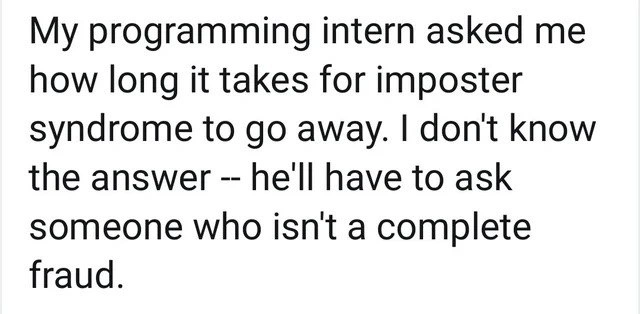
A text-based image on a plain white background. The black text reads: 'My programming intern asked me how long it takes for imposter syndrome to go away. I don't know the answer -- he'll have to ask someone who isn't a complete fraud.' This is a self-deprecating joke that perfectly encapsulates the persistent nature of imposter syndrome in the tech industry. The speaker, presumably a senior developer mentoring an intern, ironically proves the point of the question. Instead of offering an answer, they deflect by claiming they are also a 'fraud,' implying that the feeling of inadequacy doesn't disappear even with experience. The humor is relatable to developers at all levels, as it highlights the shared, and often permanent, anxiety of feeling like an imposter despite one's accomplishments



Comments
7Comment deleted
Imposter syndrome is the CVE in my mental stack that I've just learned to live with. I'm not patching it; I'm calling it a feature: 'Perpetual Humility as a Service.'
I told the intern imposter syndrome ends the day the architecture diagram actually matches what’s running in prod - so, right after we solve the Halting Problem
Twenty years in, three successful exits, and I still google "how to center a div" before every code review, just to make sure I'm not the one who finally gets exposed
The real answer is that imposter syndrome scales O(n) with your career progression - except n represents the number of technologies you've mastered, and the constant factor is your ability to remember that one production bug from 2015 that still haunts you at 3 AM. By the time you're senior enough to mentor interns, you've simply accumulated enough evidence of your own fallibility that the syndrome has achieved distributed consensus across all your neural pathways
Imposter syndrome: the one legacy bug that survives every modernization effort and outlasts COBOL
Intern asked how long impostor syndrome lasts; we treat it like technical debt - refactor around it, rename it “seniority,” and keep paying interest at every design review
Imposter syndrome at staff level is just eventual consistency for confidence - never truly resolved, so we add retries, exponential backoff, and a blameless postmortem after every demo