Skip to content
DevMeme
5073 of 7435
The Barbenheimer Guide to Startup Funding
Entrepreneurship Post #5553, on Oct 3, 2023 in TG

The Barbenheimer Guide to Startup Funding

Why is this Entrepreneurship meme funny?

Level 1: Shiny Promise, Shocking Truth

Imagine your friend shows you a beautiful, shiny present wrapped in sparkly pink paper with a big bow. It looks like the most amazing gift ever, and you’re super excited to open it. This is like the pitch deck – it’s the big talk, the promise, all the exciting “look how great this is!” on the outside.

But now picture this: when you open that present, inside you find something completely different than what you expected. Instead of a cool toy or awesome gift, you find a messy, broken thing, maybe even a little puff of smoke popping out as you open the box! It’s like, “Whoa, what happened here?” You’d probably be shocked, maybe a bit upset, but also it’s so extreme a difference that you might laugh in surprise. This is what due diligence in the meme represents – it’s the moment you peek inside and see the truth.

In simpler terms, it’s like someone promised you a trip to a gorgeous candy-colored theme park (all fun and games), but when you actually go, the place is burned down and full of smoke. The first image (the promise) makes you think of Barbie’s perfect dream house world – everything is pink, happy, and perfect. The second image (the reality) is like a scene from a disaster movie – orange sky, big explosion cloud, a guy walking away looking defeated. The meme is funny because the difference is so huge and unexpected. It’s that big gap between what we were told and what we really got. We find it funny in the same way a really exaggerated cartoon might be, because it captures a truth: sometimes people say things are going to be super great, and… well… they turn out the complete opposite!

So even if you don’t know anything about startups or tech, you can laugh at this meme. It’s basically saying: “They said it would be a paradise, but actually it was a disaster.” That idea is easy for anyone to understand. And it’s funny (in a cheeky way) because we all love to see a bit of truth come out when someone has been overhyping something. It’s like seeing the braggy kid in class claim his project is the best, but when it’s time to show it, it falls apart. You’re not truly happy it failed, but the shock of that difference is ironically amusing. This meme just uses really strong images (Barbie’s world vs. an explosion) to make that point super clear and silly.

Level 2: Slides vs Scrutiny

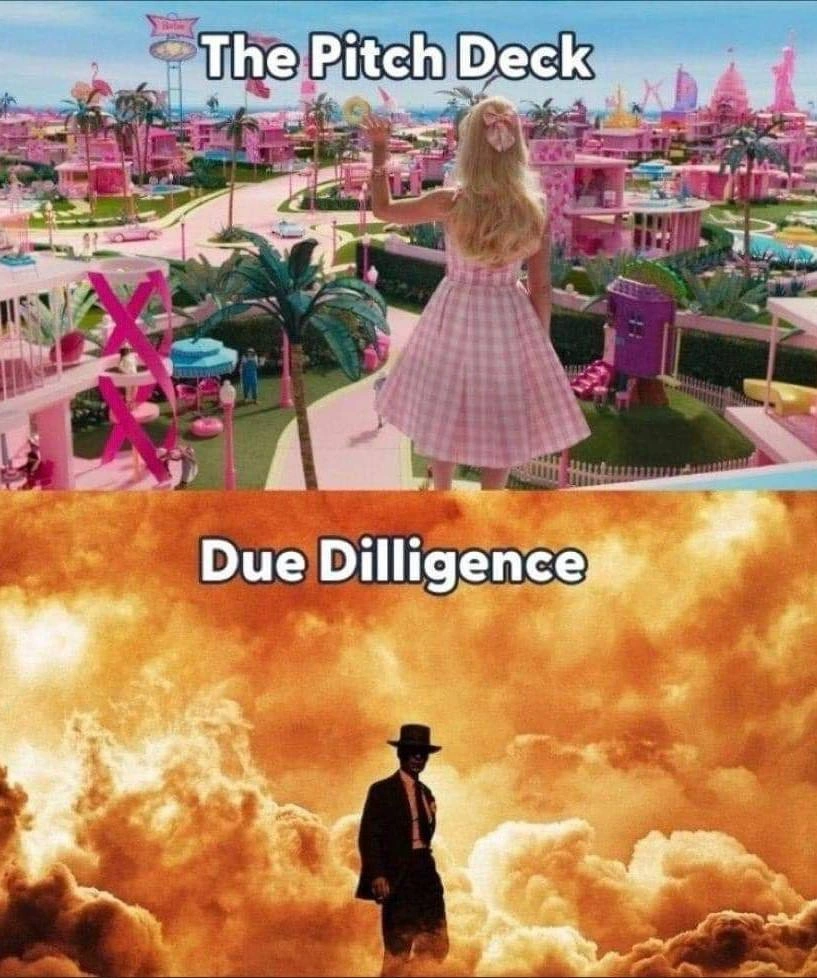
Let’s break this meme down in simpler terms. The top part labeled “The Pitch Deck” shows a scene straight out of the Barbie movie – a bright pink, perfect-looking toy city. There’s a woman in a pink dress (think of Barbie) greeting a flawless, fun world. This represents how a startup presents itself in a pitch deck, which is basically a slideshow used to pitch (propose) the business to investors. A pitch deck is all about showmanship: it highlights the best features, big dreams, and optimistic plans. It’s like when a startup says, “Our app will change the world, everything is awesome, and we just need your support!” The imagery is glossy and idealized, very much a sales and marketing view of the company. In startup culture, people often joke that pitch decks are fantasy land or Candyland versions of the truth. Here, the meme uses Barbie’s candy-pink world as the ultimate symbol of that unrealistic perfection. It’s the MarketingVsReality setup: marketing (or the pitch) is blissfully optimistic.

Now look at the bottom part labeled “Due Dilligence” (notice it’s spelled with an extra “l” by mistake!). The image is the polar opposite of the Barbie vibe: it’s dark, fiery orange, and looks like an explosion or disaster scene. In fact, it resembles a shot from the movie Oppenheimer (a film about the first atomic bomb test – very intense and not pink and happy at all). There’s a man in a suit and hat walking toward us, silhouetted against a massive cloud of smoke and fire, like he’s leaving Ground Zero of a blast. This represents due diligence, which in the startup world means a thorough investigation or audit of a company before making a big decision (like investing money or acquiring the company). Due diligence is when investors say, “Okay, show us everything for real.” They (and their experts) start checking the code, the product, the user numbers, the finances, the legal documents – everything. It’s essentially a serious reality check on all those claims made in the pitch deck.

So, the meme humorously contrasts these two stages: the rosy sales pitch vs. the harsh inspection. The joke is that during the pitch (the Barbie world) the startup looks flawless, but during due diligence (the Oppenheimer world) the truth comes out, and it can be pretty scary. It’s like night and day. This can be very relatable for people in tech or business because it happens quite often: things are hyped up in presentations and then turn out to be far messier when someone actually looks closely.

For example, a startup’s pitch deck might say, “Our product never fails and customers love it!” But if an expert does due diligence, they might discover, “Uh oh, the product crashes a lot and the customers are actually not using it much.” Or the pitch deck might boast, “We use cutting-edge technology and have top-notch security.” Then due diligence finds out, “This is mostly old, cheap hacks and there’s almost no security measures in place.” That kind of misaligned expectation between what stakeholders (like investors) expect and what’s really there is exactly what the meme is highlighting. It’s basically calling out the RelatableHumor of startup life: things aren’t always what the shiny pamphlet or slides claim.

If you’re a junior developer or just starting out, imagine a time you might have made a school project or a demo. On demo day, you show slick slides with great graphics saying, “Everything works perfectly!” But maybe behind the scenes, your code is held together with last-minute fixes, and some parts only work if you don’t poke them too much. When the teacher or a colleague actually tries to use it, suddenly errors pop up or features don’t work as advertised. Embarrassing, right? Yet, looking back, it’s a little funny because of how extreme the difference is between the promise and the reality. That’s essentially what’s happening here, just on a startup business scale. The founders promise a Barbie Dreamhouse, and the due diligence team finds a bit of a nightmare house instead.

Some key terms from the meme and tags:

  • StartupCulture: This refers to the typical environment and attitudes in a startup. Startups often move fast, break things, and hype up their ideas to get noticed. There’s a saying, “fake it till you make it,” which means act like you have an amazing product even if it’s still a work in progress. This meme is poking fun at that attitude — sometimes startups over-fake it and reality catches up.
  • Entrepreneurship: That’s just the practice of starting new businesses. Entrepreneurs often need to pitch their ideas (hence pitch decks) and convince stakeholders. This meme is very much an Entrepreneurship joke – the reality of running a business can be far less pretty than the dream you’re selling.
  • StakeholderExpectations: Stakeholders are people who have a stake or interest in something (like investors, customers, or even employees). Stakeholder expectations in a startup context could be what investors expect to find after hearing the pitch. If they expect a Barbie world and find a disaster, that’s a huge mismatch. The meme humorously captures that sense of “this isn’t what I signed up for!”
  • MarketingVsReality: This tag and concept really encapsulate the meme. Marketing (or the pitch) says one thing; reality is something else. In tech humor, you’ll see this theme a lot because many of us have experienced products or situations that were marketed as amazing but turned out to be disappointing or problematic in reality. It’s a classic formula for jokes because everyone knows the feeling of being promised X and getting Y.

Also worth noting: the meme’s use of Barbie (bright pink world) and Oppenheimer (nuclear explosion) is actually referencing an internet joke mashup called “Barbenheimer.” In 2023, the Barbie movie (bright, fun) and the Oppenheimer movie (serious, dark) were released around the same time, and people enjoyed combining their very different imagery for contrast. Here, the meme maker is using that same contrast to make the point. Even if you haven’t seen those movies, you can instinctively tell: the top image is happy and ideal, the bottom image is scary and disastrous. You don’t need to know tech to get that visual joke. It’s like saying, “Look how different these two situations are!” in one quick glance.

So, to a junior engineer or someone new to this: the lesson (and the comedy) is that big promises often come with big surprises when you look behind the curtain. Everyone in tech learns this sooner or later. It’s funny because it’s true — the bigger the hype, sometimes the bigger the “oh no!” moment afterwards. This meme just dramatizes that in a colorful, extreme way. And the reason tech folks are laughing is a bit self-reflective: we’ve all been a part of something that wasn’t as perfect as we made it seem. It’s humor with a hint of “yeah, I’ve been there.”

Level 3: Candy Pink Code Red

At first glance, this meme is a neon-lit gut-punch of startup reality. The Pitch Deck (top panel) shows a Barbie-dreamworld utopia — a bright pink, candy-colored cityscape with palm trees and toy-like buildings. It’s a fantastical paradise, like a startup’s glossy slide presentation promising the moon. But then we get to Due Dilligence (bottom panel) and it’s pure Oppenheimer: an apocalyptic orange cloud mushrooming in the sky, a lone suited figure trudging through the fallout. The contrast is jarring and hilarious to anyone seasoned in tech. It screams Marketing vs Reality in the startup world. We’ve got the Barbie land of optimistic promises colliding with the nuclear truth that thorough inspection reveals. And yes, they even misspelled “Due Diligence” as “Due Dilligence” in the meme – a cheeky little detail. Perhaps it’s an ironic hint: even the pitch deck glossy enough to blind investors might slip up on basics (like spelling), just as startups often overlook real issues while polishing their image.

In StartupCulture, this scenario is painfully familiar. The founders create a pastel-colored pitch deck to dazzle venture capitalists: everything is awesome, the product demo never crashes, the user metrics go up and to the right, and the tech stack slide lists all the hottest buzzwords (AI-driven, blockchain-secured, microservice-architected, you name it). This idealized presentation is often called slideware – it exists beautifully on slides, but maybe nowhere else. It’s the Barbie Dreamhouse version of the company: plastic perfection, all style no grime. StakeholderExpectations are sky-high in this phase. Investors see the pink paradise and think, “Wow, this could be the next unicorn.” Meanwhile, behind the scenes, the engineers are sweating bullets because they know the codebase is held together with duct tape and prayers quick hacks and TODO comments.

Then comes the brutal reality of due diligence – the moment the investors’ tech team says “Let’s see what’s really under the hood.” This is when the technical due diligence team clones the repositories, audits the architecture diagrams, reviews security practices, checks financial records, and basically digs for any skeletons in the closet. It’s the startup equivalent of a stress test, and it’s often here that the Barbie fantasy meets its Oppenheimer moment. All those things glossed over in the pitch deck (like that one little unresolved race condition, or the fact that the “AI algorithm” is actually a manual script run by an intern) will surface. That bottom image of a man walking away from a giant fiery cloud? That’s basically the lead investor’s face when they discover the code is one deployment away from a meltdown. If you’ve ever been the engineer on call at 3 AM, staring at a production outage that was glossed over as “unlikely edge case” in the slides, you know this feeling. The pitch sold a dream; the due diligence walks through the smoldering aftermath of reality.

The meme exaggerates for effect, but not by much. Anyone who’s survived a startup or two can swap war stories of rosy plans and grim discoveries. Here’s a tongue-in-cheek comparison that captures the trope:

Pitch Deck Promise Due Diligence Finds
“Revolutionary AI-driven platform” A Python script with if/else and a lot of # TODO comments
“Enterprise-grade security” admin/admin as the production database password 😱
“Scalable microservices architecture” One shaky monolith named MainServer_final_FINAL2.py running on a single EC2 instance
“Millions in potential revenue” Only a few thousand users, many of them bots or trial accounts

Oof. Each line in that table is a scenario that draws a knowing laugh (or groan) from experienced developers. It’s funny because it’s true often enough. We’ve seen startups brag about “military-grade encryption” and then find all passwords in plain text during due diligence. Or a deck touts “polished UX” with screenshots of a beautiful app, but the actual product crashes if you look at it funny. That Barbie-like perfection in the pitch is usually achieved by ignoring all the messy bits — and due diligence is precisely about uncovering those messy bits.

What really drives the humor home is the shared trauma behind it. This meme hits a nerve in tech and corporate culture. Senior engineers and tech leads chuckle (perhaps a bit darkly) because they’ve been on one side or the other of this scenario. Maybe you were on the inside of a startup, scrambling to patch holes and write missing unit tests in a panic when you heard, “Investor due diligence starts next week.” Suddenly that pretty facade needed some real walls behind it, and those were a few all-nighter crunch days, right? On the flip side, maybe you’ve been the due diligence expert, brought in to vet a company’s tech. You walk in with a hard hat and Geiger counter (metaphorically) and end up saying, “Uhh, we might have a Chernobyl situation here.” The code doesn’t build, the DevOps “pipeline” is a Jenkins job one push away from failing, and the supposed Kubernetes cluster is actually one dev’s laptop under his desk. It’s panic in paradise.

This meme’s brilliance is also in its timely barbenheimer_crossover_meme styling. In mid-2023, the internet was flooded with “Barbie vs Oppenheimer” memes (because those two movies launched at the same time, giving people a chance to mash up candy pink visuals with atomic blasts). The meme creator harnessed that cultural reference to amplify a classic tech joke. Barbie’s world represents misaligned expectations and idealized promises, while Oppenheimer’s represents the brutal truth and consequences. It’s a shorthand that everyone instantly gets: things might look cheerful on the outside, but a storm is raging behind the scenes. By using that imagery, the meme says in one snapshot what often takes a painful meeting (or a hundred Jira tickets) to communicate.

In summary (without actually saying “in summary” 😜): This meme lands because it underscores a core truth in entrepreneurship and tech: pitching is theater, but due diligence is the reality check. The humor is dark, almost cynical – we laugh, but we’re also wincing because we’ve lived it. It’s the kind of laugh you let out when hearing an on-call pager go off again: you have to find it funny, or you’ll cry. When the glossy pitch deck meets brutal due diligence reality, as the title says, it’s Barbie’s dream colliding with a mushroom cloud. And for those of us who’ve been through that collision, the meme is painfully, cathartically on point.

Description

A two-panel meme contrasting startup presentations with reality using the 'Barbenheimer' trend. The top panel, labeled 'The Pitch Deck,' shows Barbie waving over her perfect, vibrant pink world, symbolizing a flawless, optimistic business plan. The bottom panel, labeled 'Due Dilligence,' shows a stark image of Oppenheimer standing before a fiery, apocalyptic explosion, representing the intense, often brutal, scrutiny of technical and financial vetting that can uncover harsh truths and destroy the initial illusion. The meme humorously equates the idealized pitch with the fantasy of Barbie's world and the rigorous, revealing due diligence process with the destructive power and gravitas of the atomic bomb's creation

Comments

63
Anonymous ★ Top Pick The pitch deck promises a serverless, infinitely scalable microservices architecture. Due diligence finds a single, monolithic Perl script running on a Raspberry Pi under the founder's desk
  1. Anonymous ★ Top Pick

    The pitch deck promises a serverless, infinitely scalable microservices architecture. Due diligence finds a single, monolithic Perl script running on a Raspberry Pi under the founder's desk

  2. Anonymous

    Pitch deck: “Cloud-native, auto-scaling, SOC2-ready.” Due diligence: one t2.micro running MySQL as root - “I am become red flag, destroyer of valuations.”

  3. Anonymous

    The pitch deck promises "We're building the Uber of X" but due diligence reveals you're actually building the WeWork of technical debt with Theranos-level unit economics

  4. Anonymous

    Every CTO knows this feeling: the pitch deck shows a scalable microservices architecture with 99.99% uptime, but due diligence reveals a monolithic PHP app running on a single EC2 instance that hasn't been patched since 2019, held together by cron jobs and prayers. The technical debt isn't just a line item - it's the entire balance sheet, and that 'proprietary AI algorithm' is actually just a series of nested if-statements that would make any senior engineer weep

  5. Anonymous

    Pitch deck: AI-native, multi-cloud, zero-downtime. Due diligence: single-AZ RDS, a t3.small named prod-final-final, and deploys are scp in a cronjob

  6. Anonymous

    Pitch deck: “serverless AI microservices at scale”; due diligence: one t3.nano running a cron‑driven monolith, Terraform state in prod, and SOC2 “in progress” since 2019

  7. Anonymous

    Pitch deck: 'Kubernetes-native, serverless microservices utopia.' Due diligence: A Heroku dyno running a 2015 Rails monolith with god objects everywhere

  8. @Hollow_Arigo 2y

    Fuck, don't get it

    1. @S247Art 2y

      Everything is 'sunshine and roses' when enthusiastic startup owners talk about their wonderful product that will change the world. However, it can look like complete and utter nuclear fallout when you get your hands dirty to examine the financials or analyze the market.

      1. @Hollow_Arigo 2y

        Thanks bro

  9. @s2504s 2y

    Call the explanatory squad, please

  10. @callofvoid0 2y

    the pitch deck ? Due dilligence ? wtf ?

  11. @callofvoid0 2y

    wait a minute

  12. @qtsmolcat 2y

    You must be internet explorer. NFTs have basically no value anymore.

    1. @AlexKart20129 2y

      Any crypto-stuff have basically no value, and never had.

      1. @RiedleroD 2y

        cryptocurrencies do hold value. today, 400€, tomorrow 50¢

        1. @AlexKart20129 2y

          They do not hold value. They can represent value of something valuable. But there is no internal value in crypto itself, which is also true for any classic currency.

          1. @RiedleroD 2y

            all value is just human interpretation, bread in itself is worthless if there's no human to appreciate and/or eat it.

            1. @AlexKart20129 2y

              Yes, but currency is the next level of abstraction. There is some underlying value for 1kg of aluminum, but for 1 dollar or 1 euro or 1 bitcoin this underlying value is zero.

              1. @RiedleroD 2y

                no, not really. it's all just interpretation by humans

                1. @AlexKart20129 2y

                  We talking about what exactly you try to interpret in particular case. 1kg of lead can be used irl for something, 1btc or 1usd cannot be used because they do not exist. Currency is a fiction in a sense.

                  1. @RiedleroD 2y

                    lead can be used to make stuff money can be used to buy stuff bread can be used to not die it's all still just humans valuing stuff because they can do something with it

                    1. @AlexKart20129 2y

                      exchange != use. You can't directly use something that doesn't exist. You cannot seriously compare 1 liter of gasoline and a piece of paper with the inscription “1 liter of gasoline” and at the same time say that their value is equally determined.

                      1. @RiedleroD 2y

                        I can't use a raw sheet of metal either

                        1. @RiedleroD 2y

                          nor gasoline, for that matter, since I don't own a car. They're still worth the same to me as for everyone else.

                        2. @AlexKart20129 2y

                          You can definitely use it, even if you don't know how. The 1000 ways to use it directly follows from the fact of its existence. The fact that you are stupid and don’t know what to do with it doesn’t change the essence. 1 dollar does not exist in reality. A piece of paper with the inscription "1 dollar" carries as much value as a piece of paper with the inscription "1 kilogram". Money is just a symbol for something really valuable. It's just an IOU that you will be able to get what you need in the future.

                          1. @RiedleroD 2y

                            I can use the paper as a paper fan too if you insist, but that's not really worth as much, no? I can use an expensive surgical-grade scalpel to cut onions, but it's gonna do a worse job than a regular kitchen knife, yet it holds more value than one because I can give it to a surgeon. This is how money works, except it's better for trading because that's pretty much all you can do with it, unlike a surgical knife, which does have mildly different values for a surgeon and for me, since giving it to the surgeon requires effort.

                      2. @callofvoid0 2y

                        Ah how about coupons ?

                        1. @AlexKart20129 2y

                          we talking about what is valuable, and what is representing a value as a proxy.

                          1. @RiedleroD 2y

                            being valuable in proxy is still being valuable

                            1. @AlexKart20129 2y

                              no, that's a big difference

                              1. @RiedleroD 2y

                                as different as a mammal and a pig. they aren't the same, but a pig is a mammal.

                                1. @AlexKart20129 2y

                                  You're wrong. You don't see the difference between a virtual, imaginary thing and a real product that can be used. Goods and resources without money actually work the same way, it’s just inconvenient to exchange them directly. Money without goods does not work at all.

                                  1. @RiedleroD 2y

                                    obv, and gas without cars doesn't work either. Everything needs context to work, and money only works in a society

                                    1. @RiedleroD 2y

                                      fortunately, we do have a society, therefore money is valuable in it

                                      1. @AlexKart20129 2y

                                        Not really. There was a case in Russia in 1997 when they destroyed 99.9% of all rubles. And nothing has changed, because... the value of money is zero. Any amount of money can be printed or destroyed without affecting the economy.

                                        1. @RiedleroD 2y

                                          that's so hilariously untrue, it's incredible. never heard of printing money?

                                          1. @AlexKart20129 2y

                                            I saw this personally: prices became 1000 times lower, and salaries also became 1000 times lower. Nothing fundamentally has changed. No one became poorer, no one became richer. The destroyed money was worth nothing, just as freshly printed money is worth nothing. It is simply a metaphor for goods, resources and services. And it’s the same with all other currencies and cryptocurrencies - by themselves they are worth nothing.

                                            1. @RiedleroD 2y

                                              tell that to venezuela

                                              1. @AlexKart20129 2y

                                                The Venezuelan economy is suffering from sanctions imposed by the United States.

                                                1. @RiedleroD 2y

                                                  the russian economy is suffering from barely existing

                                            2. @RiedleroD 2y

                                              besides, this is just basic supply and demand: if you destroy 99% of cheese, bread is still gonna be worth the same, but cheese is gonna be worth more, so in an exchange, you'd have to pay less cheese to get bread.

                                              1. @RiedleroD 2y

                                                but that's ignoring all the funky economics and stuff that happens because humans try to predict stuff, so money works slightly differently, and inflation (AND deflation) can cripple an economy like nothing else

                                              2. @AlexKart20129 2y

                                                To create 1 million dollars you need to spend negligible resources - this can be done in 3 clicks on a computer, just a bank transfer from “nowhere” to the recipient’s account. Not a big deal. To create 1 million kilograms of cheese you need an excessive amount of resources, energy and labor. This cannot be done immidietly, and it certainly cannot be repeated indefinitely.

                                                1. @RiedleroD 2y

                                                  to create 1 million dollars, you first have to get past the US gov, which takes much more resources than creating 1 million kg of cheese I'd say.

                                                  1. @AlexKart20129 2y

                                                    I was talking about US gov (and any other gov basically), and how they “print” money. Most of the money is not printed in the literal sense of the word - it is simply transferred from account to account, then issued in the form of loans, then spent from a card, etc. It's just a numbers in bank's datacenter.

                                                    1. @RiedleroD 2y

                                                      and? That doesn't make them less valuable

                                                      1. @AlexKart20129 2y

                                                        By my opinion it makes them zero-valuable.

                                                        1. @RiedleroD 2y

                                                          the medium doesn't affect the value

                                                          1. @AlexKart20129 2y

                                                            the value of what? they do not exist.

                                                            1. @RiedleroD 2y

                                                              value is a human construct money is a human construct money has value. end of discussion

                                                              1. @AlexKart20129 2y

                                                                money has no it's own value money can only represent value of something really valuable looks like you don't understand the meaning of "valuable"

                                                                1. @RiedleroD 2y

                                                                  two can play at that game: I think you mean useful and not valuable

                                                                  1. @RiedleroD 2y

                                                                    although it can be argued that money is useful as well, so nevermind

                                        2. @mekosko 2y

                                          > Any amount of money can be printed or destroyed without affecting the economy. This is obviously wrong

                                        3. @RiedleroD 2y

                                          I think this is where the discussion ends. You brought some good points before, but this is just… idiotic.

                          2. @callofvoid0 2y

                            I guess it's an obvious thing money is the way you transfer value of things or work by itself it has no value by the things you can exchange with money it becomes valuable if something is worth being exchanged with money , so it's valuable the absolute value of something is determined by need and availability

                  2. @callofvoid0 2y

                    you can use 1usd to make a temporary fire

        2. @callofvoid0 2y

          what is the second currency that you mentioned ?

          1. @RiedleroD 2y

            …cents?

            1. @callofvoid0 2y

              oh thanks

          2. @endisn16h 2y

            lmao i like ur emoji

            1. @callofvoid0 2y

              🥴 there you go

Use J and K for navigation