Skip to content
DevMeme
3818 of 7435
Solana's 'Decentralized' Infrastructure Exposed as Classic Web2 Architecture
Blockchain Post #4160, on Feb 3, 2022 in TG

Solana's 'Decentralized' Infrastructure Exposed as Classic Web2 Architecture

Why is this Blockchain meme funny?

Level 1: One Boss, One Helper

(Focus: simple analogy and emotional core of the joke)

Imagine your teacher promises that a big class project will be done together by everyone, with no single kid in charge. That sounds fair and decentralized, right? But when you look at how the project is actually happening, you see just one kid (let’s call them the “boss”) doing all the work and another kid acting like their helper, simply copying whatever the boss does. Everyone else in class is basically watching from the sidelines. It’s a bit like a group project in name, but not in reality.

This meme is funny for the same reason: Solana’s blockchain was supposed to be like a group effort with lots of computers all equal (no boss). But the picture jokes that it’s really just one main computer (the boss) calling the shots and another computer following along as backup (the helper). In other words, they advertised a big team with no leader, but what you got looks more like a single leader with an assistant. It’s that gap between what was promised and what you actually see that makes people smirk. Essentially, it’s like calling something a team game, but only one player ever handles the ball while the rest just watch. That’s why the meme is humorous — it points out in a very simple way that maybe Solana isn’t as “all together” and democratic as it sounds, but more like a one-boss show with a helper, just dressed up with a fancy title.

Level 2: Centralized vs Distributed

(Focus: explanations of key terms and concepts for a junior developer or newcomer)

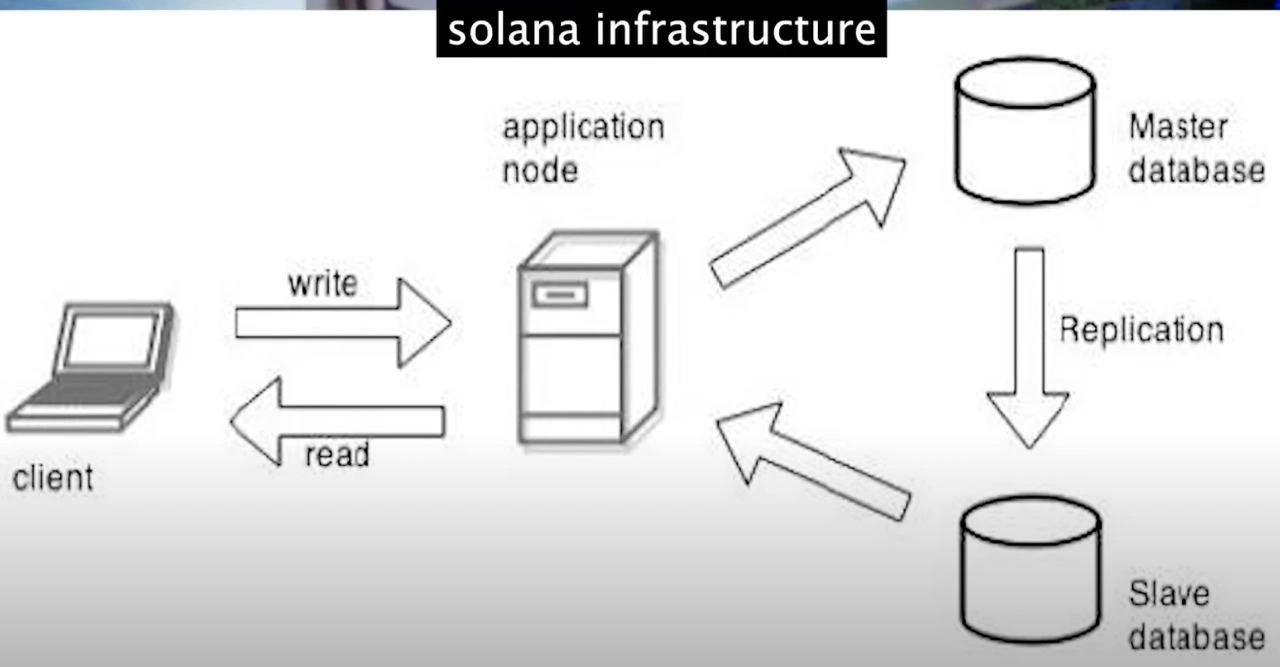
Let’s break down what’s happening in this meme diagram in simple technical terms. It’s comparing two ideas: a centralized design (like a regular database system) and a distributed design (like a blockchain is supposed to have). The meme is using the example of Solana, which is a popular blockchain platform, to make a joke.

First, understand the pieces in the picture:

  • Client: This is the user’s computer or phone (for example, someone using a wallet or app). The client wants to send or retrieve data.
  • Application node: Think of this as a server or a main computer in the network that the client talks to. In a normal web app, this might be an API server. In a blockchain context, this could be a node in the network that receives your transaction.
  • Master database: This is the primary database server. “Master” means it’s the authoritative source of data – all changes (writes) go here first.
  • Slave database: This is a secondary database server. “Slave” means it’s a copy of the master. It gets updates from the master through a process called replication. Typically, the slave handles read-only tasks to help the master with load, or it serves as a backup.
  • Arrows labeled write and read: These show the direction of data flow. The client sends write operations (like adding new information) to the application node, which then writes to the master database. For read operations (like fetching information), the application node can query the slave database (which has a replicated copy of the data) and send results back to the client. This separation is a common strategy called a read-write split: writes go to one place, reads come from another, to improve performance.
  • Solana infrastructure (the black bar title): This implies “here’s how Solana’s system is structured.”

Now, normally a blockchain like Solana is supposed to be decentralized. Decentralized means there isn’t one single master computer or database in charge. Instead, many different computers (called nodes) all hold the same data and collectively agree on updates via a protocol (a set of rules). In a decentralized blockchain:

  • Every node has a copy of the ledger (the transaction history).
  • Nodes communicate with each other to agree on what transactions are valid. This agreement process is called consensus.
  • No single node is special or authoritative; even if some nodes go offline or try to cheat, the others can still keep the system running correctly. This makes the system robust and trustless (you don’t have to trust one particular server, you trust the math and network as a whole).

On the other hand, a centralized system is like what the diagram shows: one central place holds the truth (the master database), and everything else revolves around it. If that master goes down, the system is in trouble. Everyone implicitly trusts that master to be correct and available. This is how many traditional applications are built because it’s simpler and often faster — but it does create a single point of failure.

The meme is funny to developers because it labels the very centralized picture as “Solana infrastructure,” suggesting that Solana’s network (which is advertised to work like a decentralized blockchain) might actually be working more like this old-fashioned master-slave database system. It’s a bit like saying: “Hey, maybe Solana is just one big server we’re all using, rather than a true peer-to-peer network.”

For a junior developer, think of it this way: Imagine you learned about master-slave replication while studying databases. Master-slave (also called primary-replica) replication is when you have one primary database server that handles all the new information (writes), and one or more secondary servers that copy the data to themselves and primarily handle queries (reads). This is done in many systems to scale out read performance or provide backups. It’s a straightforward top-down hierarchy: the master is on top, slaves follow its lead. Now, separately, imagine you learned about blockchains: there’s no single leader, every participant in the network can validate transactions, and data is spread out equally. These are two very different architectures!

The meme essentially takes the first scenario (master with a replica) and cheekily pastes the label of the second scenario on it (“Solana blockchain infrastructure”). It’s mocking blockchain decentralization by showing a centralized design. Kind of like a architecture_diagram_meme mashup of two worlds. If you’ve just started deploying apps, you might have set up a database and maybe even a read replica; that’s exactly what’s drawn here. Conversely, if you’ve toyed with blockchain nodes (say running a Bitcoin or Ethereum node), you know it looks nothing like having one master database — instead you connect to a network where lots of nodes talk to each other in a mesh.

Let’s define a couple of the key terms explicitly:

  • Blockchain: A type of database that’s distributed across many computers (nodes). Each new set of data (like a block of transactions) is agreed upon by the network through a consensus process. Because it’s distributed, ideally no one computer can change data arbitrarily or become a single failure point.
  • Solana: A specific blockchain platform known for being very fast and high-throughput. It uses innovations like Proof of History to order transactions quickly. Solana still has many nodes, but it’s often criticized for not being as decentralized as other blockchains (fewer nodes, more resource-intensive).
  • Centralization: When one entity or component has control. In tech, a centralized system might have one server doing the main work (like the master database).
  • Decentralization: Distributing control among many. A decentralized network doesn’t rely on one single server; many participants collectively handle the work.
  • Master/Slave (Primary/Replica): Terms from database systems. The master (primary) is the main database that accepts all writes/updates. The slave (replica) is a copy that syncs with the master and is often used for read-only queries or backup. Modern terminology prefers “primary” and “replica” or “leader” and “follower” instead of master/slave, but the meme uses the old terms likely because they’re instantly recognizable and highlight the old-school architecture.
  • Replication: The process of copying data from one database to another. Here it indicates the slave database is continuously updating itself with new data from the master. This ensures the slave has nearly the same data as the master (maybe a slight delay) and can step in if needed.
  • Single point of failure: A part of a system that, if it fails, will stop the entire system from working. In the diagram, the master database is a single point of failure — if it goes offline, the client can’t do any writes and the whole service would effectively be down or stuck. In a well-designed blockchain, there shouldn’t be any single point of failure; many nodes can drop but others keep it going.

So, for a newcomer: this meme is basically using a simple database humor analogy to say “This fancy blockchain might actually be as centralized as a regular app with one database.” It’s a critique. If you’ve ever been told something was “distributed” or “decentralized” and then found out there’s actually one big server behind the scenes, you’ll understand the joke. It’s like if someone said, “Our game is running on a worldwide network!” but you peek in the server room and there’s just one big PC running everything. The diagram’s simplicity—just a client, one app server, and a primary/secondary database—makes the contrast with the complexity of a real blockchain pretty stark.

Level 3: Decentralization Theater

(Focus: experienced developer perspective on the meme’s commentary about Solana’s architecture vs promised decentralization)

This meme strikes a chord with veteran developers by portraying Solana’s much-touted “decentralized” Blockchain network as if it were just a conventional database setup. The diagram under the label “solana infrastructure” looks suspiciously like a classic web application architecture: a client talks to an application node, which then writes to a single Master database and replicates to a Slave database. In the world of DistributedSystems, this is the epitome of a centralized design. Seasoned engineers immediately recognize the elements: a master database handling all writes, and a slave database for read replicas and failover. It’s a tried-and-true pattern for scaling databases, but it’s the exact opposite of what you'd expect from a blockchain network that's supposed to eliminate single points of failure. The humor is a sort of decentralization theater – Solana might claim to be a distributed network, but this meme implies it’s merely performing decentralization while really operating like a single master with some backups.

Why is that funny (and a bit cutting)? Because blockchain technology carries an aura of next-gen innovation and trustless design. Yet here we have Solana’s architecture cheekily reduced to something any enterprise database administrator could have set up 20 years ago. Architectural trade-offs are at the heart of the joke: Solana is known for its high throughput and speed (handling thousands of transactions per second, way more than Bitcoin or Ethereum). How does it achieve that? Critics often point out it does so by leaning into centralization: requiring powerful hardware for validator nodes, having a smaller, more controlled set of nodes, and even experiencing coordinated restarts during outages (a sign that a central group can pause and reboot the network). This meme gibes that those trade-offs basically make Solana equivalent to a fast, scalable centralized database system rather than a truly decentralized network. In other words, it’s mocking blockchain decentralization claims by showing an architecture with obvious centralized failure points (the master database is a single point of failure and control).

Every label in that diagram is painfully generic – “application node”, “master database”, “slave database”. There’s no mention of multiple validators, peer-to-peer gossip, or cryptographic consensus – all things you’d expect in a blockchain architecture diagram. Instead, it reads like the schematic for a read-write split setup in a typical web app:

  • The client sends a write (transaction) to the server (application node).
  • The server writes to the Master database (the authoritative data store).
  • The server (or the clients) perform read queries from the replicated Slave database to reduce load on the master.
  • A replication process keeps the slave in sync with the master.

This is textbook master-slave replication from the world of relational databases. Seasoned devs might chuckle because they’ve seen this kind of diagram in countless system design docs and DatabaseHumor posts, not in blockchain whitepapers! It’s as if the meme is saying, “Solana, your so-called novel infrastructure is just MySQL with extra steps.” In fact, one could joke that Solana’s real consensus mechanism is Proof-of-Database – a fictional concept where you “decentralize” by trusting one database to be always right.

Let’s compare what a decentralized blockchain implies versus what this meme shows, to really appreciate the punchline:

Decentralized Blockchain Network Centralized Database Setup (Meme)
Many equal nodes each validate and store the full ledger (no single master). One Master server holds the official data, a Slave server just copies it.
If some nodes go down or act maliciously, the network still agrees on truth (fault tolerant, no single point of failure). If the master goes down, the entire system stops or needs manual failover (the master is a single point of failure).
Consensus algorithm (e.g., proof-of-stake) lets nodes agree on writes without central authority. No consensus needed – the master decides all writes, slaves just trust and apply them (all authority in one place).

The table highlights why this meme is essentially poking fun at Solana. A real blockchain’s strength is distributing trust and workload, whereas this solana_centralization_meme illustrates an architecture where trust and work funnel into one node. For a tech humor connoisseur, the image is essentially calling Solana out: “You’ve reinvented the centralized database and called it a blockchain!”

It’s worth noting that Solana is more complex under the hood than just one database – it has many validators and a unique way of ordering transactions. But the meme exaggerates to make a point: if only a few big nodes or one coordinating node matters, is it really that different from a traditional system? This resonates with the battle-scarred devs who have witnessed plenty of hyped systems claiming to be distributed or cloud-native, yet crumbling like any old single server when a crucial component fails. It’s a cynical I’ve seen this movie before moment. The meme’s master-slave diagram is basically showing the centralization hidden in plain sight.

When experienced engineers see “Master database” and “Slave database” in a diagram labeled Solana, they smirk because those terms, aside from being dated (many now say “primary” and “replica”), belong to architectures that blockchains were supposed to make obsolete. The juxtaposition is rich in irony. It suggests that perhaps Solana’s distributed system isn’t so distributed – maybe it’s fast precisely because it’s more centralized (one big master node handling the bulk of the work, like a super-server). It’s a reminder that in system design, there are no magic solutions: if you want extreme performance, you often sacrifice decentralization or consistency, intentionally or not. In Solana’s case, the community joke (as depicted by this meme) is that they sacrificed a bit too much decentralization, ending up with what looks like a plain old centralized architecture.

In short, Level 3 reveals the inside joke: calling something decentralized doesn’t make it so if the architecture revolves around a single hub. It’s BlockchainHype meeting the reality of Databases, and the meme delivers that punch with a simple picture that says it all. For any engineer who’s been around the block, the moment they see that lone master database sitting at the top of “Solana infrastructure,” they understand the satire: this is decentralization in name only – a decentralization theater indeed.

Level 4: Byzantine vs Single Master

(Focus: theoretical contrast between decentralized consensus and a single master approach)

At the deepest technical level, this meme highlights a Byzantine fault tolerance versus single-leader replication dichotomy. In a truly decentralized blockchain system, consensus algorithms (like Proof of Stake or Nakamoto Consensus) solve the classic Byzantine Generals Problem, allowing a network of nodes to agree on a ledger without trusting any single node. Solana’s blockchain technology, for example, uses a combination of Proof of History and a Practical Byzantine Fault Tolerance (pBFT)-style consensus (often called Tower BFT) to coordinate many validators. In theory, this means no single node is “in charge” — any malicious or failing node can be outvoted or ignored while the honest majority maintains the ledger’s integrity.

However, the meme subverts this ideal by depicting an architecture akin to a simple primary-replica database cluster. In such a setup, consensus is trivial: the master node’s word is law, and the slave just copies it. This is effectively a crash-fault tolerant design rather than a Byzantine-fault tolerant one. The master-slave replication architecture assumes a trusted master; it doesn’t attempt to solve for Byzantine adversaries (i.e. nodes that lie or malfunction in arbitrary ways) because the master is supposed to be reliable (and usually under one authority’s control). In distributed systems theory terms, the meme is saying Solana’s "decentralized" network could be reduced to a leader-follower model devoid of any trustless consensus. It’s as if the complex dance of a consensus algorithm — with voting, block propagation, and cryptographic validation — has been replaced by a single transaction log that gets copied over via a Replication stream.

Why is this funny to the seasoned engineer? Because it’s a tongue-in-cheek assertion that all the high-tech BlockchainHype about Solana achieving distributed consensus at scale might secretly boil down to something as prosaic as a centralized database system. It’s practically calling Solana a glorified SQL cluster with one primary. In theoretical terms, the meme jabs at the CAP theorem trade-offs as well: Solana prioritizes Consistency and Partition tolerance (to maintain a single global ledger state) like a typical database, potentially at the cost of Availability — evidenced by Solana’s well-known outages when that “master” fails or gets overwhelmed. A true decentralized design would aim to be robust against partitions or node failures (many generals can fall, and the army still coordinates), but a master/slave design has a clear single point of coordination (and failure).

In summary, at this Level 4 depth we see that the meme humorously contrasts decentralized consensus protocols requiring complex distributed systems theory (think Paxos, Raft, or BFT algorithms with many equal peers), with a much simpler and more centralized leader-based replication. The Byzantine vs Single Master joke implies Solana's network might be operating closer to the latter: instead of a resilient web of mutually distrustful nodes reaching agreement, it’s as if there’s one authoritative node (or a small set acting as one) doing all the work and replicating state to secondaries. For a distributed systems geek, the absurdity is clear: it's comparing a cutting-edge decentralized ledger to a 1980s-style database architecture and hinting they might not be as far apart as marketing suggests.

Description

A simple black-and-white architectural diagram ironically labeled 'solana infrastructure' at the top. The diagram illustrates a standard, centralized Web2 client-server model. On the left, a 'client' laptop icon sends a 'write' request to an 'application node' (server icon) and receives a 'read' response. The application node, in turn, communicates with a 'Master database' for writes. This master database then performs 'Replication' to a 'Slave database,' which is used for reads by the application node. This diagram is humorous and critical because it deliberately misrepresents a classic, centralized database architecture - a setup familiar to any experienced web developer for decades - as the infrastructure for Solana, a blockchain platform famous for its claims of high decentralization and performance. The joke lies in the stark contrast between the hype of Web3/blockchain technology and the mundane reality of traditional, centralized systems. For senior engineers, this is a biting satire on how some of the most hyped 'decentralized' projects in the crypto space may, under the hood, rely on conventional, centralized choke points, completely undermining their core value proposition

Comments

32
Anonymous ★ Top Pick Ah, Solana's groundbreaking architecture: reinventing the 1990s-era MySQL primary/replica setup but with added consensus theater and a token. It's not a single point of failure if you call it a 'validator.'
  1. Anonymous ★ Top Pick

    Ah, Solana's groundbreaking architecture: reinventing the 1990s-era MySQL primary/replica setup but with added consensus theater and a token. It's not a single point of failure if you call it a 'validator.'

  2. Anonymous

    Solana’s secret sauce: rebrand a master - slave MySQL pair as “Proof-of-History” and call the binlog a blockchain

  3. Anonymous

    Nothing says 'decentralized future of finance' quite like a good old-fashioned master-slave database architecture diagram - because even at 65,000 TPS, Solana still needs somewhere to store those transaction receipts when the validators aren't having their weekly timeout party

  4. Anonymous

    Turns out 'web-scale decentralization' was a read replica all along - at least when Solana goes down, the postmortem only needs one diagram

  5. Anonymous

    Ah yes, the classic 'master-slave' database architecture diagram - because nothing says 'modern blockchain infrastructure' quite like terminology that would get you sent to HR sensitivity training faster than a production deployment on Friday afternoon. At least Solana's infrastructure is more reliable than their network uptime during NFT mints

  6. Anonymous

    Solana infrastructure: write to master, read from replicas; consensus is whatever replication lag and the on-call DBA decide - aka Proof-of-Read-Replica

  7. Anonymous

    If your “chain” routes writes to one primary and calls the rest “replication,” that’s not Byzantine consensus - it’s a read‑replica cluster with better marketing

  8. Anonymous

    Solana infra: writes to master, reads from slaves. Because 50k TPS is just MySQL with blockchain branding

  9. @PatiHox 4y

    pfft who needs a replication anyway?

  10. dev_meme 4y

    @RiedleroD

    1. @RiedleroD 4y

      nsfw isn't forbidden, but I'll remove it I guess

      1. dev_meme 4y

        That worse than nsfw

        1. @RiedleroD 4y

          gay nsfw is still just nsfw

  11. @RiedleroD 4y

    ah yes, master & slave. good times when these words were still used. good times. Now every time I want to checkout master, I have to check if it's main first.

    1. dev_meme 4y

      Oh this is so annoying

    2. @kitbot256 4y

      Whoever used this terms in the first place was crazy

      1. @RiedleroD 4y

        "Hmm, this device controls every action of the other one. What should I call it?" Master is one of the best options possible.

        1. @kitbot256 4y

          The problem is it does not control (as it is performed by e.g. Kubernetes controller node) but does the work on its own, and the replica node repeats the same actions. Does it look like a master-slave relation to you? For me "origin-replica" (for sql) or controller-worker (for distributed systems) makes way more sense here. The only thing about the original technology is everybody's used to it, but it doesn't mean we should not fix the old error.

          1. @RiedleroD 4y

            dunno abt SQL tbh, but in many other standards, the terminology does make sense.

            1. @kitbot256 4y

              Could you name of few?

              1. @RiedleroD 4y

                USB standard - if the devices have a master/slave connection (p2p exists as well afaik), one device does control the other pretty much entirely, as far as the USB standard allows. E.g. when file sharing, one device controls which files are copied, etc. Same with bluetooth afaik. In the gaming space, some models could be called master/slave, though server/client is usually preferred & makes more sense anyway. Uhh other than that, I don't have any good examples. I'm probably forgetting a lot of stuff though.

                1. @kitbot256 4y

                  > though server/client is usually preferred & makes more sense anyway. Funny enough, if I am dining in a restaurant, who controls the food flow — me the client or my server? :) However with bluetooth or usb master-slave naming sounds traditional, but not very obvious or logical.

                  1. @RiedleroD 4y

                    you control what the server then agrees to serve

                    1. @kitbot256 4y

                      Yes, this sounds right.

  12. @RiedleroD 4y

    spam is still forbidden

  13. @RiedleroD 4y

    please don't though

  14. @niklody 4y

    Why app node always go into master. Where is read scalability

  15. @SamsonovAnton 4y

    That is exactly why IDE was deprecated long ago! 😁

  16. @beenotung 4y

    The opposite of master doesn't have to be slave

  17. @beenotung 4y

    Could be mirror node, backup node, standby node or following node etc

  18. @callofvoid0 4y

    what? you write firectly to master but only rrad from slave? wtf is this aarch? it just copies from the master so whats the point ?

    1. @kitbot256 4y

      If you have many complicated reads and only a few occasional writes this architecture actually makes a lot of sense. Also the R/W node can be set up in your HQ or somewhere nearby, while the RO nodes are in every data center. The point is latency and resource usage optimization.

Use J and K for navigation