The All-Knowing Senior Dev and the Junior's PR
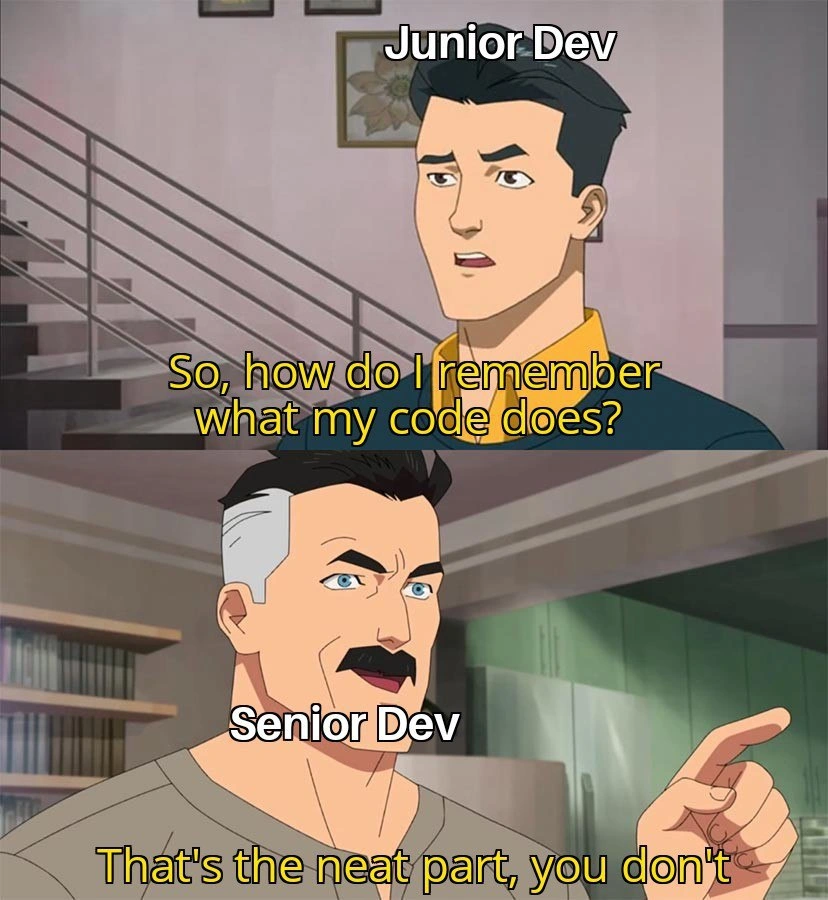
Why is this CodeReviews meme funny?
Level 1: Clues for Later
Writing code without any notes or explanation is like burying a treasure and not making a map. Imagine you hide your favorite toy in the backyard and think, “I’ll remember this spot.” But a month later, you’ve totally forgotten where it is. Oops! If you drew a little treasure map or left a big “X” mark, you wouldn’t have this problem. In the meme, the junior developer is basically asking, “How will I remember where I hid my toy (what my code does)?” and the senior developer says, “That’s the neat part – you won’t remember!” He means that it’s normal to forget details over time. So, the smart thing to do is leave clues for later. In coding, those clues are things like simple, clear code, comments that explain things, and documentation (like a short note or guide about the code). These clues help your future self (or your friends) find the treasure again. The joke is funny because it’s true: even the best grown-up programmers forget what their code does, so we all need to leave ourselves a trail of breadcrumbs to find our way back!
Level 2: No Comments, No Clue
Let’s break down what’s happening in simpler terms. The Junior Dev asks how to remember what his code does — like there’s a trick to have all that detail in his head. The Senior Dev basically answers, “You don’t remember it (at least not forever).” This is pointing out that developers shouldn’t rely on their brain alone to store every detail of the code. Instead, we rely on making the code itself clear and leaving notes for ourselves, such as code comments or external documentation.
Code readability means writing code that other humans (including future you) can easily understand. One way to achieve this is good naming: for example, using a variable name like total_price instead of tp. Another way is organizing code logically and clearly. But even with good names, complex logic can be confusing when you come back later. That’s where code comments help. Comments are lines in the source code prefixed with special symbols (like // in Java/JavaScript, or # in Python) that the computer ignores but humans read. In a comment, you might explain what a block of code is doing or why you did something a certain way. Documentation takes this a step further: it can be a README file, a developer guide, or docstrings in your functions explaining usage. Documentation and comments act like a map or cheat-sheet for anyone (your teammates or your future self) to quickly understand the code without having to remember everything from scratch.
Why is this needed? Because of something we call codebase amnesia – basically forgetting details about the code over time. It happens to everyone. Perhaps you wrote a feature last month; if you revisit that code today, there’s a good chance you won’t recall every decision or calculation you made. If the code is clear and/or documented, you can get up to speed again quickly. If not, you’ll be scratching your head. This is also related to knowledge silos: if only one person understands a piece of code (because nothing was documented), all that knowledge is stuck in that one person’s head, like a silo. If they forget or leave the team, everyone else is lost. This makes onboarding new developers (getting them up to speed on the project) a nightmare — that’s the onboarding gap the tags refer to. New folks join and have to rely on tribal knowledge (asking people verbally) because nothing was written down. Not fun!
To illustrate, here’s a quick example of code with and without helpful documentation:
# Without documentation (difficult to understand later)
def f(a, b, c):
return a / b + c # uses a formula; I'll remember why I did this... (spoiler: I won't)
# With clear naming and comments (easier to understand later)
def compute_discounted_price(price, discount_rate, tax):
# Calculate discounted price then add tax.
# Formula: final_price = (price * (1 - discount_rate)) + tax
return price * (1 - discount_rate) + tax
In the first function f(a, b, c), the purpose isn’t clear. The comment is vague (“uses a formula”) and relying on memory (“I’ll remember why...”). In a few weeks, the developer will likely have no clue why they wrote it that way. In the second function, compute_discounted_price, we’ve used descriptive names and a comment explaining the formula. Even if you forget the details, reading the code and comment reminds you what’s happening (calculate a discounted price and then add tax). This is CodeMaintainability in action: writing code today in a way that’s easy to pick up and maintain in the future.
The meme’s joke hits home for developers because it’s extremely common to forget your own code’s logic. The solution isn’t to have a superbrain; it’s to acknowledge you won’t remember and write things down. Senior devs use a bit of sarcastic humor here (“That’s the neat part, you don’t”) to emphasize that everyone faces this. It’s a friendly warning: Don’t count on remembering — count on your code and docs to explain it for you. This improves the DeveloperExperience for everyone, because working in a codebase with comments and documentation is like having a guide. Without those, every time feels like solving a mystery afresh. In short: to know what your code does later, make your code self-explanatory and well-documented now.
Level 3: The Tribal Knowledge Trap
In this two-panel Invincible meme, a wide-eyed Junior Dev asks Omni-Man (the Senior Dev figure), “So, how do I remember what my code does?” The Senior Dev, with a world-weary smirk, replies, “That's the neat part, you don't.” This punchline lands because it skewers a painful truth in software development: no matter how smart you are, you will forget the details of your own code. Seasoned developers know that relying on personal memory is a trap — a classic case of tribal knowledge doomed to vanish.
The humor here is darkly relatable developer experience. The junior’s naive question suggests an illusion that pros carry a complete mental map of every function they’ve written. The senior’s retort delivers reality: memory fades, code is forever. In a healthy codebase, you shouldn’t need to mentally cache every implementation detail; the code’s structure, naming, and comments should do the heavy lifting. But in practice, many codebases are held together by no comments, just vibes. The result? A knowledge silo where only the original author might recall the nuances — and even they’ll draw a blank after enough time (or enough coffee). Experienced devs have all had that “Who wrote this nonsense?!” moment at 3 AM, only to check git blame and discover the culprit is their past self.
From a senior perspective, this meme riffs on CodeMaintainability (or the lack thereof). The “neat part” isn’t that forgetting is good, it’s that forgetting is inevitable — so we compensate with external artifacts. High-CodeQuality projects emphasize code readability (clear naming, simple logic) and have thorough Documentation precisely because no one remembers everything. The seasoned engineer understands that the real superpower is not needing to remember: you write self-documenting code and code comments, and you maintain a good README or wiki. These act as your long-term memory. In contrast, juniors often grapple with codebase amnesia, thinking seniors have photographic code recall. This meme wryly confirms that even veterans regularly re-read their own code or documentation to remember how things work. DeveloperExperience (DX) suffers when critical knowledge lives only in someone’s head. If Bob from backend leaves and took the entire payment calculation logic with him in his brain, the team is toast. That’s why the “bus factor” (how many people can get hit by a bus before knowledge is lost) is a serious metric — and why seniors chuckle grimly at naive questions about personal memory.
Ultimately, the senior dev’s sarcastic wisdom — *“you don’t” remember your code — highlights a core software engineering mantra: code as if the person maintaining it (likely future you!) has zero context. Comments, clear code, and docs aren’t just nice-to-haves; they’re survival gear. The true DeveloperHumor here is that every developer, junior or senior, eventually learns this the hard way. It’s a shared industry joke born from countless moments of code confusion and the humbling realization that even the author can become a stranger to the code. The meme exaggerates the mentor-mentee dynamic to drive home a lesson: readable code and documentation save you from your own memory leaks.
Description
This meme uses the 'Gru's Plan' meme format. The first panel shows Gru pointing to a board that says 'Junior dev opens a pull request.' The second panel shows a close-up of the board, which now says 'It has 1,200 lines of code changes.' The third panel shows Gru looking back at the board, confused, as it now reads 'Senior dev comments: 'lgtm'.' This meme humorously depicts the sometimes-unpredictable nature of code reviews, where a senior developer, either out of trust, lack of time, or sheer apathy, approves a massive pull request with a simple 'looks good to me.' For senior engineers, it’s a funny take on the pressures of code review and the occasional need to trust your team's judgment, even when you don't have time for a deep dive

Comments
7Comment deleted
There are two types of senior dev code reviews: a 200-comment Socratic dialogue on a two-line change, and 'lgtm' on a PR that refactors the entire authentication service. There is no in-between
The cheapest encryption algorithm is six months of code rot - future-you can’t decrypt a thing
After 20 years, I've learned that git blame is less about finding who wrote the code and more about discovering it was you, six months ago, with a commit message that just says 'fixes'
The real senior move is writing code so clever that even you need a debugger and three cups of coffee to understand it six months later. Documentation? That's what `git blame` and archaeological excavation skills are for - because nothing says 'job security' quite like being the only person who can decipher your own cryptic variable names from 2019
At senior level, memory is a distributed system - grep, git blame, and that stale README you forgot to update after the last hotfix
Senior pro move: Treat juniors as living Javadoc - queryable, updatable, and always on call
Human memory has a TTL shorter than a sprint; serialize intent into tests, names, and ADRs before rebase --squash turns it into archaeology