The High-Stakes World of Peer Code Reviews
Why is this CodeReviews meme funny?
Level 1: Candy Contraband
Imagine you’re going to the movies with a backpack full of candy. You’re not really supposed to bring outside candy, and there’s a super strict guard at the door checking bags. Now, you only have candy (it’s not dangerous at all!), but this guard is checking every little pocket in your backpack, even patting down your jacket, acting like you might be smuggling something really bad. It’s a bit silly how thorough he is, right? You’re thinking, “Geez, it’s just candy!” 🍬
This meme is just like that, but for computer code. Replacing you and the guard with code and a coder: when a programmer finishes some work and wants to add it to the big app (like bringing candy into the movies), another programmer checks it carefully (like the guard checking for contraband). The funny part is how extremely careful that check can be – sometimes more careful than it probably needs to be. It feels like being frisked at the airport for just doing something small. The joke is basically saying: "Getting my code approved can feel as intense as getting through airport security with a pocket full of candy!" It’s exaggeration, of course, which is why it’s funny. Everyone knows reviewing code shouldn’t be that dramatic, but sometimes it feels that way, and that’s why we laugh.
Level 2: Code Frisking 101
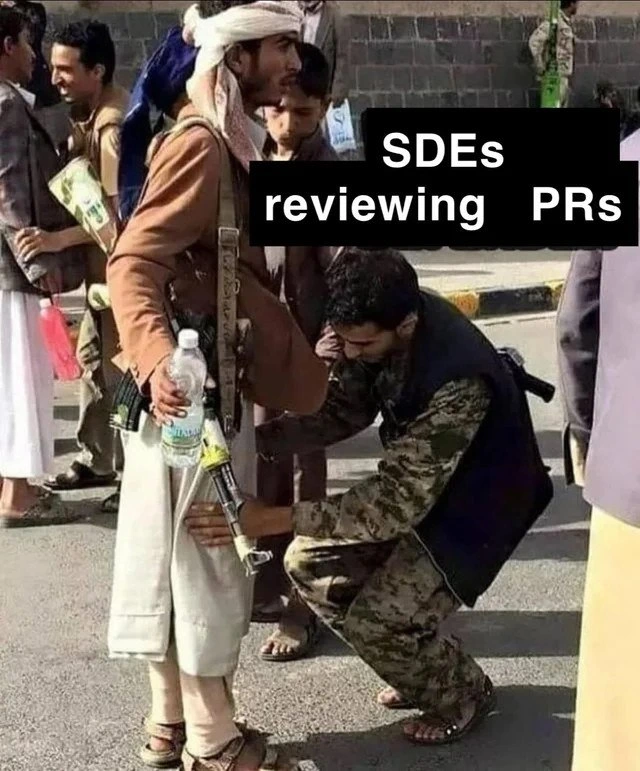
Alright, let’s break down the joke in simpler terms. In software teams, when you finish working on some code, you usually open a Pull Request (PR). A PR is basically you saying, "Hey team, I have these code changes, can you look them over and then add them to our main codebase?" The process of teammates checking your code is called a code review. The meme compares this code review process to a security pat-down at a checkpoint. One guy in the photo is the security officer, and the other is a traveler being searched. Now imagine the traveler is your code and the officer is the software engineer (SDE) reviewing your PR. The text "SDEs reviewing PRs" slapped on the image makes that connection clear. It's a funny metaphor showing an overzealous code review, meaning the reviewer is going overboard with thoroughness.
Why would a developer reviewing code act like a guard searching for hidden weapons? Well, sometimes code reviewers are very strict to ensure nothing bad (like bugs or security flaws) slips into the codebase. It's like they’re looking for contraband in your code — maybe a sneaky bug, a bad practice, or a piece of code that doesn’t follow the team's rules. In developer lingo, we often talk about "nit-picking" during reviews. A nit-pick is a super small critique, like saying “there should be a comma here” or “rename this variable to be more clear.” Nit-picks are the equivalent of the guard checking even your shoelaces for danger. They’re usually about tiny details (code style, spacing, minor optimizations) rather than big logic errors. This meme is joking that some SDEs review PRs so meticulously that it’s as if they’re patting down every line of code looking for these little issues.
Let’s define a couple of terms in case you’re new to this:
- SDE (Software Development Engineer): just a fancy title for a software developer or programmer. Companies like Amazon or Microsoft use "SDE" to label their dev positions. Here it simply means the developer who is doing the review.
- PR (Pull Request): when using a version control system like Git, a PR is a way to propose code changes and request that other developers review and merge them. Think of it as asking permission to add your work to the main project.
- Code Review: the practice of having other developers examine your code changes before they go into the main codebase. It’s like proofreading for code. The goal is to catch mistakes, improve code quality, and share knowledge.
Now, in terms of the meme’s categories like CodeReviews and DeveloperExperience_DX: this is highlighting a part of developer experience that everyone finds relatable. Code reviews can be incredibly helpful, but if a reviewer is too strict, a new developer might feel anxious, like “Oh no, are they going to find something terrible in my code?” The developer humor here comes from exaggeration. Of course, real code reviews don’t involve actual armed guards or physical searches 😜 – but emotionally, a tough review can feel that intense! You sit there reading the review comments with your heart racing a bit, similar to how someone might feel nervous at airport security even when they have nothing to hide.
This meme is tagged with CodeReviewPainPoints for a reason. One pain point is feeling like your work is being judged in extreme detail. For a junior developer, getting a PR returned with a long list of comments can feel overwhelming. But remember, usually the reviewer isn’t trying to bully you. They’re trying to help catch issues and maintain standards. It’s just that sometimes they get a little too enthusiastic about it. For example, you might add a harmless helper function, and the review comes back with:
- a request to change the name of the function,
- a suggestion to handle an edge case you never thought of,
- a reminder that there’s already a utility function in the codebase that does something similar (oops!),
- and a note that you used tabs instead of spaces somewhere.
It can feel like a lot, right? That’s why developers joke about it. We laugh because we’ve all had that feeling of “wow, this person combed through my code like a detective!” In fact, pull request reviews are sometimes informally called "PR police" when done in a very strict way. The security pat-down metaphor captures the vibe perfectly: the reviewer is the police, and your code must empty its pockets.
In summary, the meme is saying: "Sometimes code reviews are so thorough, it feels like your code is going through customs at the airport." It’s a playful jab at those very meticulous reviewers. If you’re a new dev experiencing this, don’t worry — it’s normal in many teams and often comes from a good place (keeping bugs out). And if it ever feels too much, remember that even senior devs make jokes about it, so you're definitely not alone! It’s a shared relatable developer experience that bonds the community (and spawns countless DeveloperMemes like this one).
Level 3: Contraband Commits
At first glance, this meme hilariously equates a code review to a full-on security checkpoint. One developer (the reviewer) is acting like an armed guard performing a pat-down, while the other (the author of the code) stands there like a traveler getting frisked. In the world of software, a Pull Request (PR) is supposed to be a friendly peer review of code changes, but we all know that one overzealous code review where the reviewer combs through every line of code as if searching for hidden contraband. The text "SDEs reviewing PRs" punches in the analogy: Software Development Engineers examining Pull Requests with intense scrutiny. It's a spot-on reference to CodeReview culture and the pain points that come with it.
Why is this so funny (or painfully true) for experienced devs? Because it's DeveloperHumor drawn from real life. In high-stakes teams, especially where code quality and security are paramount, a senior engineer might scrutinize a PR the way a border agent checks luggage. Every variable name is questioned, every function call double-checked. Did you format that JSON correctly? Why is that variable not const? It's like they're expecting to find a dangerous bug stuffed in a sock somewhere in your diff. The reviewer may even insist on manual testing and proof of CI passing, essentially treating your code like it needs to clear customs before merging into main. This is a classic code review pain point: the balance between ensuring quality and maintaining trust.
Notice the absurd detail in the image: the person being searched is openly carrying a rifle and a water bottle, yet the guard is still patting them down meticulously. 😅 This parallels how reviewers sometimes laser-focus on trivial issues (like an extra whitespace or a minor stylistic nitpick) even when larger changes are in plain sight. It's like a guard fussing over a water bottle when a rifle is literally hanging off the guy’s shoulder. In code terms, a reviewer might harp on formatting or a tiny optimization while the overall design (the big rifle) sails through. This meme captures that ironic security theater of code reviews, where the thoroughness can feel performative or excessive.
From a senior developer’s perspective, there’s history and rationale behind this intensity. Formal code inspections have existed since the 1970s (think Fagan Inspections at IBM), where reviewers went through checklists to catch every bug before shipping. Modern Git workflows with PRs are more casual, but the ethos remains: no unchecked code enters production. Veterans have been burned by one-liner bugs that caused outages at 3 AM, so now they’re paranoid. The result? They treat a 5-line bug fix PR like it’s crossing an international border with fake passports. They’ll comment on everything: logic, naming, spacing, even the tone of your comments.
This extreme diligence is both admired and mocked. On the upside, meticulous reviews can catch security vulnerabilities or performance problems that automated tools miss. (Think of automated tests and linters as the metal detectors and X-ray scanners of the code world, and the manual review as the final pat-down to catch the sneaky stuff.) On the downside, it can bog down development. Pull Requests sitting for days with extensive review comments can feel like your code’s being held in customs. It’s a relatable DeveloperExperience (DX) fiasco: we want quality code, but we also joke that "it's easier to get through airport security than to get a large PR approved."
In practice, experienced devs often share war stories about these gatekeeper code reviews. For example, you submit a PR to rename a function and update a few lines. Suddenly, two senior engineers jump in with 15 comments about things unrelated to the core change: “Could we refactor this entire class while we’re here?” or “This works, but have you considered the caching implications on a cold start on Tuesday under a full moon?” 🙄 It might feel excessive, but it’s oddly common. The meme exaggerates it to comedic effect: the SDE vs PR analogy shows a ridiculous level of scrutiny that rings true if you’ve ever had a nit-picky reviewer.
So, on Level 3 we laugh (and maybe cry a little) because we’ve all been there. The humor lands with anyone who’s navigated a tough code review process. It’s a knowing grin between developers: “Yup, code reviews sometimes really do feel like being frisked by a security guard.” Better hope your code isn't carrying any contraband commits!
Description
The image captures a tense outdoor scene where a man in camouflage and a tactical vest is crouched down, meticulously inspecting the rifle of another man who is standing. A black text box is overlaid on the image with the white text 'SDEs reviewing PRs' (Software Development Engineers reviewing Pull Requests). The visual gag draws a humorous parallel between the life-or-death seriousness of a weapons check and the intense scrutiny that software engineers apply during code reviews. For senior developers, this resonates with experiences of having their code examined with extreme precision, where even the smallest flaw can be flagged. It's a commentary on the meticulous, sometimes overly pedantic, nature of the peer review process in a high-performing engineering culture, where ensuring code quality is treated with the utmost gravity
Comments
11Comment deleted
LGTM, but can we refactor this? The O(n) complexity of your trigger pull is concerning. We should aim for O(1) for all critical paths
Modern code review: nobody flinches at the bazooka of 20-year-old C++ you’re lugging, but that stray newline better come with a signed SBOM and two-factor whitespace approval
The same engineer who approved the MongoDB migration is now checking if your variable names follow camelCase conventions
Ten comments on the variable naming, zero on the part where it stores plaintext passwords - ship it, LGTM
The meme perfectly captures that moment when you've spent three days on a feature, finally submit the PR with 47 files changed, and then see 'requested changes' from the principal engineer who hasn't committed code since 2019 but somehow still remembers every edge case in the legacy authentication module you accidentally touched
SDES PR reviews: where one off-by-one error triggers the full critique arsenal, because 'ship it' is for juniors
Our zero‑trust code review frisks every diff for whitespace contraband and illegal import order, then waves the O(N^2) hot‑path change through because CI is green and two LGTMs satisfy audit
“Minor typo” PR - after the frisk we found a concealed schema migration, an unpinned transitive dep, and a Friday deploy
Software Developer Expert? Comment deleted
Senior Development Engineer Comment deleted
Hahhhhh thx! Comment deleted