
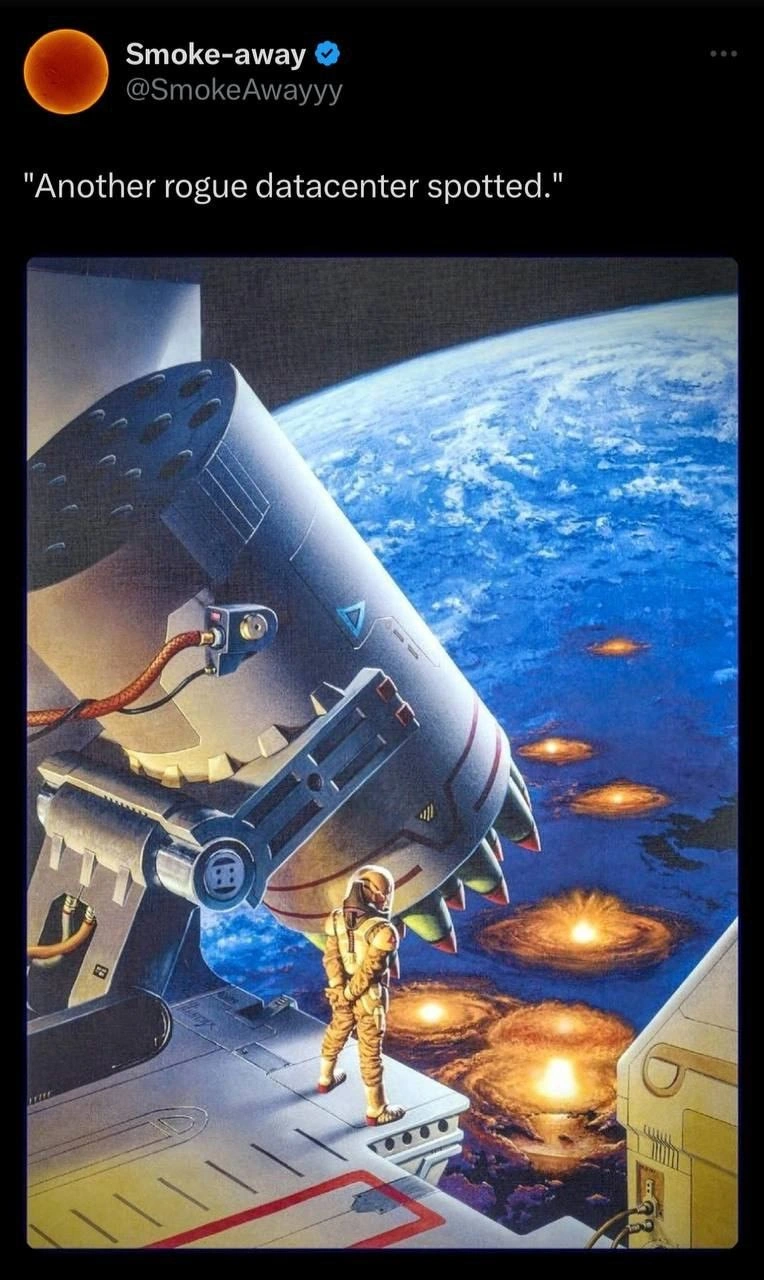
Sci-Fi Art Reimagined as a Catastrophic Rogue Datacenter Incident
Description
The image displays a screenshot of a tweet from the user Smoke-away (@SmokeAwaayyy), which reads, "Another rogue datacenter spotted." Below the tweet text is a piece of retro-futuristic science fiction art. The artwork depicts an astronaut in a golden-brown spacesuit standing on an observation deck of a space station, looking down at the planet Earth from orbit. On the planet's surface, several massive, swirling vortexes of fire and energy are visible, resembling catastrophic storms or explosions. A large, cannon-like piece of equipment is positioned on the station, pointing towards the planet. The art style is reminiscent of classic sci-fi book covers from the 1970s or 80s. The technical joke recontextualizes this dramatic sci-fi scene as a common IT problem. The fiery cataclysms on Earth are humorously labeled as 'rogue datacenters,' a metaphor for servers or cloud instances that are overheating, malfunctioning, or consuming resources uncontrollably. For senior engineers, this resonates with experiences of managing large-scale infrastructure, dealing with thermal issues in data centers, or discovering shadow IT projects that have spiraled out of control. The lone astronaut represents the on-call SRE or DevOps engineer witnessing a massive production incident that feels world-ending

Comments
7Comment deleted
That's not a rogue datacenter. That's the AWS bill after a junior dev accidentally provisioned a GPU cluster in every availability zone to train a 'hello world' model
Those glowing craters? That’s what’s left when a “temporary PoC” survives three reorgs, drifts out of Terraform state, and quietly auto-scales to the moon
When you finally get budget approval for cloud cost monitoring and discover seventeen engineering teams have been running their own "temporary" GPU clusters for the past three years
When your infrastructure team takes 'high availability' and 'geographic distribution' a bit too literally - turns out those 'edge locations' were actually in low Earth orbit. At least the latency to the ISS is finally acceptable, though I'm concerned about the blast radius if one of those availability zones experiences an unplanned reentry event
When Shadow IT achieves escape velocity: infinite scaling, zero governance, and bills that orbit the Van Allen belt
When your asset inventory needs orbital reconnaissance, you don’t have multi cloud - you have shadow IT with an unlimited blast radius
CCoE runbook: find an untagged account in an unapproved region, attach an OU‑wide SCP with "Deny:*", and close the Jira as “proactive cost optimization.”