The Great Raspberry Pi Misunderstanding
Why is this Hardware meme funny?
Level 1: Not That Kind of Pie
Imagine your friend says, “I’m bringing you an Apple.” You get all excited for a juicy fruit snack, right? But then they show up with a phone – because they meant an Apple iPhone, not the fruit. You’d probably be confused or a little bummed! That’s exactly what happened here, but with the word “pie.” The girlfriend thought her boyfriend was talking about a yummy raspberry pie you eat, like the kind of dessert you’d have after dinner. She was looking forward to a sweet treat. Instead, he meant a Raspberry Pi, which is a small computer gadget. It’s a neat little device for tech enthusiasts to play with, but you definitely can’t nibble on it for dessert.
So, in simple terms: he said a word that sounds like food, but it was actually a tech thing. It’s like hearing “cake” and getting a calculator. She expected something delicious, but got something electronic. This mix-up is funny because the same sound (“raspberry pie/pi”) led to two totally different ideas. One is a pie you bake and eat, and the other is a circuit board you plug in and code. When the package arrived, she felt disappointed – no treat for her tummy. But it’s also a bit silly and laughable once you realize the mistake. It’s a reminder that in everyday language, sometimes one word can mean very different things. In this case, the poor girlfriend learned that a Pi without an “e” isn’t dessert at all. It was not the kind of pie she hoped for, and that’s why everyone reading the tweet had a good chuckle!
Level 2: Dev Board vs Dessert
In this meme, a woman expected a raspberry pie – the sweet dessert made from the fruit – but what arrived was a Raspberry Pi, the famous miniature computer board. The joke comes from how those two phrases sound exactly the same when spoken. A Raspberry Pi (with no “e”) is a small embedded systems device, essentially a tiny all-in-one PC that electronics hobbyists and developers use for projects. It’s called a single-board computer because all the components of a computer (CPU, memory, ports, etc.) sit on one small circuit board. People use Raspberry Pis to learn programming, build robots, run home media servers, or tinker with Internet-of-Things gadgets. It’s not something you can eat, even if its name is deliciously misleading!
So what happened? The boyfriend told his partner about the delivery, and she heard the word “pie.” Naturally, she pictured a yummy raspberry-flavored pie coming out of a bakery box. Who wouldn’t? Meanwhile, the boyfriend was referring to a tech toy – likely a new model of the Raspberry Pi he ordered online. When the package came, she opened it expecting a bakery treat, but instead found a small electronic board with chips and ports. Cue the disappointment (and a bit of amusement). This mix-up is a classic case of a homophone confusion: two words that sound alike but have totally different meanings. In tech, we often borrow everyday words to name things, which leads to these comical moments.
Let’s break down the key terms and why this is funny:
- Raspberry Pi – not a pastry! It’s a popular hobbyist development board. Think of it as a complete little computer you can hold in your hand. You connect a monitor, keyboard, and power, and it can run an operating system (usually a version of Linux). Developers love it because it’s cheap, versatile, and great for experiments. The EmbeddedSystems community uses it for everything from retro gaming consoles to homemade weather stations.
- Raspberry pie – the dessert. A pie you bake in the oven, filled with raspberries and often topped with whipped cream. It’s fruity, sweet, and best served after dinner. Absolutely zero GPIO pins on this thing – unless you count how many pinches of sugar to add!
- NamingThings – This phrase refers to the challenge of coming up with clear, unambiguous names in programming and tech. Here, the tech name “Raspberry Pi” is cute and memorable to insiders, but it accidentally masquerades as a dessert to everyone else. Naming is hard because once a term leaves the tech bubble, people might take it at face value (or taste value, in this case).
The tweet is a screenshot in Twitter’s dark mode, showing the poster’s humorous realization. It resonated with a lot of folks online because it’s both a nerdy joke and completely relatable. Even if you’re new to coding or hardware, you can understand the mix-up. Many beginners learn about the Raspberry Pi as one of their first DIY tech tools – and many have had to explain to their curious family, “No, I didn’t mean pie like the food!” The humor here is good-natured: nobody did anything wrong, it’s just a funny misunderstanding. It also highlights how tech and everyday life can collide in surprising ways. When someone says a term like “server,” “bug,” or “cloud” in a normal conversation, they might not mean what a non-tech person thinks they mean! In this case, a simple delivery update turned into a memorable joke. Now she knows: raspberry_pi_vs_raspberry_pie is a real thing, and next time she’ll ask, “Computer Pi or baking pie?”
Level 3: Fruitless Expectations
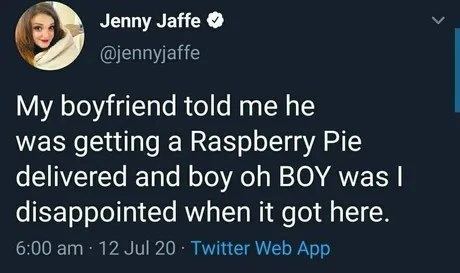
“My boyfriend told me he was getting a Raspberry Pie delivered and boy oh BOY was I disappointed when it got here.”
This tweet’s punchline lands squarely on a homophone mishap: Raspberry Pi (tech gadget) vs raspberry pie (tasty dessert). Seasoned developers immediately recognize Raspberry Pi as a famous credit-card-sized single-board computer (SBC), not something you eat. The humor is in how a bit of innocent tech jargon turns into a delicious misunderstanding. It’s a perfect example of how naming in tech can backfire outside its intended context. They say one of the hard problems in computer science is naming things, and here that problem spills into everyday life with comical results. Just a single letter “e”–the difference between Pi and pie–caused an expectation meltdown. (Yes, even one letter can trigger an off-by-one error in the kitchen!)
For a developer, hearing “Raspberry Pi is being delivered” sparks joy about new hardware: visions of hooking up sensors, installing a Linux distro, tinkering with GPIO pins, and maybe running a Python script to blink an LED. But for someone not in on the geek lingo – like the girlfriend in the tweet – it sparks dreams of flaky crust and sweet ruby-red filling. Hardware humor often arises from these mixed signals: one person’s beloved gadget is another person’s dessert disappointment. The boyfriend was likely hyped about a Raspberry Pi 4 arrival, while his partner was hyped for pie a la mode. The result? A clash of expectations that’s too real and too funny.
This kind of mix-up highlights how tech terms borrow from everyday language. Raspberry Pi itself was named to be playful – “Raspberry” following a fruit-naming tradition in computing (think Apple or BlackBerry), and “Pi” as a nod to Python and the $\pi$ number. Such naming makes tech more approachable to insiders, but it’s practically a geek trap for others. We’ve all seen similar collisions of worlds:
- Apple – could be a fruit or that phone in your pocket.
- Java – a programming language, not just your morning cup of coffee.
- Cookie – delicious snack? Or a small piece of website data stored in your browser.
- Chip – crunchy potato chip versus a tiny silicon wafer that runs your computer.
When engineers talk about these things at home, it’s no surprise family members do a double-take. This tweet blew up because it’s a relatable dev experience: the classic food vs hardware misunderstanding. Every developer with a non-tech partner or friend has had to clarify “No, not that kind of X.” It’s equal parts adorable and enlightening – a reminder that our geek humor doesn’t always translate. In the end, the boyfriend gets a nifty new programming toy, but the girlfriend is left with an empty plate. The situation is absurdly relatable, bridging techie enthusiasts and bemused onlookers. After all, nothing says “I love you” like a surprise delivery… just make sure it’s the kind of Pi(e) your loved one expects!
Description
This image is a screenshot of a tweet by user Jenny Jaffe (@jennyjaffe). The tweet reads: 'My boyfriend told me he was getting a Raspberry Pie delivered and boy oh BOY was I disappointed when it got here.' The humor stems from the classic pun and misunderstanding between the tech world and the non-tech world. The author of the tweet was anticipating a delicious dessert, a raspberry pie, but was instead met with a Raspberry Pi, a popular single-board computer used by hobbyists and professionals for electronics projects, servers, and learning programming. For developers, this is a highly relatable scenario, illustrating the amusing communication gap that can occur when industry-specific jargon leaks into everyday conversations with partners, friends, or family

Comments
17Comment deleted
The real disappointment is discovering the Raspberry Pi is for another Pi-hole to block ads, not for a Kubernetes cluster to run a needlessly complex home automation system
Always confirm whether the Raspberry Pi image you’re serving is flashed with dd or baked with butter - `dd if=raspbian.img of=/dev/plate` fails every taste test
The real disappointment is when you realize the Raspberry Pi 4 still can't handle your Kubernetes cluster dreams, but at least it won't give you a sugar crash like the pie would have
The eternal struggle of the tech household: when your partner says 'Raspberry Pie' and you're already mentally SSH'ing into GPIO pins, only to discover they meant the kind you eat with a fork. At least with actual pie, the only kernel panic is realizing there's no ice cream left
Classic naming collision: stakeholders expect dessert; platform team ships a headless ARM board - the only frosting is thermal paste, and the “baking” is flashing an SD image
Raspberry Pi: the only deployment where a typo turns infrastructure into pastry - and procurement still asks if it’s CapEx or catering
She craved pie; he delivered a 40-pin GPIO gateway to homelab heaven - priorities decoded
ofc Comment deleted
Did she get A: food item B: circuit board ? Comment deleted
I assumed B but maybe that's sexist of me to assume the boy is the one using computer Comment deleted
She said pie, not pi. That answers the question pretty clearly. Comment deleted
The girl is not a mathematician either. 🤓 Comment deleted
In english speech pi and pie is not different Comment deleted
Yes, but this is a tweet. She wrote itm Comment deleted
"Come and See" Comment deleted
Fast n"; DROP TABLE bots Comment deleted
you forgot -- at the end Comment deleted