Programming: The Ultimate Life Hack
Why is this MentalHealth meme funny?
Level 1: Life in One Basket, Tech Basket đ˘
Imagine you have a big plate of your favorite cookies, but you also have veggies you should eat. Instead of trying to balance eating both, you just throw away all the veggies so you only have cookies. That might sound awesome at first â no veggies, no complaints, right? â but pretty soon youâre going to feel sick from only eating cookies and miss out on the vitamins from the veggies. This meme is kind of like that, but with life and work instead of cookies and veggies.
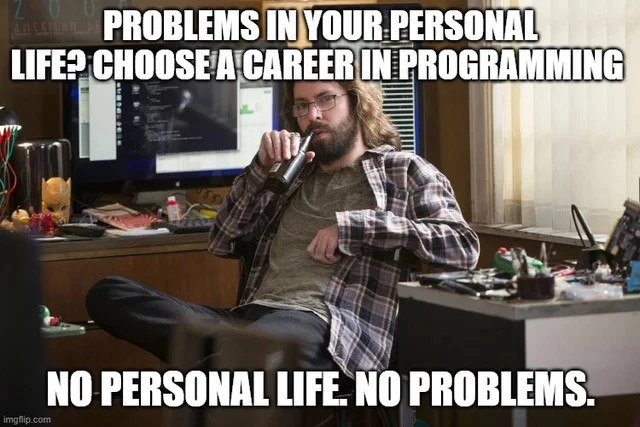
Itâs making a joke that goes like this: âAre your personal life problems bugging you? Well, you could become a programmer and then you wonât have a personal life at all. If you have no personal life, voila â no personal problems!â In super simple terms, itâs like saying if you donât want to deal with any drama or chores or tough stuff outside of work, you can just work all the time and not do anything else. Then you wonât have friend problems or family issues⌠because you wonât be spending time with friends or family at all! đ
Why is that funny? Itâs using silly extreme logic. Itâs like a friend joking, âHey, if school is giving you a hard time, just drop out and youâll never have homework again!â You know thatâs not serious advice â itâs an exaggeration to make you laugh at how ridiculous it sounds. In real life, if you ignore everything except one thing (like only work and no play), you end up with a whole new set of problems. Youâd get lonely, tired, and probably sad.
So the meme is funny in a kind of dark, laugh-at-ourselves way. It shows a programmer guy lounging at his messy desk, basically living at his computer. The text jokes that by being like him â having virtually no life outside of programming â you wonât have any personal troubles. Itâs a bit like saying, âIf having plants is too much responsibility, just donât have any plants, then they canât die on you.â True, but then you live without any plants, which is kinda bleak.
In the end, the joke is on the idea of escaping problems by avoiding life. People who see this meme laugh because itâs an absurd solution. It reminds us that burying yourself completely in work (or in any one thing) just to avoid real-life issues is a goofy idea. Itâs poking fun at the stereotype of a programmer who only codes and does nothing else. We giggle because itâs a little true for some folks, but we also know itâs not a healthy or real answer. The humor comes from that little sting of truth wrapped in a goofy, over-the-top suggestion.
Level 2: The New Coderâs Reality Check
For someone newer to the tech world, let's decode what's going on here. The meme is using humor to point out that programmers often end up with poor work-life balance â meaning they spend so much time working (or coding) that they have little time left for a personal life. The text on the image says: âProblems in your personal life? Choose a career in programming. No personal life. No problems.â It's joking that if you become a programmer, you'll be so occupied with work and coding that you effectively won't have a personal life outside of it. And if you have no personal life, well, then you won't have any personal life problems either! It's an extreme, funny way to suggest that immersing yourself in a programming career could "solve" personal issues by making you too busy (or too socially disconnected) to have any.
The picture reinforces this idea. It shows a stereotypical developer at his desk. Let's paint the scene: Heâs casually dressed (t-shirt, flannel shirt open over it â the Silicon Valley tech uniform đ). Heâs slouched in his chair with a kind of meh posture, feet propped up. This isn't a neat, tidy office space; it's cluttered with all the hallmarks of intense tech work and long hours:
- Multiple monitors: He has two screens up, one with dark-themed code and another with what looks like a terminal or an IDE (Integrated Development Environment) window. Many programmers use dual monitors to multitask â maybe one screen for coding, one for testing or documentation. The dark theme is a common choice among developers for less eye strain (and let's admit, it looks cool).
- Cables and gadgets: The desk has cables strewn about and some half-open electronic devices or components. This suggests he's not just writing software but possibly fiddling with hardware too (typical of a geek who might be into side projects like Raspberry Pi, Arduino, or building a custom PC). A messy tangle of wires is practically a badge of honor in some developer circles â it shows you're deep in the trenches with tech.
- Energy drinks / soda cans: You mentioned soda cans; wouldn't be surprising if there's an energy drink or coffee cup in there too. These fuel late-night coding sessions. It's a stereotype that developers guzzle caffeine and forget to eat proper meals when they're in the zone. Those cans indicate he's been camped at that desk for hours, maybe debugging or binge-coding.
- Beer bottle on the desk: Actually, it looks like he might be holding a bottle (possibly beer) in the image. Some tech companies have pretty casual environments â a beer after deploying a big feature, or during a late-night work session, isn't unheard of. It also signifies that the line between work time and personal relaxation time is blurred here. Heâs essentially having a drink while at work (or working while others might be relaxing). It's a bit of the âwork hard, play hardâ vibe, except heâs doing both at the desk.
Now, about that character: if you've heard of the show Silicon Valley, it's a comedy series about programmers in a start-up. The guy in the meme image is Gilfoyle from that show, known for being a brilliant systems architect with a sarcastic, nihilistic attitude. He often looks exactly like he does in the meme: chilled out, somewhat disengaged on the surface, but practically living in the tech world. The meme leverages this TV reference because Gilfoyle embodies the trope of the programmer who doesn't give much care to the outside world beyond his code and his close circle of colleagues. If you havenât seen the show, no worries â just know he's portrayed as a super-techie who can be a bit of a slacker in appearance but is extremely competent technically. Using him is a shorthand that seasoned viewers will instantly get: "Oh, it's that hardcore programmer dude who probably would joke about having no personal life."
Why is this funny to developers? It's playing on a shared joke that many programmers (especially those who have gone through intense periods of coding) can relate to: spending so much time coding or dealing with tech stuff that you end up ignoring your social life, hobbies, or sometimes basic daily routines. Newcomers in tech might not have felt this yet, but it's common to hear about:
- All-nighters or overtime: Crunching code through the night to meet a deadline or fix a critical bug. New developers might experience their first all-nighter when a college project is due or when a production bug pops up at their first job. Itâs almost a rite of passage in some places (for better or worse).
- âPassionâ projects eating up free time: Many programmers are genuinely passionate about coding. When you're learning a new language or framework, it's easy to get obsessed and spend your evenings and weekends on tutorials, pet projects, or contributing to open source. Suddenly, you realize you haven't gone out or talked to non-coders in weeks. Oops!
- On-call duty: In many software jobs, especially if you're working on a live product or service, developers rotate being "on-call." That means if something breaks at an odd hour, you might get a phone call or alert and have to jump on your laptop to fix it. Imagine being a junior dev and the first time you carry the on-call phone, it buzzes during Sunday dinner with friends â you rush off to handle a server outage. Your friends give you that really? look. Thatâs how a job can intrude on personal time.
The meme exaggerates this culture to the extreme: "No personal life at all." Of course, thatâs not literally true â most programmers do have families, friends, and outside interests. But it's poking fun at the tendency of the career to become all-consuming. There's even a bit of wordplay here reminiscent of a common saying in tech circles, "Works on my machine," used jokingly to avoid blame for a bug. Here, the phrase "No personal life. No problems." has that same blunt, overly simplistic tone. It's obviously not a healthy or desirable solution, and that contrast is what makes it funny. Youâd never see a serious WorkLifeBalanceTips article saying "Just eliminate your personal life" â thatâs terrible advice! The humor comes from the fact that itâs so over-the-top that it highlights the underlying issue (programmers struggling with balance) in a sarcastic way.
Let's clarify some terms and tags mentioned:
- Work-life imbalance: This is the opposite of work-life balance. It means work takes up so much of your time and energy that there's almost nothing left for "life" â like family, rest, hobbies, or social activities. The meme is a prime example of work-life imbalance: the guy in the picture essentially has made work his life.
- DeveloperBurnout (burnout): Burnout happens when someone is overworked and stressed for a long time, leading to exhaustion, cynicism, and a drop in performance. In tech, burnout is a known problem because of long hours and high stress. The joke "no personal life, no problems" hints at burnout culture â you solve life's problems by over-immersing in work, which actually can lead to burnout. Itâs like curing a headache with a hammer; you wonât feel the headache, but youâve caused a bigger issue.
- MentalHealthInTech: This tag indicates the meme touches on mental health topics in the technology field. Behind the humor, there's an acknowledgment of the mental health aspect â isolating yourself with work can be a sign of or a setup for mental health struggles (like depression or severe stress). Experienced devs share these memes partly to say "yeah, this job can mess with your head/life balance, watch out."
- Career_HR: This category suggests the meme is also about career choices or human resources themes. HR might use the term "work-life balance" a lot when recruiting, but here the meme is darkly joking about the opposite. Itâs almost a satirical "recruitment poster" â obviously not one HR would really put out! If an HR department actually said "Join us, you wonât have a personal life!", they'd scare people away. Instead, they usually promise good balance; the meme cracks a joke that the reality can be different.
- DeveloperProductivity: On the surface, eliminating your personal life might make you think you'd be more productive (since all you do is work). Some hustle culture folks even believe that for a while. But in reality, productivity can tank if you're exhausted or unhappy. The tag is highlighting that this meme deals with the myth of productivity through self-sacrifice. It's a commentary: a programmer with no life might crank out code quickly for a bit, but they'll eventually hit a wall. Yet, it's a trap many fall into, especially when trying to prove themselves in a new job or startup.
For a junior developer or someone just learning to code, this meme is a cautionary joke. Early in your career, it's easy to think you have to dedicate every waking moment to learning new technologies or pushing out projects to catch up with the ever-evolving field. The meme exaggerates that impulse: "Just give up everything else, it's fine!" Itâs saying donât actually do this in a tongue-in-cheek way. Remember that even if programming is your passion, balance is important. Having downtime and a life outside of coding often makes you a better, happier programmer in the long run.
Finally, notice the tone: it's sarcastic and dry. The line "No personal life. No problems." is delivered as if it's a straightforward solution, which makes it ridiculously funny because we all know it's not a real solution â it's an obvious problem itself! This kind of humor is really common in developer communities (like subreddits, forums, or Slack channels) where folks blow off steam by joking about the tough parts of the job. It's relatable developer experience packaged as a meme: a quick visual joke that says, "Yeah, I've felt like this â might as well laugh so I don't cry."
In short, this meme uses an exaggerated scenario to highlight a real issue in tech: working so much that you have no life outside work. It resonates with developers because it takes a grain of truth and blows it up into a dark joke. If you're new to the field, take the laughter as a friendly warning: donât let coding consume you completely. đ Enjoy programming, but keep your life too â that way, you'll have good problems (like which friends to hang out with or which hobby to pursue this weekend) instead of just whether that code compiles at 3 AM.
Level 3: Burnout by Design
At the highest level, this meme hits on a brutally familiar anti-pattern in tech culture: solving problems by nuking the entire problem domain. Personal issues bringing you down? Simple: delete your personal life altogether by becoming a programmer. It's a spicy echo of the old programmer joke "No code, no bugs" â here it's "No personal life, no personal problems." The top caption sets up a tongue-in-cheek "recruitment ad" for programming as if it's a miraculous escape from life's messiness. The punchline at the bottom delivers the dark twist: once you're absorbed in coding 24/7, you won't have time for any personal life drama. Problem solved, right? đ¤ˇââď¸
Look closer at the image: a scruffy developer lounges back in a chair, monitors glowing with code. The desk is a wasteland of tangled cables, soda cans, and maybe a half-finished hardware project â basically a messy dev workspace in its natural habitat. There's even a beer bottle in hand (or on the desk), signaling this coder might be pulling a late one or celebrating a deploy in true Silicon Valley fashion. In fact, the photo is a reference to HBOâs Silicon Valley TV series, which famously satirizes start-up life (context check: that bearded dude exuding can't-be-bothered vibes is Gilfoyle, the patron saint of tech cynicism). Using Gilfoyleâs image amplifies the memeâs tone: world-weary, sardonic, and all too comfortable with the idea of sacrificing normal life for code.
Why is this combination so devilishly funny to experienced developers? Because it's uncomfortably relatable. The software industry has a long history of glorifying the workaholic programmer â the kind who codes all night fueled by caffeine, code, and questionable life choices. We've all known (or been) that engineer who boasts about admits to spending more weekends in the office or in front of a text editor than with actual living humans. The humor arises from a kernel of truth: being a programmer can indeed consume your life if you let it. Deadlines, production outages, the endless learning curve of new tech â it can feel like a black hole pulling in every free hour.
This meme riffs on that common experience with dark irony. It's basically a techie spin on "escaping your problems by drowning yourself in work." Work-life imbalance is the scourge lurking behind the joke. The industry talks a big game about Work-Life Balance, but in practice, many developers end up with Work Life Work-Work Balance. Long hours are often worn as a badge of honor (the classic "crunch mode"). Startups dangle the promise of changing the world, but the unspoken fine print is "you won't have much of a life outside the codebase while doing it." It's a revelation every senior dev learns: when the sprint runs endless and the pager keeps buzzing at 3 AM, your social plans donât just get de-prioritized â they get outright garbage-collected.
Let's break down the implied algorithm of the meme in coding terms for fun:
// "No personal life, no problems" in code form:
if (programmer.personalLife === null) {
console.log("No personal life. No problems.");
}
Itâs a satirical snippet, of course â in real life, setting personalLife = null is a recipe for burnout. But the quip resonates because so many of us have been there, joking about our nonexistent lives outside of commit logs and bug trackers. The meme is essentially doing a stack trace on developer burnout culture.
- Real-world scenario 1: The On-Call Abyss â You just got home on Friday night, ready to relax, when your phone blows up with a production outage. Goodbye, plans. Hello, SSH into servers until dawn. Personal life? FileNotFound.
- Real-world scenario 2: Perpetual Crunch â That big release is 3 days away, and what was supposed to be a normal week has morphed into 12-hour days and a code marathon through the weekend. Your friends stop asking if youâre free to hang out because they already know the answer.
- Real-world scenario 3: Passion or Pressure? â You love coding so much you turn your "hobby hours" into more coding. Or your boss keeps piling tasks because youâre the "passionate" one. Either way, the lines between work and personal time blur until they practically disappear.
These patterns are so prevalent that they're almost industry memes themselves. The joke, "No personal life, no problems," lands with a smirk and a wince because itâs a coping mechanism wrapped in humor. In the tech world, commiseration often comes as laughing through the pain. Seasoned devs have traded war stories of 3 AM deploy disasters and missed birthdays. It's a shared understanding: yes, we chose a career that's mentally stimulating and developer productivity can be rewarding, but it often demands chunks of our life as tribute.
There's also an implicit commentary on mental health: rather than face the problems in your personal life, it's sometimes tempting to retreat into the comfort of code. After all, code is logical and predictable (until it's not), whereas life... life is messy. That messy desk in the image? Itâs a reflection of the messy life left on the backburner. The meme highlights how developer burnout and isolation can creep in under the guise of "productivity" or "career hustle." The absurd solution offered â just eliminate your personal life â is funny because it's obviously not healthy, yet many in tech have unintentionally followed that path at times.
Historically, this trade-off has been ingrained in tech culture. Think back to the early days of Silicon Valley or the gaming industry: crunch time was normal, 80-hour weeks expected. The stereotype of the lone coder living on pizza and Mountain Dew exists for a reason. Over decades, we've slowly started acknowledging the cost: developers hitting burnout like brick walls, mental health crises, and top talent leaving lucrative jobs in search of a life that actually feels like living. Companies now (at least the enlightened ones) talk more about MentalHealthInTech and sustainable productivity. But this meme jabs at the lingering truth: a lot of devs still end up sacrificing their personal time as if it's the only way to succeed.
In true cynical veteran fashion, there's a bittersweet laugh here. The meme basically says, "Hey, at least if I have no life, I can't screw up my life, right?" It's mocking the flawed logic we sometimes use to justify overworking. And we laugh because we've seen brilliant colleagues, or ourselves, tumble down that rabbit hole. The humor is a little self-deprecating too: it's us developers acknowledging our own tendency to get obsessed with coding problems to the detriment of everything else. It's a wry nod to the relatable developer experience where personal appointments get missed because you were deep in debugging, or you realize you haven't spoken out loud all day because you've been in the zone with your code and your Spotify.
So the senior perspective on this meme recognizes both the joke and the cautionary tale. It's funny, yeah, but it also highlights a very real industry problem. We chuckle, but also maybe sigh a bit, remembering the times we unironically lived that meme. It's a classic example of developer humor that uses exaggeration to shine light on a work culture issue. No personal life, no problems? Sure, and if you remove all features from the app, there'll be no bugs either â but then, whatâs the point? The seasoned dev knows that eliminating the problem by eliminating the whole context is a tongue-in-cheek way to say: maybe this isnât the healthiest solution. In other words, the meme is laughing at the fact that too many of us have effectively tried this "solution", to our own detriment. The veteran coder in me smirks at the memeâs wit, but also wants to pat the younger devs on the shoulder and say, "Funny, yes. But seriously, take a day off once in a while, kid."
Description
A meme featuring the character Bertram Gilfoyle from the TV show 'Silicon Valley'. He is depicted with long hair, glasses, and a beard, wearing a plaid shirt over a t-shirt. He is slouched in a chair at a cluttered desk with computer monitors and electronics, casually drinking from a beer bottle. The meme has bold, white, all-caps text at the top and bottom. The top text reads: 'PROBLEMS IN YOUR PERSONAL LIFE? CHOOSE A CAREER IN PROGRAMMING'. The bottom text provides the punchline: 'NO PERSONAL LIFE. NO PROBLEMS.'. The image satirizes the intense, all-consuming nature of a programming career, suggesting that the demanding work culture eliminates personal life, thereby 'solving' any problems associated with it. It's a dark but relatable joke for many in the tech industry who have experienced burnout or a poor work-life balance. An 'imgflip.com' watermark is visible in the bottom left corner

Comments
7Comment deleted
They say to separate work and life, but in this field, your personal life just becomes another low-priority ticket that you'll get to 'in the next sprint'
I finally achieved work-life balance by renicing the âlifeâ thread to +19 - hasnât been scheduled since 2008, but productionâs hitting 99.999% uptime
After 20 years in tech, I've finally achieved perfect work-life balance: my git commits are my diary entries and my merge conflicts are my only relationship drama
The classic engineering solution: can't debug your personal life if you've optimized it out of existence. It's like running `rm -rf ~/social_life` and wondering why your relationship tests keep failing - turns out you deprecated the entire module. At least your code compiles, even if your dating life returns null
Personal life in programming: a deprecated module we aggressively tree-shook out of the bundle
Choose programming: your personal life becomes a deprecated microservice behind a permanently open circuit breaker - PagerDuty guarantees 99.99% solitude
Product finally approved a scope cut - sunset the life microservice; SLOs green, morale red