When your mental thread pool refuses the PTO interrupt flag
Why is this MentalHealth meme funny?
Level 1: Vacation? What Vacation?
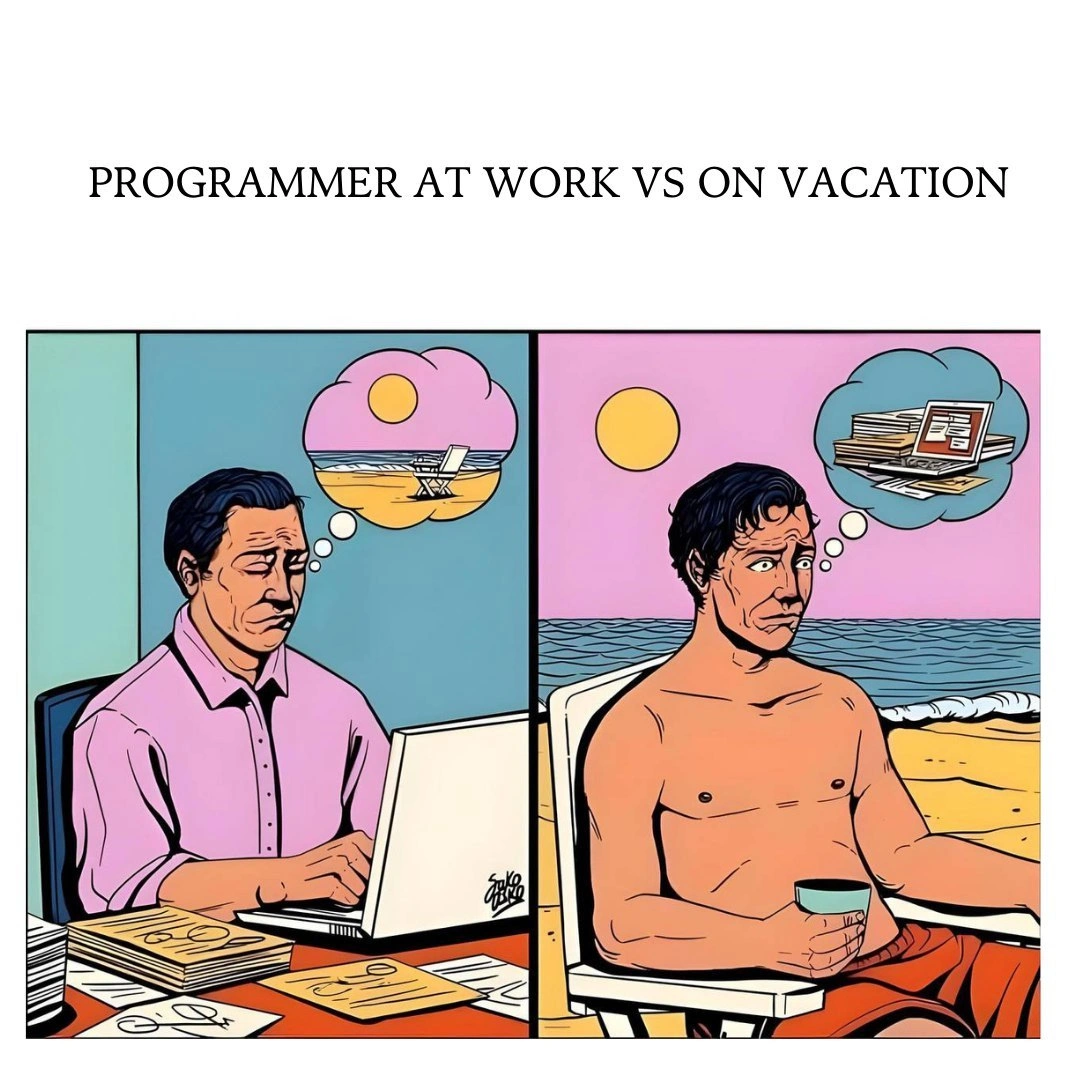
Imagine you’re playing outside on a beautiful sunny day, but all you can think about is the homework you have to do. Kinda ruins the fun, right? That’s exactly what’s happening in this picture. In the first scene, the man is at work wishing he were relaxing under the sun at the beach. But in the second scene, when he actually is at the beach, he’s sitting there worrying about all his work piled up back at the office! It’s a funny opposite situation: when he’s working, his brain is on vacation; when he’s on vacation, his brain is back at work.
This is humorous because we all know the feeling of not being able to stop thinking about something. It’s like when you try to take a break, but your mind keeps reminding you of that one thing you haven’t finished. The poor guy on vacation should be building sandcastles or swimming, but you can see on his face he’s distracted, imagining his desk with all the papers on it. It’s as if his brain refuses to take a vacation with him.
Anyone can relate to this feeling a little bit – like if you’ve ever gone on a holiday but were too worried about your pet at home or an upcoming exam to enjoy it. The meme is poking fun at how sometimes people just can’t relax, even when they’re in the most relaxing place. For a programmer (a person who writes computer code for a living), this often happens because they have a lot of responsibilities and problems to solve in their head. It’s a silly image that says: “What good is a vacation if you bring all your worries with you?” The best part is we can laugh at the exaggeration (nobody actually sees floating paperwork while on a beach), and maybe remind ourselves to really let go when we take time off. After all, a vacation is supposed to be a vacation, not just a change of scenery to do your worrying in!
Level 2: Thread Pools & PTO
Let’s break down the technical jargon and scenario in simpler terms. The meme shows a programmer in two situations: at his desk and on vacation. When he’s at his work desk, he’s daydreaming about being on vacation (thinking of a beach scene). When he’s actually on vacation at the beach, he can’t stop thinking about work (his thought bubble shows stacks of work papers and his laptop). This role-reversal is the joke. Now, the title mentions a “mental thread pool” and a “PTO interrupt flag,” which are analogies mixing computer terms with real life:
A thread pool in computer science is a tool that manages a bunch of worker threads (mini-tasks) that can run in parallel. Imagine a restaurant kitchen with multiple chefs (threads) ready to cook tasks that come in. In the meme, the “mental thread pool” means the developer’s brain is running many thoughts at once, like multiple threads. Some of those threads are work-related thoughts that keep running in the background of his mind.
PTO stands for Paid Time Off – basically your vacation or leave from work. Saying “PTO interrupt flag” humorously combines the idea of taking time off with the idea of an interrupt flag. An interrupt flag in programming is like a little signal that says “stop what you’re doing” or “pause now.” For example, a running task might be asked to stop early if some condition is met, often by setting a flag that the task checks regularly. So a “PTO interrupt flag” is a made-up concept where taking vacation would set a flag to interrupt (halt) all work-related thinking.
So, putting it together: “when your mental thread pool refuses the PTO interrupt flag” means when your brain’s busy work threads refuse to stop even though you’re on vacation. It’s like telling all the little workers in your head “hey, break time!” and they all say “Nope, we’re carrying on with work.” The left image shows he wants a break; the right image shows that even during the break, his brain didn’t get the memo and is still stuck on work mode.
Why does this happen? In real life, many developers (especially those very dedicated or stressed) have a hard time unplugging from work. Work-life balance can be tricky in tech. People might have ongoing projects or issues that are hard to forget about. If you’ve ever had a school assignment or personal project that you kept thinking about even on a weekend, you know the feeling. Here the project is represented by those files and laptop in the thought bubble on the beach. The term context switch is useful here: a context switch is when you shift your focus from one thing to another. For computers, switching contexts (between threads or processes) has a cost – it’s not instant. Similarly for humans, switching from “work mode” to “vacation mode” can take a while. If your mind is still processing unfinished tasks or worrying about something at work, it won’t immediately go quiet just because you flew to a beach. That’s the context_switch_overhead in human terms – the mental lag and effort to change gears.
The meme also hints at the on-call mindset. Some developers work in roles where they might be responsible for fixing urgent issues even during off hours – we say they are “on call.” Over time, this can train a person to always be a bit alert or anxious that the phone might ring with a problem. Even if you’re not literally on call, you might feel responsible for your code or servers. So on vacation, you might still check your email or think “Did I push that fix correctly? What if something goes wrong when I’m away?” This leads to anxiety and difficulty relaxing. It’s a common contributor to developer burnout – when you burn out, you’re exhausted and lose motivation, often due to chronic stress and never mentally resting.
The categories like MentalHealth and DeveloperProductivity are tied in here. Mental health advocates in tech often talk about how important it is to really disconnect and recharge during your time off. If you never let your mental “threads” rest, you can end up frazzled or depressed. Productivity can actually DROP if you don’t take genuine breaks. The meme exaggerates the scenario to make us laugh, but it’s pointing at a real issue: a lot of developers just struggle to relax because their mind is still at the office.
The comment "You guys leave hotel room when on vacation?!" is another joke implying that some developers don’t even bother going to the beach at all – they’ll travel somewhere for vacation but then stay in the hotel (perhaps glued to a laptop). It’s tongue-in-cheek, but it underscores the same point: people in this field often have a hard time stepping away from work completely. Whether it’s due to personal work ethic, imposter syndrome (worrying about not doing enough), or company pressure, many devs feel like they should be doing something productive even during downtime. So the meme is very relatable to anyone who’s caught themselves “doom-scrolling” through work emails on what’s supposed to be their day off.
In summary, at this level we understand the meme as a funny depiction of a software developer who can't stop thinking about work. It uses the language of developers (threads, interrupts, PTO) to highlight a work-life balance problem. If you’re a junior dev or someone just getting into tech, know that this is a shared joke – even experienced engineers struggle with balancing their passion or responsibility for work and their need to rest. And the advice hidden in the humor? Try to really let your brain unplug on vacation (don’t be like the meme guy if you can help it!). It’s healthier and you’ll come back more productive.
Level 3: Jira on the Beach
Stepping down to a senior developer’s perspective, the meme captures an all-too-familiar irony of tech life: when we’re at work, we daydream about escaping to a sunny beach, but when we finally are on that beach, cocktail in hand, our mind drifts right back to work. In the left panel, the programmer at his desk has a thought bubble of a tranquil ocean scene – the classic office reverie of PTO bliss. In the right panel, he’s physically on vacation (shirt off, sitting by the actual ocean), yet his thought bubble is filled with piles of paperwork and an open laptop – essentially his sprint backlog or ticket queue following him to paradise. It’s a hilarious and painful role reversal: the office-bound self imagines freedom, the free self imagines the office.
Why is this so funny and relatable to developers? Because many of us have been there. You finally take that much-needed PTO, but a part of you just can’t let go of the project deadlines, the code you shipped last week, or the impending release. The meme is poking fun at the always_on_call_mindset prevalent in tech culture. In many teams, especially if you’re a senior or a key player, you develop a constant background awareness of your systems – a little mental daemon process that’s always running checks like “Is production okay? Did I handle that Jira ticket? What if there’s an incident?” Even when you’re theoretically “off the clock,” your brain doesn’t have an off switch. This is the "cannot_unplug" phenomenon at the heart of DeveloperBurnout and DeveloperAnxiety narratives.
The visual gag of seeing a stack of files and a laptop in the beach thought-bubble is basically depicting Jira on the beach – the backlog is invading his vacation brain space. It’s exaggeration, of course (most of us don’t literally hallucinate Jira tickets hovering over the waves), but it feels true metaphorically. How many times have you found yourself checking email or Slack “just for a minute” during a holiday, or mentally debugging an issue while you’re supposedly building sandcastles with your kids? The joke lands because it reflects a real imbalance: work is mentally pervasive. Modern corporate culture often praises hustle and dedication, but the flip side is that employees end up internalizing their work to the point where they struggle to detach.
There’s also a bit of dark humor in the caption and the top text. The meme title itself – “When your mental thread pool refuses the PTO interrupt flag” – is phrased like a bug report. It humorously diagnoses the condition of being unable to relax as if it were a concurrency bug in one’s brain. This is something a senior dev with too much on their plate might joke about at 2 AM on Slack: “My brain’s thread pool won’t shut down, I’m on vacation and still thinking in Kanban cards.” The all-caps heading “PROGRAMMER AT WORK VS ON VACATION” in the image sets up a comparison that underscores the twist: a programmer’s WorkLifeBalanceTips often fail because their mind isn’t following the plan.
From an CorporateCulture angle, this meme also jabs at companies that encourage vacation in principle but still have an environment where people feel guilty or anxious for taking time off. If you’re the only one who knows a particular legacy system (a common plight of senior engineers), good luck truly relaxing – you might get a “quick question” ping or just anxiety wondering if things are on fire. The commenter’s joke, “You guys leave hotel room when on vacation?!”, perfectly encapsulates this tongue-in-cheek: some of us end up staying tethered to our laptops even in lovely destinations, effectively never leaving the “hotel room office.” It’s a bit of gallows humor among devs: we joke that PTO stands for “Pretend Time Off” when you’re in a bad crunch culture. Everyone laughs, but also sighs, because the struggle to disconnect is real.
In essence, the meme resonates on a senior level because it highlights the context_switch_overhead between work and rest. Seasoned devs know that context-switching isn’t just a CPU thing – human brains also pay a price when switching from sprint planning mode to relaxation mode. If your brain has a lot of in-flight threads (production issues, code concerns, upcoming features), trying to abruptly swap to “idle” state can be jarring. Often, we carry that background load with us for days into a vacation. The humor has an edge of truth: it’s pointing out a collective foible in the developer community – the inability to truly unplug, which is both a personal habit issue and a systemic issue with how tech work is structured. And it’s developer humor at its finest because it uses our own jargon (threads, interrupts, pools) to describe our pain. We laugh, perhaps a bit ruefully, because we see ourselves in that poor guy on the beach, sun on his skin but Jira on his mind.
Level 4: Deadlocked on PTO
At the most technical level, this meme is a clever play on operating system and concurrency concepts, using them as metaphors for the developer’s mental state. The phrase "mental thread pool refuses the PTO interrupt flag" frames the brain as a multitasking runtime where threads (thought processes) are running work tasks and ignoring a request to pause for vacation. In computing, a thread pool is a collection of worker threads that efficiently handle tasks. Threads can often be signaled to stop or interrupted – e.g., by setting an interrupt flag – but if the threads never check that flag or if they’re executing non-interruptible code, they won’t stop. Here, the developer’s internal “threads” are like stubborn background processes that ignore the interrupt, i.e., they keep crunching on work thoughts despite the Paid Time Off (PTO) signal to stand down.
This situation is analogous to a high-priority process that refuses to yield CPU time. In OS terms, it's as if the brain’s scheduler cannot preempt the work-focused threads with the "relaxation" thread. We might say the developer’s mind is experiencing a kind of deadlock or livelock: the “relax and enjoy vacation” operation is waiting for the work tasks to finish or release resources (like mental energy and attention), but those work tasks have entered an endless loop. Imagine a loop in code that doesn’t check for a stop condition:
bool ptoInterrupt = false;
void brainThread() {
while (!ptoInterrupt) {
workOnBacklog();
// This thread never checks ptoInterrupt, so it never stops working.
}
}
The PTO interrupt flag is set (meaning, "hey brain, we’re on vacation, stop thinking about work"), but each mental thread just barrels on with workOnBacklog() because it’s not coded to respond. The developer’s mind lacks a proper cancellation mechanism. In many programming frameworks, threads or tasks require cooperative cancellation – the code running in the thread has to periodically check an interrupt flag or token and gracefully exit if it’s set. If it doesn’t, the thread will continue indefinitely, much like our engineer on the beach still obsessing over Jira tickets. It’s a classic case of a non-preemptive multitasking nightmare: the tasks won’t stop unless they decide to stop.
We can also see a hint of context switch overhead in the scenario. In computer architecture, switching contexts (from one thread/process to another) is expensive – it involves saving state, flushing caches, loading new state, etc. Similarly, for a brain heavily loaded with work-context, completely unloading that and loading "vacation mode" isn’t instantaneous or easy. If the mental threads are constantly active with work, the “vacation” context might keep getting evicted from the cache. The result is a thrashing mental CPU that stays in work mode. There might even be a priority inversion: the low-priority relaxation thread can’t run because the high-priority work threads hog all the cycles, effectively starving the vacation mindset. The poor developer’s brain is like a server that’s technically in idle mode but still running a bunch of daemon processes doing background computation (or in this case, background worry).
In summary (for those of us fluent in tech-speak), the meme humorously depicts a scenario where the brain’s operating system fails to context-switch to “vacation mode” because of an internal scheduling bug. The interrupt to stop thinking about work is masked or ignored, leading to a runaway process of anxiety. It’s a nerdy way to say the guy cannot mentally disconnect from work, rendered in terms of threads and interrupts. And any engineer who’s dealt with unkillable threads or processes (those that laugh in the face of kill -9 or ignore a Thread.interrupt()) will smirk at the parallel: sometimes our brains are just as stubborn as a rogue thread that won't shut down, exhausting system resources (in this case, mental energy) and leading to a figurative kernel panic in our work-life balance.
Description
Two-panel comic with headline text, “PROGRAMMER AT WORK VS ON VACATION,” in all caps. Left panel: a formally dressed programmer types on a laptop at a cluttered desk covered with paper stacks; a thought bubble shows an idyllic beach chair under a blazing sun. Right panel: the same person, now shirtless and sipping coffee on an actual beach, stares ahead while a thought bubble shows the very same piles of paperwork and an open laptop. Bright pop-art colors, thick outlines, and simplified shading emphasize the ironic role reversal: at the office the dev fantasizes about the ocean, yet at the ocean the dev visualizes the sprint backlog. The meme riffs on senior engineers’ perpetual context-switching, inability to detach from Jira tickets, and the cognitive load of always-on incident mental models - even during PTO

Comments
16Comment deleted
Turns out PTO is just a soft delete - the GC keeps your mental backlog in the retained heap
After 15 years of debugging production issues, I've learned that the only difference between a beach and my desk is the sand gets everywhere instead of just in my code's error handling
The real tragedy isn't that we think about code on vacation - it's that we've optimized our beach time with the same efficiency as our CI/CD pipelines, yet somehow both still feel like they're in perpetual 'pending' state. At least the beach has better uptime than our staging environment
PTO follows CAP: you can be consistent with disconnecting or available to PagerDuty - but partition tolerance is mandatory
Work: O(1) beach daydream. Vacation: infinite loop of ghost PRs and hotfixes
Set PTO=true, but the brain’s scheduler pinned Jira to a hot core - apparently those thoughts ship with a no-preempt flag
You guys go on a vacation? Comment deleted
You guys work? Comment deleted
Come on you guys... Comment deleted
You guys leave home? Comment deleted
Guys... Comment deleted
You work in tech and you are still guys? Comment deleted
They became gays Comment deleted
There are two genders Comment deleted
Vacations for me is work on my personal projects hahahahha Comment deleted
go work(loudly)!!! Comment deleted