Skip to content
DevMeme
4343 of 7435
Image not processed
Post #4749, on Aug 9, 2022 in TG

Image not processed

Why is this developer meme funny?

Level 1: Dirty Work

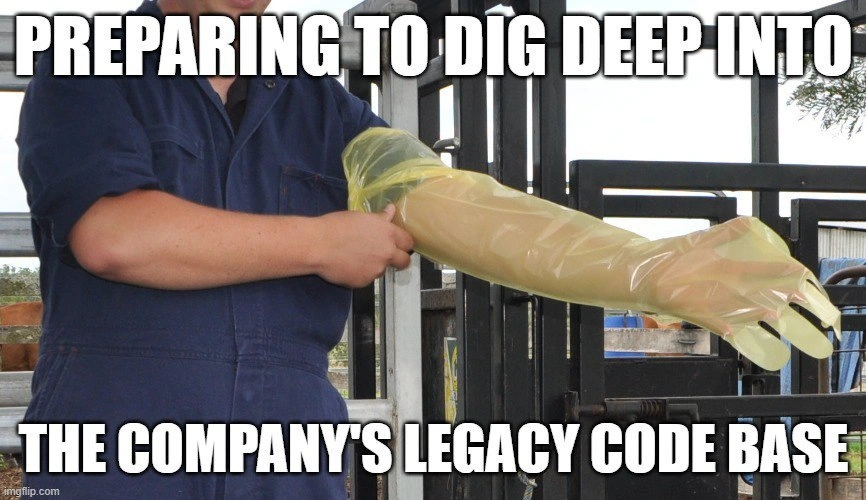
Imagine you have to clean up a really messy room that hasn’t been touched in years – trash everywhere, mysterious sticky spots, and a smell that makes you cringe. You’d probably put on some gloves and maybe even a face mask before diving in, right? That’s exactly the feeling this picture is joking about. It shows someone putting on a huge glove, like they’re about to do a gross chore. The words say they’re getting ready to go deep into the company’s old computer code. The funny idea is that working on old, messy code is as unpleasant (and as tricky) as sticking your arm into something yucky. It’s a silly comparison: coding is usually just typing on a keyboard, but here it’s compared to literally cleaning up after a large animal! We laugh because we know coding isn’t actually smelly or slimy – but old code can be a big mess in its own way, full of confusing bits. So just like you’d gear up to handle a dirty job, a programmer mentally gears up (glove and all) to face the ugly, tangled older code. In simple terms, the meme is saying: “Fixing this old code is gonna be gross and hard, so I better prepare myself!”

Level 2: Old Code, New Headaches

Let’s break down what legacy code means and why developers find this meme funny. A legacy codebase is basically an old software project that’s still in use but was written a long time ago (often by other people, possibly using outdated practices or tools). Over years, many quick fixes and features were piled on, which creates something we call technical debt – imagine it like shortcuts or “loans” the original programmers took to save time, but now those shortcuts make the code confusing and risky to change (the “interest” on the loan has come due). Working in such a codebase can be tricky: the code might not follow modern code quality standards, and it often lacks proper refactoring (clean-ups of the code’s structure). For example, you might find one giant function doing way too much, or see global settings that magically affect everything (that’s a code smell, meaning a hint that something’s poorly designed).

The meme’s image of a person putting on a long veterinary glove – the kind that goes up to the shoulder – is a funny exaggeration of a developer’s feeling when about to handle a messy legacy system. In real life, a vet uses that glove for messy, unpredictable jobs like assisting a cow in labor or examining livestock internally (yep, it’s used for exactly what you think it is). So the humor comes from comparing that yucky, cautious task to a programmer opening up an old, kludgey codebase. It’s like saying, “Alright, time to dig through this nasty old code – better protect myself!” Junior developers might not have fully felt this yet, but picture inheriting a project where:

  • The last update was 5 years ago.
  • There’s practically no documentation explaining how things work.
  • No automated tests to catch mistakes.
  • Variables with names like temp or data2 all over the place.

Changing anything in such a system can be scary – if you fix one bug, you might accidentally break something else far away (unintended side effects). That’s why developers often call it “code archaeology” when you sift through old code trying to understand it; you feel like an archaeologist carefully brushing dirt off fragile fossils. The categories here – LegacySystems, TechDebt, Refactoring, CodeQuality – all relate to this scenario. Improving a legacy system (through refactoring and paying down technical debt) is possible, but until then, touching that code can be like stepping into a swamp. So preparing to dig deep into a legacy code base means gearing up for a tough, messy debugging session, much like gearing up with a big glove for a messy physical task. The meme is essentially lighthearted developer humor about the frustration (and slight horror) of working with old, convoluted code.

Level 3: Hazmat Mode Engaged

Seasoned developers will immediately recognize the scenario: opening up a brittle legacy code module that hasn’t been touched in ages (and probably lacks any unit tests) is a task you approach with trepidation. The meme nails that feeling by showing a person pulling on a full-arm vet glove – essentially going elbow-deep into something unpleasant. Diving into the company’s old codebase is portrayed like handling biohazardous material – you mentally don protective gear and proceed cautiously, because one wrong move might unleash foul surprises (in coding terms, that’s a production crash or a chain-reaction of bugs). This is developer humor at its finest: equating code maintenance with a gross farm chore. The “murky legacy code” implies a tangle of spaghetti code (highly unstructured logic) and mysterious patches layered over the years. Perhaps the original developers have long since left, and now the code feels hostile to any intruder. Changing one line might have unpredictable side effects scattered across the system – much like how sticking your arm in a cow might yield… unexpected outcomes.

In a senior engineer’s world, this image screams TechnicalDebt and “brownfield” project woes. We joke about needing a tetanus shot or a hazmat suit before handling such code. The glove is basically an “engineering hazmat mode” symbol – you’re bracing for exposure to toxic code smells. Every seasoned dev has war stories: that one time a “simple” tweak in legacy code broke half of the reporting module because of an unseen dependency, or the night they had to trace a bug through 15-year-old functions named DoStuff() with zero documentation. The text “PREPARING TO DIG DEEP” perfectly captures the mindset shift: you take a deep breath (maybe literally roll up your sleeves) before poking around in that ancient mess. It humorously underscores the contrast between greenfield development (fresh, new projects) and maintaining old systems: one is like gardening on a sunny day, the other is mucking out a stable in the rain. The meme gets a knowing laugh because it’s painfully relatable – cleaning up messy codebase chaos is a dirty job, and every experienced dev has done it. The punchline lands: tackling legacy code isn’t just a minor task, it’s an archeological excavation cum hazardous waste cleanup, so you better gear up!

Level 4: Entropy Always Wins

In software engineering, there's a grim joke that code obeys a kind of second law of thermodynamics: left alone, it tends toward maximum disorder. This meme plays on that reality. Legacy systems often evolve into a big ball of mud architecture – a term from a 1990s research paper describing how many systems, over time, accumulate random patches and ad-hoc fixes until any coherent design has dissolved into muck. The technical debt metaphor (coined by Ward Cunningham) explains how quick-and-dirty coding decisions compound “interest” over years, making the code harder to change later. In theoretical terms, the complexity of a large legacy codebase can approach intractability; reasoning about its behavior without formal specifications or tests becomes a near-NP-hard problem for humans. If you’ve ever seen functions thousands of lines long or global variables spawning “spooky action at a distance” in a program, you know how unpredictable such a system can be. It’s akin to code archaeology – digging through layers of old commits and ancient APIs, hoping the whole brittle structure doesn’t collapse. The meme’s absurdly long veterinary glove humorously acknowledges this software entropy: working in a decades-old codebase can feel like performing an invasive procedure without contaminating the patient – or yourself. It’s a nod to the fundamental law of legacy code: entropy always wins, unless brave developers continuously fight it through refactoring and cleanup (hence the hazmat-level precautions).

Description

This image could not be processed due to an error

Comments

7
Anonymous ★ Top Pick I'd make a joke about this image, but I can't see it. Maybe it's a 404 error?
  1. Anonymous ★ Top Pick

    I'd make a joke about this image, but I can't see it. Maybe it's a 404 error?

  2. Anonymous

    I only reach for the shoulder-length vet glove when the git log reads like a CVS export: Struts 1, EJB2, and a hard-coded Y2K patch still squirming inside

  3. Anonymous

    The glove goes up to the shoulder but somehow it's still not long enough to reach the original business logic buried under seventeen layers of abstraction, three deprecated frameworks, and a homegrown ORM that predates Hibernate

  4. Anonymous

    Every senior engineer knows that moment when you're assigned to 'just add a small feature' to a 15-year-old codebase with zero documentation, negative test coverage, and comments in three different languages - none of which are English. The glove length is directly proportional to the number of 'temporary' fixes that became permanent architecture decisions

  5. Anonymous

    Legacy codebases: making proctologists jealous since mainframes roamed the earth

  6. Anonymous

    I put on the vet glove before touching the legacy monolith - git blame says “svn import,” everything mutates global state, and the test suite is the CFO

  7. Anonymous

    My PPE for legacy refactors: shoulder-length gloves, read-only creds, feature flags, and a rollback - because in that monolith the constructors hit the database and the tests are the customers

Use J and K for navigation