Oracle support calmly confirms irreversible account deletion and data loss
Why is this Cloud meme funny?
Level 1: Eggs in One Basket
Imagine you have a huge collection of your favorite toys or all your best drawings. You decide to store them at your friend’s house for safekeeping because you trust this friend a lot. One day, you go to get your stuff back, and you discover that your friend threw everything away without telling you. All your toys or drawings are gone. Shocked, you ask, “Why would you do that? Those were all my favorite things! Can’t you get them back for me?” Your friend just shrugs calmly and says, “Yep, I did that. They’re not coming back.”
You would feel completely upset and betrayed, right? They didn’t even warn you or explain why—they just erased all your stuff. This meme is basically showing that kind of situation, but with important computer data instead of toys. The big lesson is: it’s risky to trust only one place or person with something you can’t afford to lose. It’s like the saying, “don’t put all your eggs in one basket.” If you do, and that basket breaks, all your eggs are gone at once.
In the meme, an individual trusted Oracle (a big company that stores data for people) with everything. And Oracle let them down by deleting it all. The reason it comes off as darkly funny is because of how the company’s support person responds. The support person is as calm as a librarian telling you a book is overdue, even though something really terrible (all the data being lost) happened. It’s such an over-the-top bad situation that you almost have to laugh at how matter-of-fact the response is.
So in simple terms: the meme is warning everyone never to rely on just one place (like Oracle) for your important stuff. Always keep backups or copies of things you care about. And if someone who’s supposed to help you just coolly says “That is correct” when something awful happens, it’s both frustrating and a bit darkly comic – like, how can they be so casual about it? The whole joke is a way to say, “Look, this company really messed up, so learn from this and be careful – don’t let all your treasures hang on one thin thread.”
Level 2: Vendor Lock-In 101
Let’s break down the technical ideas and context behind this meme in simpler terms. At its core, it’s about relying too much on a single cloud provider and then suffering a huge loss when that provider shuts you out. In this case, the company is Oracle, which is famous for its database products and now also offers cloud services (think of servers and storage you rent over the internet).
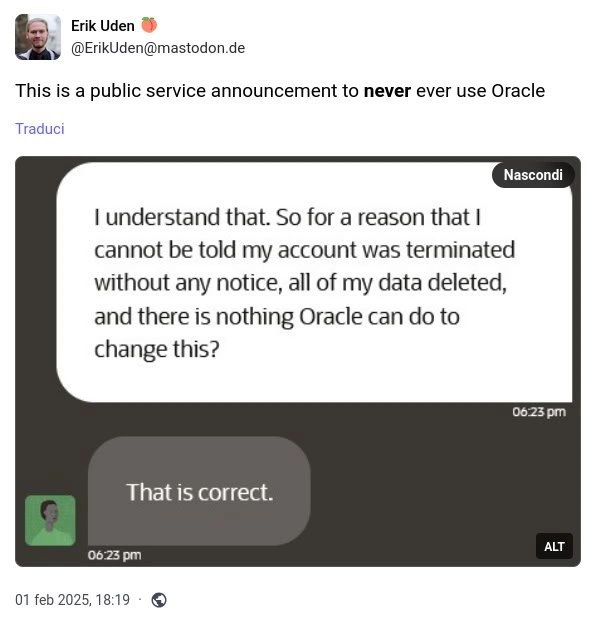
The meme itself is presented as a screenshot of a chat conversation (white and grey message bubbles on a dark background) between a customer and Oracle’s support. In the image, the person asks a question in the white bubble at 06:23 pm, and the Oracle support agent’s reply comes in a grey bubble, also time-stamped 06:23 pm. This chat transcript style highlights the conversation: the user is basically saying, “So, you’re telling me my account was terminated without warning, all my data is deleted, and there’s nothing you can do?” and the support person answers, “That is correct.” The stark confirmation is what makes the meme striking (and darkly funny to those of us in tech).
Now, why is this a big deal? A few key points:
- Data loss: All of the user’s information (files, databases, whatever was stored with Oracle) is gone forever. Unless they saved a copy elsewhere, there’s no getting it back. In tech, we always talk about keeping backups – extra copies of important data stored somewhere safe – precisely to avoid this situation. Here it sounds like there were no effective backups outside of Oracle’s system, so when Oracle deleted everything, the user had nothing left.
- No reason given: Oracle’s support told the user they cannot disclose why the account was terminated. This is like being kicked out of a service without being told what you did wrong. Companies sometimes do this if they suspect a serious violation or due to legal/security policies. It’s frustrating because the person has no idea what triggered it – it could even be a mistake (for example, an automated system flagging a harmless activity as suspicious). Not knowing why means you can’t easily appeal or make sure it never happens again.
- No remediation: “Nothing Oracle can do to change this” is a formal way of saying the decision is final and cannot be undone. The support agent is basically saying the deletion is irreversible. In many cloud services, once data is truly deleted on their end, even the support team can’t recover it. It’s gone from the servers. So, no fix, no roll-back button, no magical recovery option. This adds to the feeling of helplessness – the user is at a dead end.
This all ties back to vendor lock-in. That term means you’ve put so much into one company’s platform that you’re “stuck” with them. Here the person’s entire setup (their account, data, likely their application or website) was all in Oracle’s cloud. When Oracle terminated the account, everything related to it went away. If the user had instead kept copies of data elsewhere or used multiple providers, an incident like this wouldn’t be as devastating. But moving data out or maintaining a second setup is hard (it costs time, money, and effort), so many people don’t do it – that’s how you get locked in. Companies like Oracle (and others) love when you use more and more of their services, but it can put you in a tough spot if you ever need to leave or if something goes wrong on their side.
The meme is also a bit about corporate culture in tech support. Notice how the Oracle support representative gives a very brief, almost cold confirmation. They don’t explain, they don’t apologize (beyond maybe a scripted sorry not visible here), they just agree that yes, it’s all gone and cannot be changed. In big organizations, support staff often have strict rules on what they can say or do. The agent answering likely isn’t allowed to recover the data or even to give details on why the account was closed – those decisions might be made by another department entirely. So you end up with a support chat that feels very impersonal. To a new developer or customer, that can be shocking: you’d hope for some help or at least an explanation, and instead you get a wall of “that’s just how it is.”
For someone starting out, the takeaway from this scenario is: be careful about putting all your trust in one service. Cloud services are fantastic and convenient (you don’t have to maintain your own hardware, you can scale easily, etc.), but things can go wrong. Always keep backups of your most important data, and consider the what-if scenarios. What if your cloud provider account gets suspended or something odd happens? Do you have a copy of your work elsewhere? Can you switch to a different provider if you had to? These are tough questions, but as you can see, ignoring them can lead to a world of hurt.
In summary, this meme uses a bit of DatabaseHumor/CloudHumor to deliver a serious public service announcement: if you rely completely on one cloud company (like Oracle) and they decide to pull the plug, you could lose everything in an instant. It’s a joke, but one with an important lesson attached. As a junior dev, it's wise to remember this: always have a backup plan (literally and figuratively) for your data and systems.
Level 3: Single Point of Failure
This scenario—captured in a short Oracle support chat snippet—shows a worst-case risk of vendor lock-in in the cloud. The user entrusted all their critical data to a single cloud provider (Oracle in this case) and got burned badly. An unexpected account termination occurred without any warning, resulting in total data loss. There’s a biting irony in how calmly Oracle support confirms the irreversibility: “That is correct.” That laconic response highlights the powerless feeling of being at the mercy of corporate policies.
From a senior developer’s perspective, this conversation is chillingly familiar. It screams “single point of failure” at the architecture level: the entire operation depended on one vendor’s systems and goodwill. Oracle abruptly pulling the plug meant everything evaporated — all data deleted without notice, with no backup plan in place. In other words, complete DataLoss. It's a textbook example of why seasoned engineers harp on about backups, multi-region redundancy, and avoiding being completely cornered by one provider. As the meme bluntly frames it, it’s practically a public service announcement to never use Oracle (or at least to be extremely cautious if you do).
The humor here is dark. Anyone who’s dealt with enterprise support or rigid corporate culture recognizes the almost robotic politeness in the support agent’s reply: “That is correct.” No empathy, no alternative offered — just a calm confirmation of the worst-case scenario. It’s painfully funny because it’s true: large vendors often train support staff to stick to script. The poor agent likely cannot disclose the reason and has no power to undo the termination. So we get this Kafkaesque chat where the customer essentially asks, “So... for some mystery reason my entire account was nuked, all of my data is gone, and there is nothing Oracle can do?” and Oracle support just responds, “Yes, you got it.” That’s the whole cloud vendor trust issue captured in two lines of chat. It’s absurd, and that absurdity is exactly where the CloudHumor comes from (with a hefty side of horror).
This exchange hits a shared nerve in the tech community. Many experienced devs have war stories of being locked out of a service or facing a critical outage caused by someone else’s decision. It’s a scenario you pray never to encounter: you follow all the rules, put everything in the cloud, and yet one day your Oracle Database or server instance is just… gone. The meme exaggerates a genuine concern — VendorLockIn is real, and so are the nightmares that come with it. Oracle, in particular, has a long-standing reputation in this area. For decades they've been known for binding customers tightly with proprietary tech and contracts. (The old joke: escaping an Oracle license agreement is harder than escaping The Matrix.) Today, Oracle’s cloud services are an extension of that philosophy. If you go all-in on them and something goes wrong, you might find there’s no easy way out. In this story, Oracle not only locked the user in, they threw away the key… and the entire room with it.
From an architectural standpoint, we see every anti-pattern here. Relying on a single vendor’s platform with no Plan B or external backup? Surely nothing will go wrong, right? It’s easy to get lulled into a false sense of security because big providers promise high availability and durability. Oracle might boast about multiple 9’s of uptime or resilient storage. But those guarantees mean nothing when an account termination (automated or otherwise) wipes everything by design. It’s like having a super-redundant database cluster across many servers, but then an account-level kill switch deletes all of them at once. No amount of RAID or replication helps if the system decides you shouldn't have an account at all.
The conversation also underscores how CorporateCulture and bureaucracy can turn into a nightmare for customers. Maybe Oracle had a “reason” — perhaps a billing issue, a suspected terms-of-service violation, or some security flag. But the user is told that they “cannot be told” the reason. That lack of transparency drives tech folks crazy; it gives no chance to correct the issue or even learn from it. It’s corporate obfuscation at its finest: “Something happened, we did the thing, we won’t tell you why, and now it’s irreversible.” The calm finality of “That is correct.” is both the punchline and the gut-punch. It’s basically Oracle support confirming the absolute worst with the polite tone of a waiter confirming your lunch order.
Every senior engineer reading this shakes their head and chuckles nervously. It’s the kind of dark laugh you emit when a joke hits a little too close to home. “I’ve never had it this bad… but imagine if I did. Do I have backups? What if my cloud provider did this to me?” The meme resonates as a cautionary tale wrapped in gallows humor. It reminds us why designing for resilience and maintaining independent backups isn’t just paranoia — it’s necessary. And it drives home the point that trusting any single vendor (especially one with Oracle’s track record) with all your data is a huge gamble. In summary, the story behind this meme cements an age-old lesson in tech: never put all your eggs in one basket. Or as the tweet translates it: never ever use Oracle.
Description
Screenshot of a social-media post by ‘Erik Uden 🍑 @[email protected]’ reading: “This is a public service announcement to never ever use Oracle”. Beneath it is a two-message chat transcript styled in white and dark grey bubbles on a dark background. The white bubble (06:23 pm) says: “I understand that. So for a reason that I cannot be told my account was terminated without any notice, all of my data deleted, and there is nothing Oracle can do to change this?”. The dark grey reply bubble (06:23 pm) simply states: “That is correct.” The meme highlights the risk of relying on a single cloud/database vendor - here Oracle - where an unexplained account shutdown results in total data loss and no remediation path. It humorously underscores vendor lock-in, the necessity of backups, and the perils of trusting corporate support processes
Comments
23Comment deleted
Architect’s lesson of the week: if your DR strategy is “trust OCI”, congratulations - you’ve discovered a new durability tier: /dev/null-as-a-Service
The only thing more reliable than Oracle's licensing audits is their ability to delete your entire production environment without explanation - at least their consistency in customer hostility remains enterprise-grade
Oracle support achieving the impossible: making AWS's billing surprises look like a feature. When your cloud provider's idea of 'customer service' is confirming they've nuked your data with the enthusiasm of a SIGKILL, you know you've transcended mere vendor lock-in into vendor Stockholm syndrome. At least with on-prem, when your data disappears, you get to blame your own infrastructure team over beer - not receive a polite 'That is correct' from someone who clearly peaked at reading JIRA tickets
Architectural lesson: if all copies are in one cloud, vendor lock‑in can turn into vendor lock‑out - RPO: 06:23 pm, RTO: never
Oracle support: Proving their real persistence layer is a black hole, where data achieves escape velocity from your account
Multi-region HA looks great on the diagram - until the provider flips the ToS bit and your architecture collapses to one box labeled “RPO = infinity.”
"That is correct" Comment deleted
If someone is willing to use oracle after knowing what the company is like for years, it's natural selection when oracle deletes your entire company like with OP Comment deleted
with the performance of Oracle DB, sqlite is probably faster Comment deleted
Duckdb is where it's at Comment deleted
I have one gh repo with actions that crawls data and commit the SQLite automatically Comment deleted
It's pretty good for hosting a minecraft server Comment deleted
Although I'll admit getting a free compute instance was kind of a pain in the rear Comment deleted
Hahaha, using cloud in business and not having local backups (at least daily, hot spare mode is preferable obviously). Lol lollol Comment deleted
Unfortunately, egress fees are still a thing. Worth the investment though probably Comment deleted
The last company I worked with handled about 20TB of incoming data daily, retaining it for 60 days before archiving it in deep storage for another two years. There are also legal restrictions on storing sensitive data, so you can't just "back up" everything locally. Regulations impose strict rules on how and where data can be stored, often requiring encryption or geographic limitations. And that data is only one part of disaster recovery - the infrastructure is just as critical. If you suddenly lose access to your cloud account, you can't simply replicate everything locally or on another cloud. In practice, backups are typically managed by the cloud provider itself and/or replicated to another data center within the same cloud. BTW, Oracle typically bans accounts for free-tier abuse. Their TOS allows them to do so without warning or explanation. While their services are generally cheaper than AWS or Azure, I'm not a fan of their business approach. Comment deleted
How can one abuse free tier? Comment deleted
Cloud storage is a fancy term for someone else's computer. Comment deleted
A lot of corpo insurance firms require Cloud for liability. Comment deleted
I work on their product as consultant, it"s fucking hell Comment deleted
oh hey, it's erik. this mfer follow-requested me some time back (and I declined) Comment deleted
he also follow-requested my gf xD I think he's trying to follow literally everyone on fedi Comment deleted
Like this. Typical Oracle. Also multiple free accounts are strictly prohibited. And if their fraud detection system gets it wrong, they couldn't care less Comment deleted