
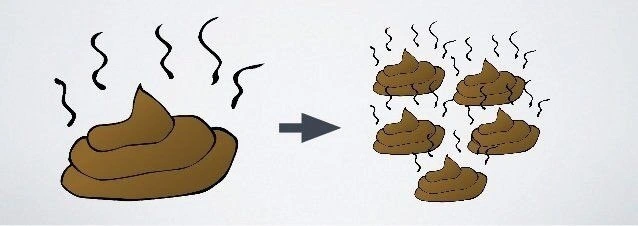
Microservices: The Art of Distributing the Mess
Description
A simple, two-part cartoon diagram on a light grey background illustrates a cynical view of software modernization. On the left, there is a large, single, steaming pile of brown cartoon poop. A dark grey arrow points from it to the right side of the image. On the right, the single pile has been replaced by five smaller, individual, steaming piles of the same cartoon poop. The accompanying caption for this image was 'Advantages of rewriting monolithic code into micro services'. The joke is a visual metaphor for poorly executed architectural migrations. The large pile represents a legacy monolithic application that is messy, smelly, and difficult to work with (i.e., 'a pile of crap'). The smaller piles represent the new microservices architecture. The meme humorously argues that if the underlying problems (bad code, poor design, tech debt) aren't fixed, simply breaking the monolith into microservices doesn't solve anything; it just distributes the same problems across multiple services, turning one big problem into many smaller, interconnected problems


Comments
6Comment deleted
Congratulations, you've replaced your single point of failure with a complex, distributed system of failures that now requires a service mesh just to tell you which part is on fire
We broke up the monolith - now every turd has its own Kubernetes deployment, separate on-call rotation, and a mutually incompatible protobuf schema
We successfully migrated from one point of failure to five points of failure, each requiring its own Kubernetes cluster, service mesh, and dedicated on-call rotation
Ah yes, the classic microservices migration: we took our one big problem and successfully transformed it into dozens of smaller, interconnected problems that now fail independently at 3 AM. Bonus points for the increased operational complexity, distributed transaction nightmares, and the realization that Conway's Law means your org chart now dictates your service boundaries. At least when the monolith went down, you only had one place to look - now you get to play detective across 47 services, each with its own logging format, to figure out which one decided to cascade-fail the entire system
Singleton bug pattern in theory; Gang-of-Five factory in prod reality
We didn't refactor the monolith; we sharded the odor - same invariants broken, now with retries, circuit breakers, and an overall availability that's the product of each service, so the smell is eventually consistent across the cluster