Helm's honest opinion on Kubernetes development
Why is this Containerization meme funny?
Level 1: Learn the Hard Way
Imagine you’re a kid who hates getting soap in your eyes during bath time. There’s a special shampoo that promises “no tears” – meaning it shouldn’t make you cry if it gets in your eyes. You excitedly ask, “Can we use the no-tears shampoo so I won’t cry?” But your older brother, who’s in charge of bath time, just hands you the regular shampoo and says, “No.” Of course, when you use the regular shampoo, it stings your eyes and you end up crying anyway. The joke here is similar: someone is hoping for an easy, pain-free way to do something hard, and the experienced person is basically saying, “No, you have to do it the hard way.” In other words, sometimes there’s no magic solution – you just have to put in the effort (and maybe a few tears) to get through it. The meme is funny because it shows that tough-love truth in a simple, exaggerated way.
Level 2: No Pain, No Kubernetes Gain
Kubernetes is basically a system that helps DevOps teams run lots of software containers (like mini programs) across many computers. It’s extremely powerful but also complex, which means setting it up and working with it can be really hard. “Without tears” in the meme means without frustration or pain. But in reality, working with Kubernetes often does lead to frustration – newbies quickly discover why people joke about “YAML hell.” YAML is the format for configuration files that tell Kubernetes what to do (for example, how to run your app in a container, how many copies, which network settings, etc.). Writing these configs by hand for each app and environment can make anyone want to cry if they’re not careful. That’s why tools exist to help manage all these config files, and Helm is one of the most popular ones. Helm is often described as a “package manager” for Kubernetes (similar to how you use apt for Debian/Ubuntu packages or npm for JavaScript libraries). It lets you bundle a bunch of Kubernetes YAML files into a reusable package called a Helm chart. With a chart, you can install or upgrade a whole application in your cluster with one command (helm install myapp ./myapp-chart). Sounds great, right? The catch is that Helm charts use templates and variables to be flexible. If you open a typical chart, the YAML isn’t normal static YAML – it has placeholders like {% raw %}{{ .Values.port }}{% endraw %} sprinkled throughout. Those get filled in from a values.yaml file or command-line --set flags you provide.
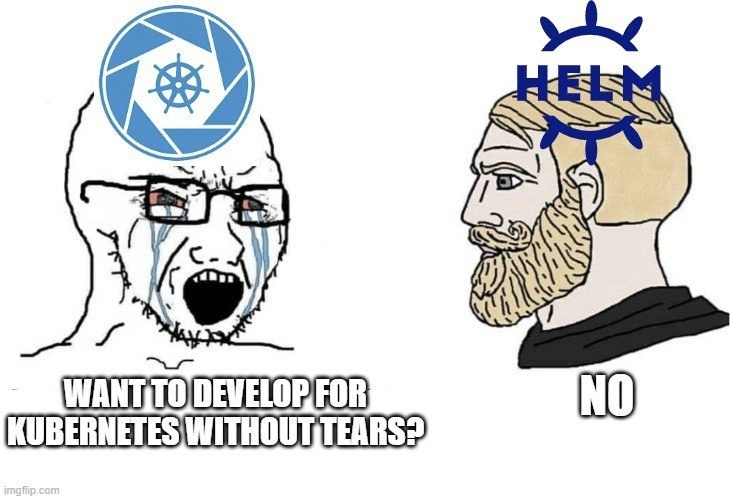
So what’s the joke? The meme shows two characters from a common wojak_chad_format meme style. On the left, there’s the “crying wojak” figure with the Kubernetes logo on his head, asking “Want to develop for Kubernetes without tears?” – basically, “Do you wish working with K8s was easy and didn’t make you frustrated?” On the right is the muscular Chad character with the Helm logo on his head. He just replies “NO.” This is funny to developers and SREs because it reflects a reality: working with Kubernetes is often painful, and even the tools that are supposed to help (like Helm) can be complicated. There really is no simple, tear-free path… at least not according to the gruff Helm Chad.
To break it down: Helm is being personified as this confident Chad who refuses to entertain the idea of “easy Kubernetes development.” Why would Helm say no? Because if you’re going to use Kubernetes in a serious way, you almost inevitably have to deal with the complexity – there’s no avoiding it. Many newcomers hope there’s an alternative that will magically simplify Kubernetes. For instance, you might hear about a “tear-free” solution or a friendlier tool (some alternatives like Kustomize or other UI-based deployers exist). But the meme’s punchline is that Helm (representing the traditional, established way) isn’t on board with that. Helm has a bit of a reputation: it simplifies some tasks by organizing configs, but it also adds its own twists. For example, you need to learn Helm-specific concepts like charts, releases, and the templating syntax. A lot of us went through the learning process and definitely shed a few metaphorical tears dealing with cryptic errors or confusing behaviors. The term helm_charts in the tags refers to those bundles of templates/values. Working with them is essentially a required skill for Kubernetes deployment engineers—hence it being “entrenched.”
Think of it this way: Kubernetes is powerful but notoriously difficult to use directly (tons of configuration details). Helm stepped in to help by giving a structured way to package those details. It does help – you can find official Helm charts for complex software like databases, monitoring systems, etc., and deploy them quickly. But you pay an upfront cost in complexity: figuring out how to override settings in the values, understanding how the chart’s maintainers set up the templates, and sometimes debugging why something didn’t render as expected. That’s the kubernetes_dev_workflow_pain that the tag mentions – the everyday pains of developing and deploying on Kubernetes. The meme is relatable because a lot of DevOps_SRE folks have had that exact conversation: “Surely there’s an easier way to do this?” asks a new developer with hopeful eyes. The seasoned engineer, who has been through the ringer with these tools, just smirks and says, “No, not really.” It’s a bit of dark humor: we laugh so we don’t cry (again).
In short, the Kubernetes Chad vs. crying Wojak meme uses exaggeration to say: “No, you can’t have Kubernetes development without tears. Helm is going to make sure of that.” It highlights ToolingFrustration: even our helpful tools can be frustrating. It also touches on DeploymentPainPoints: deploying apps is never as easy as some sales brochure (or meme question) would have you believe. The whole scene is a RelatableDeveloperExperience for anyone who has tried to tame Kubernetes using Helm. We find it funny because we’ve been that crying Kubernetes user at some point, and we’ve met that unyielding Helm attitude in ourselves or colleagues – the acceptance that this is complicated stuff, deal with it.
Level 3: Helm or High Water
At the cutting edge of Containerization, humor often hides hard truth. This meme pits Kubernetes against its own package manager Helm in a battle of wills that senior DevOps engineers know all too well. On the surface, Kubernetes is a powerful container orchestrator for deploying and scaling applications. But shipping apps to a K8s cluster involves wrestling with countless YAML files, fragile configurations, and infamously steep learning curves – the kind that can reduce even hardened SREs to tears. Helm was introduced as a solution: a way to package those Kubernetes configs into reusable Helm charts with templates and default values. In theory, Helm should make life easier by letting you deploy complex apps with a single helm install. In practice? Helm simply trades one kind of complexity for another.
The left side of the meme asks, “Want to develop for Kubernetes without tears?” – the rhetorical answer is obvious to any veteran: Of course you do, but good luck. The right side, a stoic Chad with the Helm logo, flatly says “NO.” This blunt reply speaks for Helm’s entrenched status in the Kubernetes ecosystem. The joke is pointing out that any promise of “tear-free” Kubernetes development is unrealistic when Helm is involved. ToolingFrustration is practically a rite of passage here. Helm’s templating language is powerful but can be painfully opaque. It’s based on Go templates, so your Kubernetes YAML ends up littered with double curly braces, pipeline operators, and conditional logic. One mis-indented space or a missing quote filter can sabotage an entire deployment. Debugging a failing helm upgrade at 3 AM because a value didn’t propagate correctly? That’s a DevOpsPainPoints classic. We’ve all spent an hour staring at a **Error:** parse error in chart: template: ... message, wondering which nested {% raw %}{{ if }}{{ end }}{% endraw %} block we broke this time.
Why is Helm portrayed as dismissive Chad? Because Helm has become the de facto standard – the entrenched Helm toolchain – and it isn’t about to step aside for any “simpler” alternative. It’s the “my way or the highway” package manager of the Kubernetes world. Experienced engineers chuckle (or cringe) at this because they’ve seen well-meaning proposals to simplify Kubernetes workflows get shot down by reality. Perhaps a new tool promises “Kubernetes development without tears,” or a junior dev suggests ditching Helm for something more straightforward. Enter the bearded Helm Chad: “No.” In other words, you can’t escape Helm, and by extension, you can’t avoid the complications it brings. There’s irony here – Helm was supposed to ease Kubernetes deployments, but mastering Helm itself often causes frustration and tears.
Let’s unpack the irony deeper. Kubernetes deployments involve massive configuration files – defining services, deployments, ingresses, config maps, you name it. Copy-pasting those YAML manifests for each microservice or environment is untenable, so Helm offers templating and values injection. You write a generic chart with placeholders (like {{ .Values.image.repository }} for the container image name) and supply specifics via a values.yaml. This enables DRY (Don’t Repeat Yourself) practices and easier updates… once you’ve climbed the learning curve. Helm charts themselves have a structure (Chart.yaml, templates, etc.) and lifecycle (install, upgrade, rollback), which is a whole mini-ecosystem. The DeploymentPainPoints come when that ecosystem doesn’t behave. For example, a Helm chart might produce dozens of Kubernetes objects; if one sub-component fails to schedule properly, you’re left sifting through kubectl describe outputs and Helm’s somewhat obtuse error logs to diagnose it. Not exactly tear-free debugging.
The meme captures a RelatableDeveloperExperience: Many of us have eagerly tried to streamline our Kubernetes dev workflow – maybe using newer tools like Kustomize (for patching YAML instead of templating) or scripts to auto-generate configs. Some vendors even pitch GUI-based or “easy mode” Kubernetes platforms. But for hardcore clusters, teams often default back to Helm because it’s what they know and trust (despite the headaches). Helm is the Chad saying “No” to alternative approaches: it’s widely adopted, battle-tested, and not going anywhere soon. In the real world, migrating away from Helm means rewriting tons of deployment logic, retraining team members, and risking new issues. So, organizations stick with Helm come hell or high water. The result? DevOpsHumor like this meme, where we laugh (perhaps a bit bitterly) at the fact that even our “solution” (Helm) is an obstacle to tear-free development. It’s funny because it’s true – we’ve all seen someone optimistically ask, “Can’t this Kubernetes stuff be painless?” only for the seasoned engineer to pat them on the shoulder, point to the Helm manual, and simply say, “No.”
Description
This image uses the 'Crying Wojak vs. Chad' meme format to comment on the developer experience with Kubernetes. On the left, a distraught, crying Wojak character has the blue Kubernetes (k8s) logo superimposed on its head. Below it, the text asks, 'WANT TO DEVELOP FOR KUBERNETES WITHOUT TEARS?'. On the right stands a stoic, bearded Chad character, representing a superior or more realistic viewpoint. This character has the Helm logo and the word 'HELM' on its head. His simple, blunt response is 'NO'. This meme humorously captures the deep-seated frustration many developers feel when working with Kubernetes's complexity. While Helm is a package manager designed to simplify Kubernetes application deployments, the joke, aimed at experienced engineers, is that even this essential tool doesn't eliminate the inherent difficulties. It stoically acknowledges that pain and complexity are part of the Kubernetes ecosystem, and no tool can offer a completely tear-free experience. The humor lies in its cynical realism

Comments
7Comment deleted
Helm doesn't remove the pain of Kubernetes, it just templatizes it so you can deploy your suffering across multiple environments consistently
Helm: converting “kubectl apply -f .” into a choose-your-own-adventure novel of recursive YAML, Sprig one-liners, and existential rollback dread
After 15 years in the industry, you realize Helm doesn't eliminate Kubernetes complexity - it just adds another abstraction layer where your YAML can fail, your dependencies can conflict, and now you need to debug both your application AND your charts when production goes down at 3 AM
Ah yes, managing Kubernetes without Helm - because who doesn't love maintaining 47 nearly-identical YAML files across environments, each with subtle differences that will definitely cause a production incident at 2 AM? Sure, you could use Helm charts with templating and version control, or you could embrace the artisanal, hand-crafted approach of copy-pasting manifests and playing 'spot the difference' during incident reviews. The Chad knows: sometimes the real DevOps maturity is admitting that YAML archaeology isn't a core competency worth developing
Helm trades Kubernetes YAML despair for structured tears over chart dependencies and upgrade hooks gone wrong
Helm doesn’t remove tears; it templates them into values.yaml - rendered with nindent(24) at deploy time
Helm is Kubernetes’ “easy” button: press it and your values.yaml becomes a 500‑line DSL, hooks morph into a hidden state machine, and upgrades are just praying you guessed the right CRD order