Just Put Crude Oil on the Blockchain to Move It Anywhere
Why is this Blockchain meme funny?
Level 1: Emailing a Sandwich
This is like someone watching movers struggle with a piano and offering, "You're overcomplicating this — just email the piano." Writing down information about a thing and sending it anywhere instantly is easy; the actual heavy, sloshing, physical thing still has to travel the slow, hard way. The joke is funny because the advice is given with total confidence, in the exact tone of every person who has ever solved a hard problem by simply not understanding it.
Level 2: Tokens, Ledgers, and Why Oil Doesn't Fit in Either
The concepts being lampooned, briefly:
- A blockchain is a shared, append-only database replicated across many computers, designed so no single party can secretly rewrite history. It's good at one thing: tracking who owns which digital entries without a central referee.
- Tokenization means creating a digital entry (a token) that represents a real-world asset — a barrel of oil, a house, a concert ticket. Trading the token is instant; the asset itself doesn't move.
- The oracle problem: blockchains can't see the outside world. Some trusted party must report "this token = that barrel," and at that moment you've reintroduced exactly the middleman the blockchain was supposed to eliminate.
- Web3 solutionism: the reflex of proposing blockchain for any problem, especially problems that are actually about physics, law, or logistics.
If you're newer to the industry, the lesson generalizes beyond crypto: beware any proposal where the hard part is waved away with "just." "Just migrate to microservices," "just add a cache," "just put it on the blockchain" — the word marks the spot where six months of pain has been compressed into one syllable.
Level 3: The Map Is Not the Tanker
The tweet's genius is its flawless impression of a pitch deck:
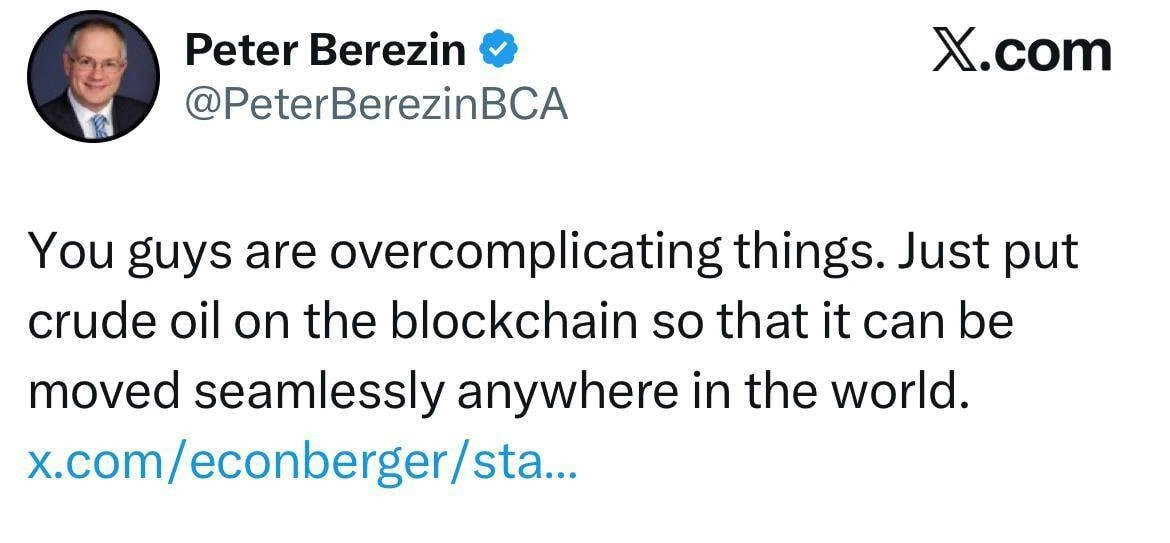
You guys are overcomplicating things. Just put crude oil on the blockchain so that it can be moved seamlessly anywhere in the world.
Delivered deadpan by Peter Berezin — a verified, suit-and-tie chief global strategist, which is precisely the costume this genre of advice usually wears — and aimed (via the quoted x.com/econberger/sta... link) at some earnest discussion of oil logistics, presumably about the gloriously physical problems of pipelines, tankers, and sanctions. The satire works because it commits fully to the category error at the heart of a decade of Web3 pitches: confusing a record of a thing with the thing itself. A distributed ledger can move a token representing a barrel of oil across the planet in seconds. The barrel, regrettably, remains a 159-liter drum of toxic hydrocarbons that still has to ride a ship through the Strait of Hormuz. Updating the map does not relocate the territory.
Veterans of the 2017–2022 hype cycle will recognize the template instantly, because it was applied with a straight face to everything: blockchain for supply chains (IBM and Maersk's TradeLens, sunset after years of trying), blockchain for lettuce provenance, for real estate, for medical records, for voting. Every one of these collided with the same rock the joke is built on — the oracle problem. A blockchain can guarantee that nobody tampered with the data after it was written; it cannot guarantee the data was true when written, and it has no opinion about whether the physical asset still exists, got diluted, or fell off a truck. The immutable ledger faithfully preserves whatever lie you feed it, forever. "Just put X on the blockchain" was never engineering; it was a spell for summoning Series A funding. The word "seamlessly" is doing the heaviest lifting in the tweet — the universal tell of solutionism, the adverb that means "I have not thought about the seams." Anyone who's sat through a vendor demo knows the seams are where the entire job lives.
Description
A screenshot of a tweet from X.com by verified user Peter Berezin (@PeterBerezinBCA, chief global strategist at BCA Research, shown with a suit-and-tie avatar). The tweet reads: 'You guys are overcomplicating things. Just put crude oil on the blockchain so that it can be moved seamlessly anywhere in the world.' followed by a truncated link 'x.com/econberger/sta…'. The 'X.com' wordmark appears top right. The deadpan satire mocks the 'put X on the blockchain' solutionism of the Web3 era - distributed ledgers can move tokens representing oil, but conflating data with physical logistics is exactly the category error blockchain pitches kept making
Comments
3Comment deleted
Works great until someone runs the oil through a mixer for privacy and it comes out as 10,000 unrelated barrels
and it will be TRANSPARENT Comment deleted
real Comment deleted