Remote Developers: Social Distancing Since 2010
Why is this RemoteWork meme funny?
Level 1: Stay-Home Hero
Imagine you love staying in your room playing video games or reading comics all day. Now suppose there’s a big bad sickness going around outside, so everyone is told they must stay at home to be safe. The city mayor (or the government) then comes to you and says, “Wow, thank you for not going outside – you’re a real hero for staying in and playing!” It’s funny because you’re basically being praised for doing your favorite thing, something that was super easy for you. Usually, being a hero means doing something hard or brave. But in this case, you became a “hero” without even trying – just by chilling at home like you always do. The meme makes us laugh because it’s like getting an award for doing nothing new, and that silly surprise feeling is the joke at the heart of it.
Level 2: Hero by Default
This meme plays on the sudden mainstream acceptance of remote work during COVID-19. A remote developer is basically a software engineer who works from outside the office (often from home) using the internet and a laptop to do their job. In March 2020, when the coronavirus pandemic hit, many governments issued stay-at-home orders – essentially telling everyone to avoid going out, including to workplaces. They even publicly thanked people for working from home and helping to stop the virus from spreading. The humor here comes from the fact that the “me” in the meme (labeled “ME, REMOTE DEVELOPER”) was already staying home long before any pandemic. Working from home was this person’s normal lifestyle, not some new heroic sacrifice.
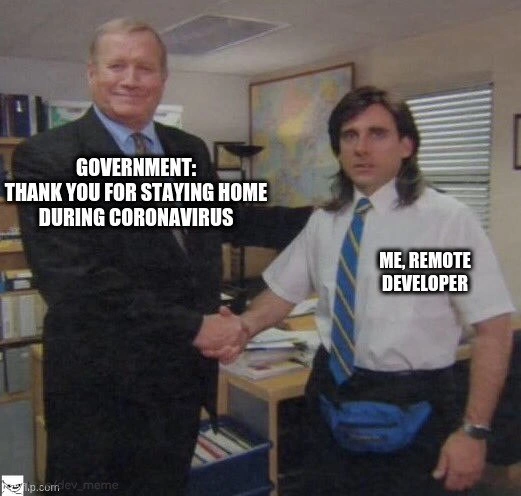
In the image, a government official in a suit is shaking hands with the remote dev in a very official, congratulatory way. The text over the official says: “Government: Thank you for staying home during coronavirus.” Over the developer it says: “Me, remote developer.” It looks like an award ceremony where the government is the presenter and the developer is the awardee. The joke is that the developer is being applauded for doing something completely ordinary for him – it’s like giving someone a medal for eating breakfast. The developer’s face even has a kind of confused, awkward expression (blurred in the meme, but you can tell he’s a bit wide-eyed), which reflects the feeling of “Uh, sure... I guess you’re welcome?”
RemoteWorkCulture in tech has been around for years. Developers often use tools like Slack (for text chat), Zoom or Microsoft Teams (for video meetings), and GitHub or GitLab (online code repositories) to collaborate from anywhere. Many programmers love WorkFromHome arrangements because it lets them avoid long commutes, work in comfy clothes, and design their own quiet workspace. It wasn’t unusual at all for a developer to have a home office setup with multiple monitors, a fast internet connection, and maybe even a fanny pack of gadgets (okay, the blue fanny pack in the meme is probably just for comedic effect!). So when the pandemic forced almost everyone to work from home, these remote devs didn’t miss a beat. They didn’t have to learn how to use Zoom or set up a VPN connection – they were already pros at it. They were essentially remote-work veterans, while a lot of other people were “newbies” trying to figure out where the unmute button is on a video call.
The handshake meme template used here is notable too. It’s actually a still from a popular TV comedy (The Office). In that show scene, one character is being thanked in a somewhat over-the-top formal way. Meme creators love using this image to show two labeled characters shaking hands when something ironic or unexpected is being acknowledged. In reality, during the pandemic, nobody was shaking hands (everyone was social-distancing). But the meme uses this handshake image to really drive home the point: it visually represents a very official “thank you.” It’s like the government is giving the developer a handshake and a pat on the back for staying home. That adds to the silliness, because staying home is usually a pretty easy thing to do (especially for someone accustomed to coding in their pajamas!).
So, to put it simply: the government is treating the remote coder like a hero for following lockdown rules, but the coder was living that lockdown life well before it was a necessity. The phrase “unwitting pandemic hero” sums it up perfectly — the developer didn’t set out to be heroic at all; he just kept doing his normal job from home. This meme resonates with tech folks because it highlights a moment when the rest of the world finally caught on to something the tech community already knew: working from home can be just as productive (and in this case, life-saving) as being in the office. And it’s funny to see that recognition happen in such an exaggerated, meme-worthy way.
Level 3: WFH in Production
In early 2020, a world-wide coronavirus lockdown flipped corporate culture on its head: suddenly working from home wasn’t just allowed—it was officially commended. This meme nails that irony. The left side (the suited government official) represents authorities applauding people for not going out, saying “Thank you for staying home during COVID-19.” The right side (“Me, remote developer”) is a coder who’s been doing Work From Home (WFH) all along, now standing there like a deer-in-headlights being praised as a model citizen. It’s a classic case of the remote developer becoming an unwitting hero simply by sticking to his pre-pandemic daily routine. For seasoned engineers, the humor cuts deep: we’ve spent years perfecting remote work setups, often battling managers who insisted “innovation only happens in the office,” and now those same practices are being lauded as lifesaving. Talk about a rapid deployment to production – remote work went from a niche dev perk to national policy overnight.
To an experienced dev, this scenario also highlights a delicious reversal in workplace attitudes:
| Before 2020 (Old Mindset) | During Lockdown (New Mindset) |
|---|---|
| “No, you can’t work from home on Friday.” | “Please, everyone work from home, for safety.” |
| “Are you really working if I can’t see you?” | “Thank you for working remotely — you’re saving lives!” |
| “We need you in the office for this meeting.” | “Let’s jump on a Zoom call from home.” |
Just months before, a remote dev might have been viewed with suspicion or considered less serious. Fast-forward to lockdown, and that same dev’s lifestyle is suddenly the gold standard. The meme’s handshake image (borrowed from a popular handshake meme template, notably a scene from The Office with an awkward award ceremony vibe) perfectly amplifies this feeling. A formal handshake symbolizes official recognition – here it’s as if the government is holding a ceremony to thank developers for sitting in their home offices in sweatpants. It’s even funnier when you consider that actual pandemic guidelines frowned on handshakes and close contact. The meme knowingly breaks that rule for comedic effect, contrasting a very in-person gesture with the message of staying isolated. That tongue-in-cheek dissonance gives seasoned meme connoisseurs a little extra to smirk about.
From a tech perspective, the remote developer was already optimizing for a distributed, online workflow. We had our code in remote Git repositories, teams communicating over Slack and Microsoft Teams, daily stand-ups via video calls, and continuous integration pipelines churning away in the cloud. In other words, our entire development pipeline was location-agnostic well before COVID hit. So while many other professions scrambled to set up VPNs and home offices, developers just carried on as usual. It’s like our work culture had a built-in disaster recovery plan for “office not available” — we simply failed over to our living rooms. A senior engineer can appreciate the “distributed system” parallel here: an office is a single point of failure, and remote-capable teams are a multi-node system with built-in redundancy. When the office “node” went down during the pandemic, remote developers kept the system running without missing a beat. The government essentially said, “Thanks for making this system resilient,” but to the dev it’s like, “No biggie, we’ve been running in distributed mode for years.”
It’s almost as if the remote dev’s code had an if/else for pandemic conditions that didn’t need any new logic:
if (pandemic) {
workFromHome();
} else {
workFromHome(); // Routine unchanged for the remote dev
}
In other words, nothing changed – the workflow stayed constant. That’s why the praise feels so disproportionate. Imagine being congratulated for doing something so ordinary it’s basically your default setting. Many veteran developers responded to these stay-home hero messages with tongue-in-cheek pride: “I’ve been training my whole life for this!” The meme channels that sentiment. The right side character (with his short-sleeve shirt and bright blue fanny pack) looks a bit socially awkward – a nod to the stereotypical geek attire – as if he just rolled out of a home office where fashion means comfort. It’s a subtle joke on remote work culture: developers often relish not having to dress up for the office. (Who hasn’t paired a button-up shirt with pajama pants for a video call?) Now here comes the government effectively saying, “Love the outfit, keep doing what you’re doing!”
The senior-perspective punchline is that it took a global crisis for remote work to get this level of validation. There’s a whiff of dark irony that many of us in tech can’t miss. We recall the pre-pandemic days of pleading for a more flexible WFH policy – only to be told that “we just don’t do that here.” Fast forward, and not only is everyone doing it, but it’s framed as a noble sacrifice. The meme hits that sweet spot of TechHumor and WorkplaceHumor, because it exposes a truth: sometimes the biggest workplace revolutions aren’t driven by new technology or management wisdom, but by external events forcing our hand. Developers who had been quietly enjoying their remote lifestyle suddenly found themselves elevated to role-model status. It’s hilariously gratifying and absurd at the same time. As a battle-worn engineer, you can’t help but chuckle and think, “Finally, society caught up with what we already knew. Welcome to remote work – sorry it took a pandemic to handshake on it.”
Description
A meme using the awkward handshake scene from the TV show 'The Office', featuring Michael Scott and his former boss Ed Truck. Ed Truck is labeled 'GOVERNMENT:' with the caption 'THANK YOU FOR STAYING HOME DURING CORONAVIRUS'. Michael Scott, looking uncomfortable with a mullet and a fanny pack, is labeled 'ME, REMOTE DEVELOPER'. The humor stems from the irony of the government thanking a remote developer for staying home, a practice that has been a standard part of their professional life long before the COVID-19 pandemic made it a global mandate. The developer's awkward acceptance of the handshake signifies the strange feeling of being praised for simply continuing their normal work routine, highlighting how the tech industry was already accustomed to the remote work culture that the rest of the world was suddenly forced to adopt
Comments
7Comment deleted
I've been 'flattening the curve' of my social life for years. My reward? The rest of the world finally got on my level of asynchronous communication
Government: “Thanks for staying home.” Me: “Sure thing - I’ve been socially distanced since CVS; the only outbreak I’m tracking is log4j still festering in the monolith.”
The only time in history when "I haven't left my house in three weeks" went from a production incident post-mortem excuse to a civic duty
Remote developers during the pandemic: 'You merely adopted the home office. I was born in it, molded by it. I didn't see a physical office until I was already a senior engineer, and by then it was nothing to me but fluorescent lighting and pointless commutes.' While companies scrambled to set up VPNs and figure out Zoom, remote devs were already three years deep into their optimized home setup with mechanical keyboards, standing desks, and a carefully curated collection of houseplants for those video calls - finally getting recognition for a lifestyle choice that was previously met with skepticism about 'real work' happening outside the office
Government mandates WFH; remote devs smirk from clusters scaled across home basements since the Web 2.0 era
We feature-flagged the office off in 2012 - coffee is eventually consistent, meetings idempotent, and the only handshakes we do are TLS over a flaky VPN
The only handshake I accept is TLS 1.3 with mTLS - been remote since we strangled the monolith