From Tiny OSes To Cloud Deploys
Why is this TechHistory meme funny?
Level 1: Different Mazes
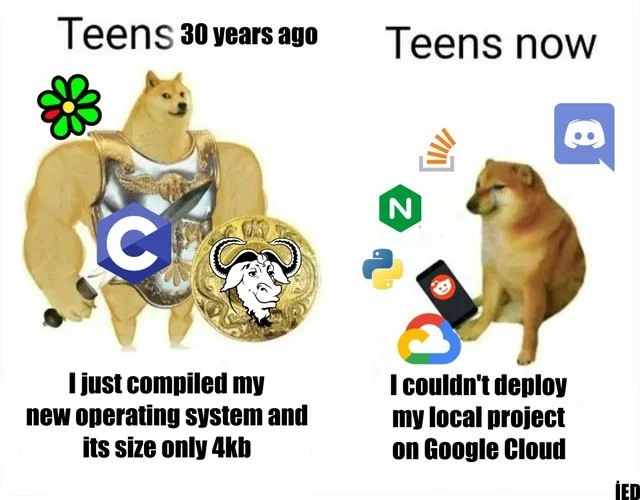
This is funny because the old teen looks powerful for making a tiny operating system, while the modern teen looks sad because he cannot put a small project on the internet. It is like one person building a little engine from scratch, and another person struggling to get permission to park a finished car in a giant parking garage. Both problems are hard, just in very different ways.
Level 2: Two Kinds of Hard
An operating system is the software layer that manages hardware and lets programs run. Building even a tiny one can involve low-level concepts like memory layout, booting, drivers, interrupts, files, and process control. The meme exaggerates this with the claim that a teen from 30 years ago compiled a new OS that was only 4kb.
Google Cloud is a cloud computing platform where developers can run applications on remote infrastructure. Deploying a local project there means moving code from your own computer to managed servers. That often requires configuration that has nothing to do with the app's main logic.
The modern teen's problem, I couldn't deploy my local project on Google Cloud, is relatable because deployment failures can be caused by many small mismatches: the wrong runtime version, a missing environment variable, incorrect permissions, a port not exposed, a database connection blocked, or a build command that works locally but fails in the cloud.
The meme compares systems programming complexity with cloud computing services complexity. One is close to the machine; the other is close to infrastructure bureaucracy. Both are technical, but they hurt in different places.
For newer developers, the lesson is that modern tools are powerful but not magic. Running code locally proves that the code can run somewhere. Deployment proves that the code, configuration, platform, network, permissions, and operational assumptions all agree at the same time. That agreement is where many afternoons go to disappear.
Level 3: From Bootloaders to Dashboards
Teens 30 years ago
I just compiled my new operating system and its size only 4kb
Teens now
I couldn't deploy my local project on Google Cloud
This meme uses the buff Doge versus sad Doge format as a compressed history of developer frustration. On the left, the exaggerated old-school teenager stands with the C logo and GNU mascot, proudly claiming to have compiled a tiny operating system. On the right, the modern teenager sits beside symbols for tools and platforms like Python, Nginx, Stack Overflow, Reddit, Discord, and Google Cloud, defeated by deployment.
The joke is not simply "old programmers were stronger." That is the mythic surface layer. The better joke is that the industry traded one kind of complexity for another. Low-level programming demanded close contact with memory, compilers, hardware assumptions, and operating-system concepts. Cloud deployment demands contact with identity permissions, service configuration, networking, build steps, environment variables, container settings, billing boundaries, logs, regions, and documentation written as if the reader already completed three other tutorials.
The left caption, its size only 4kb, invokes the romance of small systems: boot sectors, tiny kernels, demoscene minimalism, and the era when a program's entire world might be comprehensible by one determined person. The right caption invokes the modern Deployment reality where "local project" is almost never just local once it leaves the laptop. It becomes a cloud resource graph. A simple app may need a runtime, a web server, a database, a container registry, a service account, IAM roles, HTTPS, DNS, secrets, build logs, and a pricing model quietly waiting in the corner.
That is why the sad Doge is surrounded by logos instead of source code. The pain is not necessarily in Python or Nginx alone; it is in the glue. Each service is reasonable in isolation, but the complete path from "it runs locally" to "it runs on Google Cloud" crosses multiple ownership boundaries. The developer must understand the app, the platform, the deployment tool, and the failure mode produced when those three disagree.
The historical irony is delicious. Earlier computing had brutal constraints, but fewer layers. Modern computing has spectacular abstractions, but they often fail by leaking implementation details at the worst possible moment. We did not eliminate complexity; we moved it behind buttons, dashboards, YAML files, and permission screens. Progress, naturally.
Description
The meme is split into two columns labeled "Teens 30 years ago" and "Teens now." On the left, a muscular Doge warrior stands with old-school computing symbols including a C logo and GNU mascot, with the caption "I just compiled my new operating system and its size only 4kb"; on the right, a small sad Doge sits beside logos for Stack Overflow, Nginx, Python, Reddit, Google Cloud, and Discord, with the caption "I couldn't deploy my local project on Google Cloud." The humor contrasts romanticized low-level systems competence from earlier computing eras with modern deployment complexity, where even small projects can involve cloud platforms, services, and dependency-heavy stacks.
Comments
18Comment deleted
We traded fitting the OS in 4 KB for needing three dashboards to discover the service account is missing one IAM verb.
😂 Comment deleted
Что такое N? Comment deleted
Nginx Comment deleted
Благодарю Comment deleted
что такое I? Comment deleted
Что такое G? Comment deleted
Что такое E? Comment deleted
Что такое R? Comment deleted
Node Comment deleted
пи*да Comment deleted
что такое S? Comment deleted
At least nobody asked what is C Comment deleted
That's easy. Like C++, but C++-- Comment deleted
--C++ Comment deleted
If like this it's ++C-- Comment deleted
Google cloud 😍 Comment deleted