From Milk to Milk.zip to torrent: file-format logic applied to dairy
Why is this DataFormats meme funny?
Level 1: Download the Whole Cow
Imagine you want a glass of milk to drink. There are a few ways you could get it:
- You could pour fresh milk straight from a jug. That’s like having the thing itself, right there.
- Or, pretend you could somehow squish that milk down to make it easier to carry, and later get it back to liquid — kind of like how we turn milk into cheese, which is easier to carry around because it’s not sloshing everywhere and it lasts longer. Cheese is basically milk made more compact.
- Now, here’s the silly part: what if instead of getting milk at all, you went and got a whole cow delivered to your house? With a cow, you can get fresh milk whenever you want, straight from the source!
This meme is funny because it’s taking those three ideas and labeling them with computer words:
- The regular milk is like a normal file on your computer.
- The cheese (milk that’s been condensed) is labeled “milk.zip” as if the milk was squished into a smaller file –
.zipis just a name that means a compressed package of something. - And the cow is shown with the word “torrent”, which in computer terms is a special way to download stuff by getting bits of it from lots of places. It’s as if to say, “if you used that fancy download method for milk, you’d end up somehow downloading a whole cow!”
Think of it like this:
- Buying a bottle of milk from the store is simple, like downloading a file normally.
- Packing the milk into a smaller box (imagine powdered milk or cheese) is like zipping a file to make it smaller to send to a friend.
- But calling a farm and ordering a cow to your house because you want milk? That’s overkill in real life – and that’s why it’s so goofy. It’s like using an extremely complex method to solve a simple problem, which makes us laugh.
So the big joke is comparing everyday milk and cheese with computer files. Even if you don’t know much about computers, you know a cow is way more than a glass of milk. The idea of “downloading” a cow is just plain ridiculous! It tickles people because it’s mixing something ordinary (dairy products) with something nerdy (file downloads) and coming up with a crazy result. Essentially, the meme is saying:
- Milk is just milk.
- Cheese is milk in a smaller form (milk made compact).
- If you think like a computer person and go one step further, you’d do something wild like getting a whole cow for that milk.
Anyone who’s ever used a computer to zip files or download torrents will get an extra chuckle, but even without that, the image of a cow being the way you’d “download milk” is a funny exaggeration. It’s like if someone asked for a cup of juice and another person said, “Sure, let me download you an orchard of oranges.” It’s silly on purpose — that’s the heart of the humor.
Level 2: Food as File Types
Now let’s explain this meme in a straightforward way, as if to a junior developer or an interested non-developer who knows a bit of tech lingo. The meme takes the concept of file formats and distribution methods and compares them to forms of dairy (milk products and a cow). Here’s what each part means:
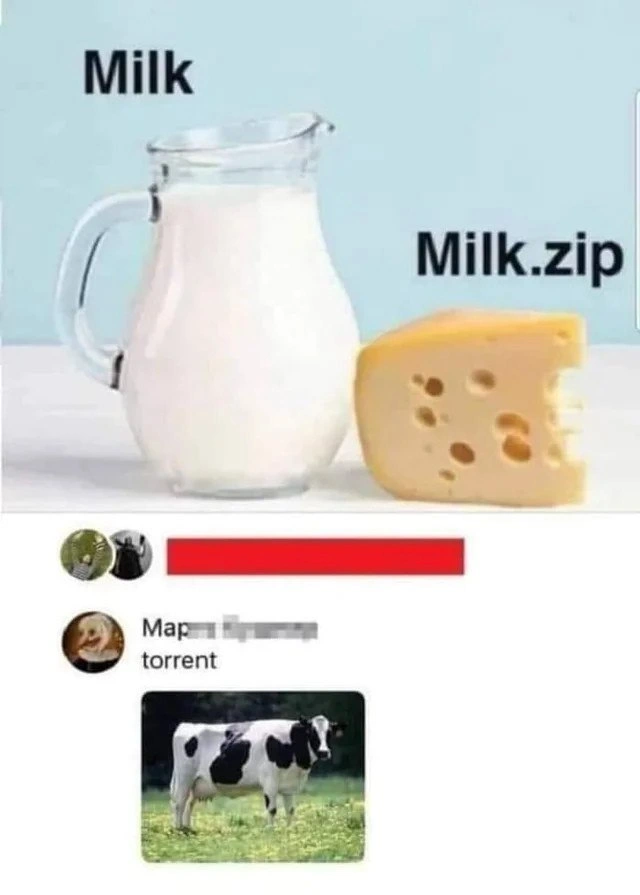
Milk (the left image, labeled "Milk") – This represents a raw file or just data in its original form. Think of it like an uncompressed file on your computer. For example, a full-quality image or an original text document. It hasn’t been packed or reduced in size; it’s the whole thing as is. In the picture, it’s just a plain pitcher of milk, nothing done to it. So in the analogy, milk = the raw data.
Milk.zip (the right image with cheese) – The “.zip” part is key. In computing, “.zip” is a file extension for a ZIP archive, which is a common format for file compression. When you “zip” a file or folder, you’re compressing it – meaning you make it smaller for storage or transfer by cleverly encoding repetitive bits and leaving out unnecessary information (in a way that you can later restore fully). We often compress files to save space or send them quicker over the internet. Now, how does that relate to cheese? The meme humorously treats cheese as
milk.zip– essentially saying cheese is a compressed version of milk. Why? Well, cheese is made by taking a lot of milk and removing a bunch of water and concentrating the solids (curds). You end up with something smaller and denser that contains much of the milk’s substance (fats, proteins) in compressed form. It’s like how a file compression algorithm might remove redundancy and pack data tighter. So in the analogy, cheese = milk compressed into a smaller package (milk.zip).If you think about it, to get a chunk of cheese, you might need several cups of milk. Likewise, when you unzip a compressed file, it “inflates” back to a larger size. The joke is that cheese is milk that’s been “zipped up” into a concentrated block. It’s a playful visual way to understand what a ZIP file does by comparing it to something familiar.
Torrent (the comment and cow image) – The bottom part of the meme is a comment where someone just says “torrent” and shows a picture of a cow. This is referencing the BitTorrent protocol, usually just called a torrent when we talk about files. A torrent is a way to download files via peer-to-peer networking. Instead of getting a file from one place (like clicking a download link from a single server), with a torrent you download bits and pieces of the file from many other people (peers) who already have those pieces. Your computer assembles all the pieces together to recreate the original file. Torrents are popular for sharing large files (like Linux distributions, videos, etc.) because they distribute the load across many users. Now, what does it mean in the meme? The commenter is joking that if milk is a file and cheese is a zipped file, then to follow that logic, a milk torrent would give you something even bigger or more original than just milk – it would give you the entire cow (since cows are where milk comes from!). Essentially, cow = the full source of milk. It’s like saying, “Why get just the data (milk) when you can get the source it comes from (the cow) by downloading via torrent?” This is a comedic exaggeration because of course, downloading a torrent doesn’t usually give you more than the file – it’s just a different method to get the same file. But the meme treats the torrent as if it’s magically delivering the actual cow to you, which is silly and that’s why it’s funny.
Let’s put the mappings clearly:
| Tech Concept | Meme’s Dairy Equivalent | Explanation |
|---|---|---|
| Raw file (uncompressed) | Milk (pitcher) | Original form, full size content. |
Compressed file (.zip) |
Cheese (milk.zip) | Compressed form, data condensed (smaller). |
| Torrent download (BitTorrent) | Cow (as “milk.torrent”) | Peer-to-peer source, getting the origin of the data. |
In simpler terms, the top half of the image says: “Here’s milk. Now here’s milk.zip.” To a programmer, appending “.zip” to something means it’s a compressed archive of that thing. So seeing milk.zip with a picture of cheese is an immediate pun for anyone who knows both what cheese is and what a .zip file is.
The bottom half comment adds another layer by referencing torrenting. Typically, if someone posts a link to a large file, a nerdy reply might be, “Do you have a torrent for that?” meaning an alternate download method. Here, someone cheekily responded just with the word “torrent” as if saying: “If milk.zip (cheese) exists, maybe there’s a torrent for milk.” And they attached a cow picture, implying that torrenting milk gets you a cow. In internet humor, especially among developers, responding with one word like that (“torrent”) is a way to take the original joke a step further without a lot of explanation. It assumes the readers can connect the dots: milk → milk.zip → milk.torrent (cow).
For a junior dev or someone new to these terms:
- Zip file: a way to package one or more files and compress them so they take up less space. You’ve probably right-clicked and created a
.zipor opened one to extract files. It’s lossless, meaning nothing’s supposed to be lost in the process – you get the exact original files back when you unzip. We use zip files all the time to email projects or distribute software in a single neat file. - Torrent (BitTorrent): a method to download files by sharing the bandwidth load with others. Instead of one server sending the whole file, everyone who wants the file and those who already have it participate in exchanging pieces. It’s kind of like a potluck where everyone brings a little piece of the file to the table. You need a torrent client (program) and a
.torrentfile or magnet link which tells your client how to find those people and pieces. Torrents were and are used for legitimate large file sharing (like game patches, OS images) and yes, also for less legitimate sharing of movies, etc.
So in the meme, the social media reply “torrent” is both a technical reference and a punchline. It suggests using the most tech-heavy solution (a torrent) for something as simple as getting milk, and the result shown (the cow) is comically overkill. It’s like if someone said they wanted a cup of coffee, and a techie friend handed them a coffee plant saying “I got you the torrent version.” 😄
This connects to geek humor where we often apply computing terms to everyday life for laughs. It’s also an example of food_as_file_types humor, a mini-genre where food items are labeled as if they’re computer files or formats. Another subtle thing: this meme lives in the intersection of CodingHumor and InternetCulture. The format of showing an image with labels and then a humorous comment thread is common in meme circles, especially on sites developers frequent.
For a new developer, the key takeaways to understand the joke are:
- What compression (zip) is, and that cheese can be seen as “compressed milk”.
- What a torrent is, and that a cow can be seen as the “source code” of milk.
- The humor comes from translating these tech ideas literally into the physical world and seeing how ridiculous it becomes (because obviously a cow is much more complicated than a glass of milk, just like managing a torrent is a bit more complicated than a direct download!).
Once you know those, the meme is pretty straightforward and funny: It’s saying “milk is to cheese as file is to zip”, and then, “taking that further, if file.zip is cheese, then the torrent version of that file might as well just be the cow.” It’s a nerdy file_format_joke that combines knowledge of DataFormats (raw vs compressed) and Networking (peer-to-peer torrents) with an everyday subject.
Level 3: Cow-Sourced Download
For those with some industry experience, this meme hits on multiple levels of developer humor. Let’s unpack why seasoned tech folks found this so clever (and hilariously literal):
First, it’s playing on the classic pattern of over-extended logic in programming jokes. We start with a simple equivalence: Milk is like a raw file. Okay, cute. Then, cheese is milk.zip – a compressed version of milk. That’s a funny image and it makes sense if you think of cheese as “concentrated milk.” But an experienced dev knows this meme format well: there’s always someone in the comments who one-ups the joke by pushing the analogy to the extreme. Enter “torrent.” A torrent download of milk? That’s taking the file analogy to the next level by invoking peer-to-peer network distribution. And what do you get when you torrent milk? Apparently, an entire cow. 🤣
This escalation is funny because it’s absurdly logical. In developer culture, we often encounter colleagues who take things hyper-literally or follow a thought experiment to its wild conclusion (often for laughs). Here, the commenter treats milk as if it were a piece of data you might download. If plain milk is a direct download and cheese is a zipped download, then the ultimate source – the cow – would be like downloading from the original server itself, or even getting the source code. It’s reminiscent of how devs joke, “Why use the packaged library when I can get the source code and build it myself?” The cow is essentially the “source repository” for milk.
From an industry perspective, the meme is also poking gentle fun at how we handle resources:
Compression (Cheese): In software projects, we compress files to make them portable, whether it’s zipping up logs, assets, or build artifacts. Everyone’s had that moment of turning a bulky folder into a neat
.zipfile to email or upload it. Seeing a chunk of Swiss cheese labeled "Milk.zip" is a visual gag: it's taking that process we do on computers and mapping it to a kitchen scenario. An experienced dev might smile because they recall countless times they compressed something to save space or bandwidth – and here it’s as if a cheesemaker was the “compression algorithm” for milk. There’s truth under the joke: cheese really is milk with the bulk (water) removed, somewhat like stripping out redundant data.Torrent (Cow): Seasoned internet users (especially in the early 2000s era of distributing Linux ISOs or, ahem, Linux ISOs 😉) know exactly what a torrent implies. Instead of downloading one file from one place, you pull pieces from many peers. The comment dropping just one word, “torrent,” implies “Let’s apply peer-to-peer logic to this milk situation.” And the result shown is a cow, implying that using a torrent magically gets you the entire origin of the milk. This is humorous to a techie because it conflates distribution method with content. It’s like the commenter is saying, “Oh, you compressed milk? Well, I went and got the entirety of milk at the source. Beat that!” In real terms, if milk were data, a torrent might involve multiple farmers each sending you a bit of milk until you have a full glass. But showing one cow is funnier and simpler — it’s the original single source, acquired whole.
Why is this so relatable to developers? It mirrors our daily thought patterns:
- We often think about the most efficient or clever way to get something. If a normal person sees milk and cheese, they don’t think much beyond food. But a programmer’s brain, steeped in file systems and internet culture, immediately sees file formats: milk (raw data), cheese (zipped archive). It’s the kind of nerdy connection that makes us laugh because it’s both nerdy and oddly apt.
- Then taking it to “torrent” resonates with the part of dev life dealing with networks and distributed systems. Many have lived through the days of downloading large SDKs or disk images via BitTorrent because it was faster or more reliable. The idea of torrenting a physical commodity is just delightfully absurd. It’s like saying, “Why go to the store for milk when I can leverage an entire peer-to-peer network of cows to get it for me?” It lampoons our tendency to apply high-tech solutions to low-tech problems.
There’s also an undercurrent of MemeCulture here: the format of a two-panel image with a simple label on top and a witty comment screenshot below is typical in online communities. It’s communal humor — one person posts the initial joke, and someone else in the community tags onto it with a witty reply, creating a kind of collaborative meme. Devs enjoy this because it feels like pair programming a joke. The original poster did the setup (milk vs milk.zip), and the commenter wrote the punchline (torrent = cow). It’s a bit of geeky one-upmanship for comedic effect.
Finally, consider the internet culture aspect: references to torrents and file compression are staples of geek humor. They evoke nostalgia for older tech days (dial-up modems struggling with large zip files, or using BitTorrent clients back when that was the edgy new thing for sharing files). An older developer might remember when storing data was expensive and compression was critical (like zipping files onto floppy disks), or when peer-to-peer was the hot new way to distribute files without a central server. This meme tickles that part of our memory, but in a lighthearted way that doesn’t require actual archiving or networking headaches — just a laugh at the dinner table imagining a cow as a download.
In sum, the senior-perspective humor comes from recognizing real patterns (compressing data, grabbing source, distributed downloads) hidden in a silly context. It’s geek humor at its finest: taking something utterly mundane (milk and cheese) and viewing it through the warped lens of a developer’s brain, where everything maps to computing. The result is a multi-layered joke that’s udderly brilliant for those in the know.
Level 4: Peer-to-Peer Pasteurization
At the deepest technical level, this meme riffs on data representation and distribution by using dairy as an analogy. Let’s break it down in terms a systems architect or computer scientist would appreciate:
File Compression (the
.zipinmilk.zip): In computing, a ZIP archive compresses data using algorithms (like LZ77 and Huffman coding) to remove redundancy and reduce file size without losing information. By analogy, turning milk into cheese is like a physical compression algorithm. Raw milk is ~87% water, and cheese-making removes much of that water and packs the nutritious milk solids tighter. In information-theory terms, cheese has higher entropy density (more concentrated “milk-information” per ounce) just as a compressed file packs the same data into fewer bits. Lossless compression? Well, in computing, zipping is lossless (you can unzip to get back the exact original). In dairy, cheese isn’t truly reversible – you can’t perfectly “unzip” cheese back into milk (that would be some impressive rehydration algorithm). It’s more like a lossy compression in practice, but the meme glosses over that for the sake of the joke. The key idea is the concept of milk being condensed into a smaller form, akin to how a large file becomes a smaller.zipfile. This playful stretch of logic takes a real data compression concept and maps it onto the kitchen counter.BitTorrent (torrent): The commenter’s “torrent” reply shifts the joke from compression to distributed networking. A torrent (specifically the BitTorrent protocol) is a way to download files by grabbing pieces from many computers (peers) rather than one central server. Under the hood, BitTorrent breaks a file into chunks, uses cryptographic hashes to ensure each chunk’s integrity, and lets peers share those chunks in a swarm. The more peers (including seeders who have the whole file) in the swarm, the faster everyone can assemble the complete file. If we extend the dairy analogy to this peer-to-peer model, “downloading milk via torrent” might mean multiple sources providing parts of the milk simultaneously – imagine a network of cows all contributing a little milk to your glass at once! The meme simplifies this by just showing a cow as the torrent payload, essentially treating the whole cow as the “file” you get when you download the milk via torrent. In a tongue-in-cheek way, the cow represents the entire source of the data (milk). In computing terms, that’s like skipping the packaged download and cloning the entire repository or getting the original data source in its raw form. It hints at the idea of going to the source (literally the udder source, in the case of milk 🐄).
DataFormats and Packaging: We’re also seeing commentary on different data formats and distribution methods. “Milk” is analogous to a raw file (uncompressed data). “Milk.zip” (cheese) is a compressed archive of that data. A “milk torrent” providing a cow suggests a completely different format: not just a file, but an interactive source that can generate more files (milk) on demand. This borders on a meta joke about how developers sometimes approach problems – why settle for the file or even the compressed file when you can have the entire system that produces the file? It’s like opting to get an entire database dump or an API to the live data instead of a static data snapshot. In distributed systems theory, this also touches on data availability and replication: BitTorrent ensures availability by having multiple copies (cows) in the network. If one source goes down, others still supply milk. It’s a nod to resilient peer-to-peer design, much like how a herd of servers (or cows) is more fault-tolerant than a single server (one cow).
Networking Constraints and Humor: On a more theoretical note, consider the absurd efficiency (or inefficiency) of “milk.torrent.” In real networking, downloading a huge file via BitTorrent can often be faster or more reliable than a single source, especially if that single source is slow. But downloading a cow over the internet? That’s an amusing impossibility that highlights the physical/digital divide. It’s riffing on how the internet distributes intangible data effortlessly, but physical objects (like a cow) can’t be downloaded – yet here the meme imagines it as if they could be. There’s an implicit wink at how far file sharing has come: from simple downloads to torrents, the next joke-step is “materializing a cow out of data” (some futuristic 3D printing or Star Trek replicator humor). It’s a cheeky way to underscore just how powerful and almost magical our data distribution methods have become, by jokingly applying them to something concrete and absurd.
In essence, at this deep level the meme marries file compression algorithms with peer-to-peer networking protocols, using milk science as the carrier. A senior engineer might chuckle at the data_compression_analogy of cheese-as-zip, and the networking leap of logic in “milk torrent.” They appreciate the layers: the file_format joke on top, backed by real concepts like how .zip files work and how BitTorrent swarms share data. It’s a delightful case of taking serious CS concepts (entropy, compression, distributed systems) and finding their parallels in the dairy aisle.
Description
Image is split in two sections. Top half shows a clear glass pitcher full of white milk on the left, captioned "Milk", and a wedge of hole-filled Swiss cheese on the right, captioned "Milk.zip" - implying cheese is compressed milk. Bottom half is a screenshot of a social-media comment thread: a pixelated username (redacted with a red bar) replies "torrent" and embeds a photo of a black-and-white cow standing in a grassy field, humorously suggesting that a torrent download of milk would provide the entire source animal. The meme parodies file-format concepts - raw file, zipped archive, and peer-to-peer torrent - by mapping them to stages of dairy production, blending developer humor with everyday objects
Comments
6Comment deleted
Cheese is milk.zip and a cow is milk.torrent - sounds elegant until Legal wants an SBOM for every seeder and you’re notarizing 500 GB of udder metadata
When you realize dairy farmers have been running the world's oldest continuous integration pipeline, but nobody's documented the build process for converting grass to milk.zip - and now we're all just downloading pre-compiled binaries from the grocery store
This meme perfectly captures the essence of data compression: you take something liquid and voluminous (raw data/milk), apply an algorithm (fermentation/enzymatic processes), and get a dense, portable format (cheese) that's easier to distribute. The magnet link joke is chef's kiss - because of course you'd seed the original source material via BitTorrent. It's the kind of layered technical humor that works on multiple levels: file compression, P2P protocols, and the literal 'source code' being a cow. The only thing missing is a .tar.gz extension for when you need to compress the cheese further before shipping it across the network
Cheese: nature's LZ77 implementation - perfect compression ratio, but good luck decompressing back to milk
Milk.zip is cheese; Milk.torrent is a cow - compression ships the artifact, torrents ship the upstream repo with a nondeterministic build pipeline. Reproducible dairy not guaranteed
Milk.zip is the binary; torrent returns the entire repo (cow), but the build-from-source pipeline has a nine‑month compile and multi‑year aging stage