When you sneak production code past review and security catches you
Why is this CodeReviews meme funny?
Level 1: Cookie Thief Caught
Imagine you and your siblings have a house rule: no taking cookies from the cookie jar unless an adult says it's okay. Now, one evening you decide to break that rule. You quietly lift the lid, grab a big cookie, and think, "Heh, nobody saw me. I'm so smart!" You even start walking out of the kitchen, already tasting that cookie victory. That’s like the first part of the meme: the person did something they know they’re not supposed to (put new code into the real product without anyone checking) and they feel proud and sneaky about it.
But then comes the second part: suddenly, the kitchen light flips on and Mom or Dad catches you red-handed. Uh-oh! They're standing there with that "you're in big trouble" look. You freeze, cookie in hand, realizing you’ve been found out just before you could escape. In the meme, the senior developer is like that parent, catching the naughty developer just as he was about to leave after doing the misdeed. The dev has to put his hands up and surrender, just like you might slowly put the cookie back and apologize when caught.
The humor here is the dramatic way it’s shown. It’s as if sneaking a cookie turned into a scene from a cops-and-robbers movie. In real life, Mom isn’t going to pull out a megaphone and yell "Freeze!" with SWAT team gear. And in a real office, a senior developer isn’t actually going to tackle someone or pull a gun. But it feels that intense to get caught breaking an important rule. The meme makes us laugh because we’ve all had moments of trying to get away with something small and then facing an authority figure who immediately stops us. It’s funny and embarrassing at the same time.
So, basically: the developer tried to break a big team rule (like you sneaking a cookie) and the senior dev caught him immediately (like a parent catching a child in the act). The lesson is simple: when there are important rules, trying to secretly break them often ends in an “Oops, I got caught!” moment. And it’s extra funny here because the meme shows that moment as if it were a high-stakes arrest at the airport – a huge over-the-top reaction to highlight the point. If you follow the rules (ask for a cookie or do a code review), you won’t have to worry about getting busted in the first place!
Level 2: Code Review Checkpoint
Let's break down the scenario in simpler, real-world dev terms. Code reviews are a standard practice in software development where one or more other developers examine your code changes before those changes are merged and deployed. This usually happens on platforms like GitHub or GitLab in the form of a pull request (PR). Think of a pull request as the propose stage: "Hey team, I have some new code. Can you all take a look?" If everything looks good (no bugs, no security issues, code follows the guidelines), a teammate or senior dev gives approval and the code gets merged into the main codebase. This process is like a security checkpoint for code - it helps catch mistakes or bad ideas before they reach the production environment (which is the live system real users interact with).
Now, what did the developer in the meme do? He skipped that checkpoint entirely. Instead of making a pull request and waiting for review, he directly pushed his changes to the main branch and thereby to production. This is often jokingly called cowboy coding – acting solo and fast, without following team processes. It’s akin to hopping a fence instead of going through the gate. The caption says: “Me getting off work after pushing the production code without code review.” So picture him as a developer who made changes and went straight to deploying them live, not bothering to have anyone else look at it. In many teams, there are rules (like branch protection settings in Git) that prevent direct pushes to the main production branch. The fact he could do it suggests either those safeguards were off or he found a way around them. It’s definitely against the norms—like skipping a line at airport security and hoping nobody notices.
For context, here's how code is supposed to move to production in a healthy process:
- Write code changes – The developer fixes a bug or adds a feature on a separate branch (an isolated workspace).
- Open a Pull Request (PR) – They push that branch to the repository and open a PR, essentially asking for a code review. Colleagues (often including a Senior Dev or tech lead) will review the code. They might leave comments like “Hey, this part is confusing” or “This could break if user input is null, maybe add a check?”
- Incorporate Feedback – The developer responds to the comments, maybe changes the code to address issues. Eventually, the reviewers give approval (some teams require two approvals, especially for sensitive code).
- Merge and Deploy – Once approved, the code is merged into the main branch. An automated Continuous Integration/Continuous Deployment (CI/CD) pipeline usually runs tests and then deploys the code to production servers if all checks pass.
In our meme’s story, the developer jumped from step 1 directly to step 4 – no PR, no review, nothing. 🚫🔍 That’s why it’s like sneaking through an airport security checkpoint with something shady: there was no proper scan of his "luggage" (code changes). He confidently walks off, thinking "Ha, I'm done for the day, no one caught me." This ties into DeveloperHumor because many junior devs might fantasize about skipping tedious reviews or think “my change is so small, it’s fine.” But in reality, even a small unchecked change can cause big problems in production (e.g., a typo in a config file could crash an app, or a missed null check could throw exceptions for users).
The second panel caption reads: “Senior dev finding out before I managed to get to the door.” This implies that a senior developer discovered the rogue deployment almost immediately. Perhaps the team has monitoring on the repository that alerts when someone pushes to main, or the CI pipeline failed and sent up a red flag, or simply the senior saw the commit pop up in Slack. However it happened, the senior dev effectively intercepted the culprit before he could actually leave. In the image, we see the man kneeling with hands on head and a security guard aiming a gun. In the office scenario, imagine the senior dev confronting the junior at his desk or near the elevators: "Hold it right there! Did you just deploy without a review?" It’s obviously a comedic exaggeration — no actual guns at work! — but it dramatizes the feeling of getting busted for breaking a critical rule.
Why would a senior dev react so strongly? Because unreviewed changes are risky. Production is sacred ground: if it breaks, real users are affected and the company could lose money or reputation. Senior engineers are often responsible for the stability of the product (they might even be the ones on-call to fix issues at odd hours). They’ve likely experienced ProductionIncidents where something went wrong due to a bad deploy. So they enforce processes like code reviews to prevent those late-night emergencies and DeploymentAnxiety. When those processes are ignored (especially by someone trying to sneak off after doing so), it’s a big deal. In many companies, doing a direct push to production without review can trigger a whole incident response or at least a stern talk with your manager. It’s not just a CodeReviewPainPoints issue – it’s about trust and responsibility. Everyone on the team needs to follow the rules so that the software stays reliable and safe.
The humor here also comes from the speed and force of the response. The meme could have shown a gentle tap on the shoulder with “Hey, about that commit…” But instead it shows a full-on armed takedown. 😂 This exaggeration makes it funny and highlights the importance of the rule. It’s saying: code reviews are so vital that skipping them is practically a crime. The security_checkpoint_meme style drives the point home: you wouldn’t skip airport security with a prohibited item because you’d get tackled. Similarly, you shouldn’t skip code review with risky code because you’ll get “tackled” by senior devs or the process.
Let’s clarify a few key terms that appeared in tags and the scenario:
- Production: This means the live environment where the application or website is running for end-users. Changes here have immediate real-world impact.
- Deployment: The act of releasing new code to a certain environment (production, in this case). It often involves building the code, running automated tests, and then publishing it to servers or cloud services.
- Code Review: The practice of having other developers examine your code changes. This helps catch bugs, improve code quality, and share knowledge among the team. Often done via pull requests.
- Pull Request (PR): A request to merge your code changes from one branch into another (usually into the main or master branch). It includes a list of commits and file changes, and supports comments and discussions from reviewers. It’s the main tool to facilitate code reviews on platforms like GitHub.
- Senior Dev (Senior Developer): An experienced developer who often has additional responsibilities like mentoring others, reviewing lots of code, designing architecture, and making sure best practices (like doing code reviews!) are followed. In a team, a senior dev might be the one who must approve PRs for certain areas of the code.
- Cowboy Coding: A term for when a programmer writes code with little to no process, planning, or coordination – like a lone cowboy in the Wild West doing whatever they want. It often implies ignoring team standards, not writing tests, not doing reviews, etc. It's usually seen negatively in professional settings, because it can lead to unstable or unmaintainable code.
- Production Bug/Incident: An error or problem that occurs in the production environment. If new code introduces a bug that affects users (e.g., a login button stops working, or data is corrupted), that’s a production incident. These can be costly and stressful, especially if they happen off-hours.
- Deployment/Release Anxiety: The nervous feeling developers get when releasing new code, because there's always a chance something could go wrong. Proper process (automated tests, code reviews, gradual rollouts) helps reduce this anxiety. Skipping those safeguards would increase anxiety for anyone who understands the risks. (Though the meme character appears oddly not anxious — until he gets caught!)
In simpler terms, this meme is showing a developer doing something he really shouldn’t (pushing code live without letting anyone check it) and getting caught by a senior colleague who is responsible for code quality. It’s funny to developers because it hyperbolically portrays the situation as an airport crime thriller scene. But behind the humor is a real lesson: always do code reviews and follow your team’s deployment rules, or you might end up in serious trouble (if not literally on your knees, at least in reputation). It highlights those DeploymentPainPoints and ReleaseAnxiety feelings – skipping the process might save a little time now, but it could lead to much worse pain later. The meme is an inside joke: anyone who has worked on a software team knows this feeling, whether as the guilty party or the one holding others accountable. And if you’re new to this world, let this meme be a friendly warning: deploying unreviewed code is like trying to sneak a forbidden item past security – you’re gonna regret it!
Level 3: Pull Request Police
This meme captures the thrilling climax of a cowboy_coding caper gone wrong. In an ideal world, every change to the codebase goes through a code review via a pull request. That’s the standard safety net in modern software teams: you create a PR, your peers (especially a Senior Dev) scrutinize the changes, add comments, request tweaks, and only then give a thumbs-up (the famous LGTM – "Looks Good To Me"). Once approved, the code merges and eventually deploys to production. But here our intrepid developer decides to go rogue: they bypass that entire process and push code directly to the live system. This is the programming equivalent of smuggling contraband through an airport metal detector – a brazen no_code_review_push.
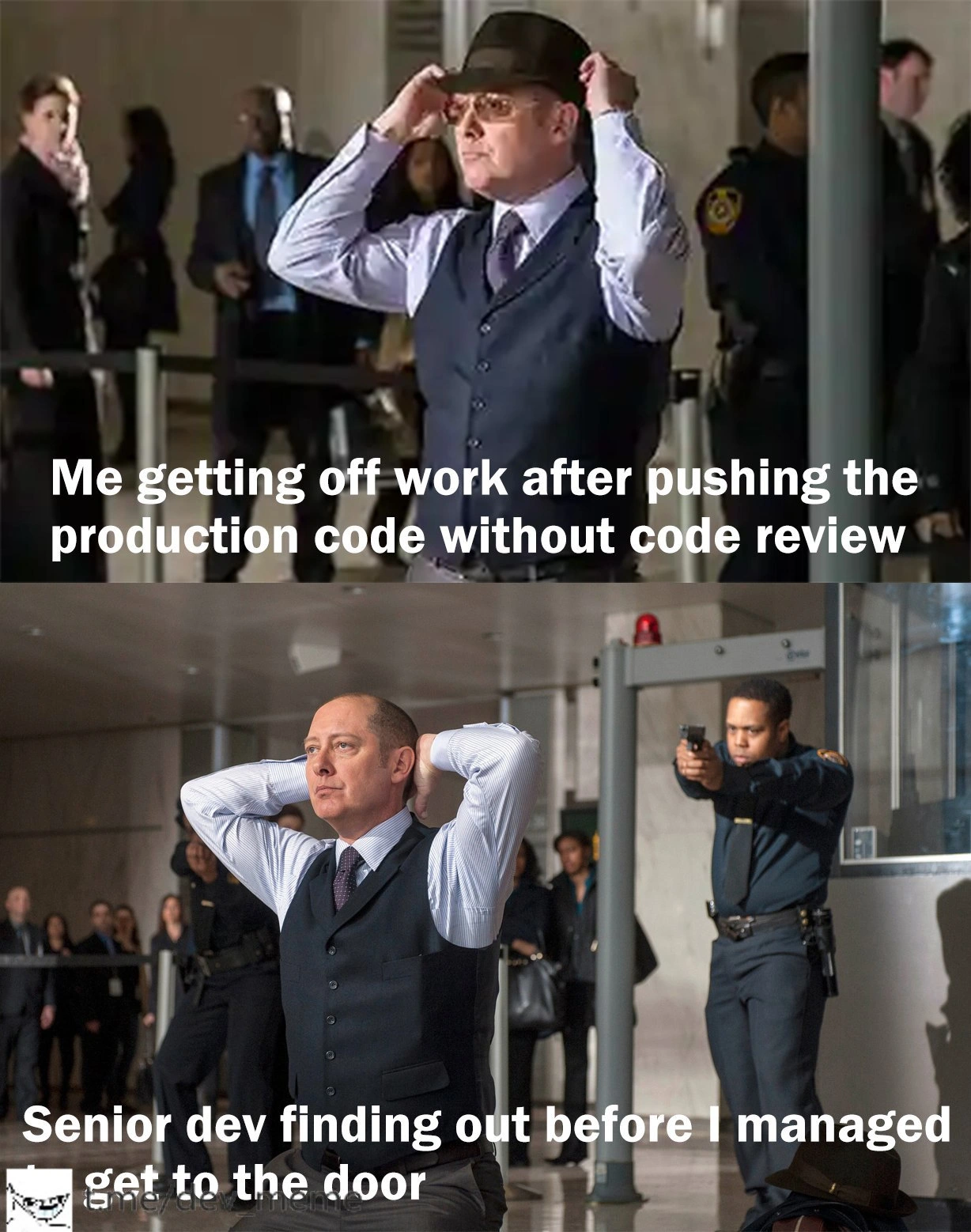
In the first panel, the developer struts through the "security gate" (i.e., the deployment pipeline) with a smug face, adjusting his hat like he just pulled off the perfect crime. It's the DeploymentAnxiety-fueled adrenaline high: "I did it! I got code live without anyone noticing. Time to clock out, nothing to see here." The humor here is how overconfident he is – any seasoned engineer knows this mindset is a ticking time bomb. Skipping code review might feel like a shortcut, but it's like walking out of the office with a blinking red light over your head. In real life, many teams have branch protection rules to prevent this exact stunt (e.g., requiring at least one review before merging to main). So to pull this off, either this team’s process is weak, or our sneaky dev found some loophole (perhaps he has direct access to production and did a manual change, yikes). The meme exaggerates it as a literal security breach at an airport: he’s sure he slipped past the metal detector of peer review.
Then comes panel 2 – the punchline: The same developer is on his knees, hands behind head, with a security officer’s gun aimed at him. Senior dev finding out before I managed to get to the door. This is dev_escape_attempt thwarted with extreme prejudice. The senior engineer has effectively tackled him at the door, just before he could slip away for the day. It’s a perfect metaphor: senior devs act as the last line of defense, the Pull Request Police, who do not mess around with rule-breakers. The armed guard imagery hilariously dramatizes how seriously tech leads take unauthorized production changes. After all, they've likely lived through on-call nightmares triggered by unreviewed code. A senior dev’s worst fear is discovering some Friday evening risky_deploy was done without oversight — that's how you end up woken at 3 AM by pager alerts because someone's "tiny fix" crashed the site or introduced a catastrophic ProductionBug.
The meme nails that shared industry trauma: one moment you think you've gotten away with a quick-and-dirty push, the next moment you’re face-to-face with the Production equivalent of airport SWAT. 🤣 Among developers, there's an unwritten rule: no code goes to prod without a second pair of eyes. Break that rule, and you'll face either immediate human wrath (like that senior dev with the gun... er, code review comments loaded and ready) or future karmic justice when the bug hits. The senior dev in the image isn’t literally going to draw a firearm in the office, of course, but you can bet they'd unleash a blistering code review or a stern talk in the team chat. The faces in the background (bystanders at the airport) are like the other team members or maybe QA folks, shocked and glad that the perpetrator got caught. Everyone in a dev team knows that letting unreviewed code slip by is a security and quality time-bomb. It will blow up, and nobody wants to be on cleanup duty because one person decided the rules don’t apply to them.
This scenario also pokes fun at the Deployment culture: many companies treat production deployments with almost ceremonial rigor (change approval boards, QA sign-offs, CI/CD pipelines with tests). When someone ignores all that, it's both terrifying and darkly comical. Terrifying because we've all seen what can go wrong; comical because the audacity is just facepalm-worthy. The meme essentially says: "I tried to be a smooth criminal with that last commit, but the code cops caught me red-handed." The dramatic arrest visuals reflect how a senior dev reaction can feel if you violate process: maybe not a literal takedown, but definitely a career-impacting confrontation. In reality, the "gun" might be a quick revert of your changes and a serious meeting with your lead first thing next morning.
From a senior engineer’s perspective, this joke hits home. They’ve reviewed 1000+ pull requests, fought production fires, and established processes precisely to avoid ProductionIncidents. When a junior bypasses that, seniors see their worst nightmares flash before their eyes (hence the drawn gun – it's a fight-or-flight response!). The humor comes from how extra the scene is: picturing Bob from accounting tackling Jim the developer at the office door because Jim skipped code review on a CSS file. It's absurd… yet it perfectly encapsulates the TechHumor of rule-breaking in software teams. The senior dev could have been peacefully sipping coffee, but now they have to play detective, figuring out who made an unauthorized change because something triggered an alert or code diff. There's also an element of ReleaseAnxiety: every deployment carries some stress, and code reviews help reduce that. By sneaking code, this developer just transferred all that anxiety onto the senior (and boy, is he angry about it).
In summary, the meme humorously illustrates a very real software engineering lesson: don't deploy like a lone wolf. If you do, expect the Pull Request Police (i.e., your vigilant teammates) to come down on you hard. It's a shared cathartic laugh for those who have seen a "simple unreviewed hotfix" bring down a system, as well as a wink that in healthy teams, someone’s got your back (or will kick your butt) to ensure quality. CodeReviewPainPoints become comedy here: it’s funny because we've all wanted to do this at some point when rushing, and also because we know exactly why it’s a terrible idea. The meme just takes that truth to action-movie extremes, with the senior dev as an armed hero preventing a disaster at the last possible moment.
Description
Two-panel meme using a dramatic airport security arrest scene. Panel 1 shows a well-dressed man walking away from a metal detector, adjusting his hat with a smug expression; white caption text reads, “Me getting off work after pushing the production code without code review.” Panel 2 shows the same man forced to kneel, hands behind his head, while an armed security officer aims a pistol at him; caption reads, “Senior dev finding out before I managed get to the door.” Background includes blurred bystanders, metal detector arch, and uniformed guards, all faces pixelated for privacy. The humor contrasts a risky, unreviewed production deploy with the swift, forceful response of senior engineers, highlighting best-practice violations around pull requests, code reviews, and deployment pipelines
Comments
6Comment deleted
Tried a Friday ‘git push --force --no-verify’ like breezing past TSA - senior dev’s audit-log webhook had me face-down before the CI even spun up
The only thing faster than a hotfix deployment is a senior engineer's git blame query when production starts throwing 500s - they'll have your commit SHA memorized before you've even updated your LinkedIn to 'seeking new opportunities'
The classic 'git push --force origin master && run' maneuver - where the time between your deployment completing and your Slack notifications exploding is inversely proportional to the severity of what you just broke. Senior devs have a sixth sense for unauthorized production deployments; they can smell a skipped PR review from three floors away, usually right around the time you're reaching for your coat. It's the software engineering equivalent of trying to sneak out of a house party you just set on fire - technically possible, but the smoke alarm (PagerDuty) tends to give you away before you hit the exit
Skipping review for velocity? Bold - until git bisect pins the outage on your commit in the RCA
A direct push to main is the UDP of change management - no handshake, and the first ACK is a staff engineer materializing with a rollback link and the SOC2 auditor CC’d
Force-pushing to main is sprinting past the metal detector; in mature orgs the only gun is a pre-receive hook and the bullets are rejected commits