Skip to content
DevMeme
2812 of 7435
Elon Musk Breaks Up with Bitcoin
Blockchain Post #3108, on May 14, 2021 in TG

Elon Musk Breaks Up with Bitcoin

Why is this Blockchain meme funny?

Level 1: Shiny New Toy

Imagine you have a favorite toy that you were super excited about. All your friends got excited about it too because a really cool kid in school was playing with that toy. Now, one day, that cool kid suddenly says, “I don’t like this toy anymore,” and he drops it on the ground and walks away to play with something else. How would everyone feel? They’d be surprised and maybe upset, right? Some kids who only started liking that toy because the cool kid did might even stop playing with it too, thinking “If he doesn’t like it, maybe it’s not cool anymore.”

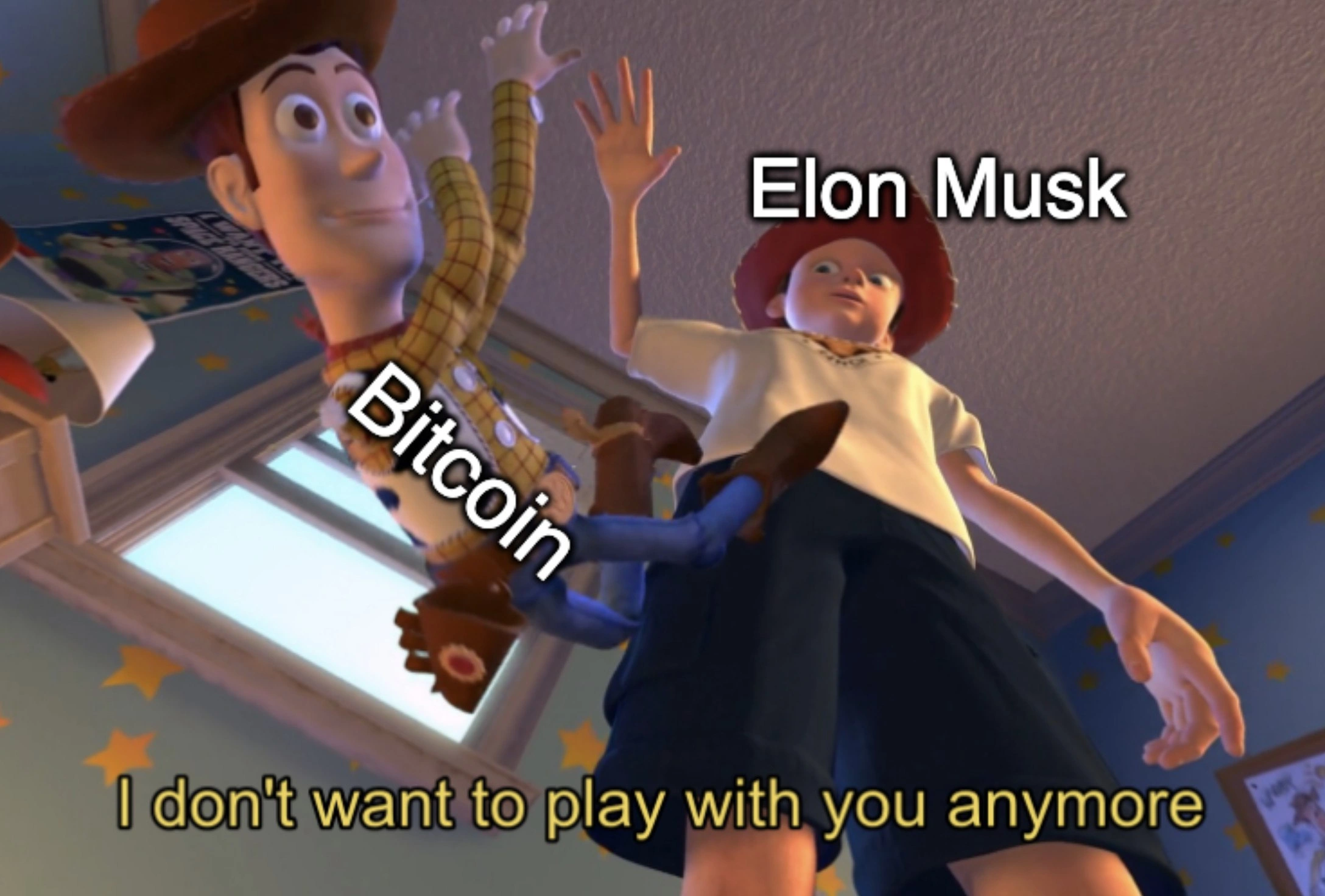
That’s exactly what this meme is showing, but instead of a toy, it’s talking about Bitcoin, which is kind of like digital money people get very excited about. And the “cool kid” here is Elon Musk, a famous technology guy that a lot of people pay attention to. Elon was playing with (supporting) Bitcoin, and everyone said “Wow, Bitcoin is so cool!” But then he suddenly decided, “I don’t want this anymore,” and dropped it. In the picture (which is a scene from the cartoon Toy Story), a boy drops his cowboy doll and says, “I don’t want to play with you anymore.” The meme replaced the boy’s name with “Elon Musk” and the doll’s name with “Bitcoin.” So it’s just like Elon Musk dropping Bitcoin like a toy he’s bored with.

It’s funny in a simple way because we don’t usually think of big important things (like money or technology) as toys – and we don’t think of adults as behaving like kids who get bored quickly. Seeing a grown-up situation turned into a kid’s playtime scene makes us laugh. It also feels a bit true: sometimes big trends or popular things are treated just like fads in a playground. One day everyone loves it, the next day nobody does, just because a popular person changed their mind. So the meme is like an easy-to-understand picture of how quickly excitement can disappear: one moment you’re a favorite, and the next moment you’re tossed aside like an old toy.

Level 2: Bitcoin Basics & Hype

Let’s break down what’s happening in this meme in simpler terms, and why it’s funny to people in tech:

The Image & Labels: We see a scene from Disney/Pixar’s Toy Story. In the original movie, a boy named Andy is playing with his favorite cowboy doll, Woody. But when Andy gets a brand-new Buzz Lightyear action figure, he loses interest in Woody. In one famous scene, Andy drops Woody and says, “I don’t want to play with you anymore.” This meme takes that moment and relabels it: the boy (Andy) is labeled “Elon Musk” and the doll (Woody) is labeled “Bitcoin.” The subtitle at the bottom actually quotes Andy’s line: “I don’t want to play with you anymore.” So the meme is showing Elon Musk dropping Bitcoin like a toy he’s bored with.

Who is Elon Musk? He’s a very famous tech billionaire – the CEO of Tesla (electric car company) and SpaceX (rocket company), among others. He’s also known for being very active (and sometimes unpredictable) on Twitter. His tweets and public statements often have HUGE effects. For example, if Elon tweets about a company or a product, a lot of people pay attention. In the context of cryptocurrency, Musk has been an influential figure.

What is Bitcoin? Bitcoin is the first and most well-known cryptocurrency. A cryptocurrency is basically digital money that isn’t controlled by any government or central bank. Instead, Bitcoin runs on a technology called a blockchain – think of it as a ledger or database that is duplicated across thousands of computers globally. Everyone has a copy, and they all have to agree on any new entries – this is called distributed consensus. New Bitcoins are created through a process called mining, where computers solve hard math problems (hash puzzles) and get rewarded in Bitcoin. All this is to say: Bitcoin is both a technology and an investment asset. It became extremely valuable (at one point around the time of this meme, one Bitcoin was worth tens of thousands of dollars).

Why was Elon playing with Bitcoin? Around late 2020 and early 2021, Elon Musk showed a lot of enthusiasm for Bitcoin. He even announced that Tesla had bought a large amount of Bitcoin and that Tesla would accept Bitcoin as payment for cars. This was a big deal – it made the price of Bitcoin go even higher because it was seen as a major tech endorsement. Elon’s support was like Andy playing happily with Woody – he seemed to love Bitcoin at that moment. The whole crypto community was excited because having someone as influential as Musk on board felt like a huge win. This period is an example of blockchain hype or cryptocurrency trends at work: whenever a respected tech figure praised a coin, everyone’s interest and the coin’s price would soar.

What changed? A short while later (in May 2021, right before this meme’s post date), Elon Musk suddenly changed his stance. He tweeted that Tesla “suspended vehicle purchases using Bitcoin.” The main reason he gave was environmental: he was concerned about the energy usage of Bitcoin mining (remember those computers solving math problems? They use a lot of electricity, some of which comes from coal and other non-renewable sources). Essentially, Musk went from “Bitcoin is the future!” to “Hmm, Bitcoin has issues; I’m stepping back.” He also started talking more about other cryptocurrencies like Dogecoin, which started as a joke but he found interesting. This was exactly like a kid dropping one toy and picking up another. People online joked that Musk treated Bitcoin like Andy treated Woody – fun for a while, then tossed away.

Why is this funny or significant to developers and tech folks? For one, it’s a meme culture thing: using a familiar movie scene to comment on a real-world event is a classic internet humor tactic. It’s relatable and goofy to see a big-shot CEO depicted as a temperamental child from Toy Story. The phrase “I don’t want to play with you anymore” is something a child would say – applying it to a billionaire’s very adult decision makes the situation feel absurd and comical. It highlights the immaturity some see in the crypto market – that even grown-up financial decisions can behave like playground games.

From a tech industry standpoint, it also mocks how volatile and influencer-driven the crypto world can be. Volatility means big ups and downs in price or sentiment. Bitcoin’s price and the whole crypto market often swing wildly based on news or tweets. When Elon praised Bitcoin, a lot of investors jumped in (the price went up); when he discarded Bitcoin, many investors freaked out and sold (the price went down). It’s almost like everyone was watching Elon’s Twitter to decide if they should buy or sell – which, frankly, was kind of true! This meme is poking fun at that reality.

Connecting to experiences: Even junior developers or newcomers have seen trends where something is super hyped one day and dropped the next. Maybe you remember a time when a particular tech (say, a new JavaScript framework or a hot programming language) was all the rage, and then suddenly it fell out of favor. In cryptocurrencies, this happens a lot – a coin gets hyped, its price skyrockets, then interest fades and the price crashes. It can feel like a crazy roller coaster. Here it’s happening because of a celebrity’s influence: Elon Musk quickly changing his mind acts as a trigger for a hype reversal. It’s a bit scary that one person can have that effect, but also darkly funny when portrayed through a meme.

We also see how internet humor blends tech and pop culture: the use of a beloved pop culture reference (Toy Story’s iconic scene) immediately communicates the emotion – dropping something you used to love – without needing heavy explanation. If you’ve seen Toy Story (or even if you just know the meme format), the image alone tells a story. Elon’s face isn’t literally in the image, but the label “Elon Musk” does the job. Same for “Bitcoin” on the toy. Our brains fill in the blanks: “Oh, Elon was playing with Bitcoin and now doesn’t want it anymore.” It’s a one-panel visual joke about celebrity market influence on a highly speculative tech asset.

In summary, at this level we learned:

  • Bitcoin = a popular cryptocurrency, runs on blockchain technology, subject to lots of market excitement (hype) and fear.
  • Elon Musk = influential tech celebrity whose opinions can dramatically sway public interest and market prices, especially in crypto.
  • The meme uses a Toy Story scene (“I don’t want to play with you anymore”) to illustrate Elon’s sudden decision to drop support for Bitcoin, making the situation easy to understand and humorously exaggerating it.
  • It’s funny (and a bit disconcerting) because it shows how something as serious as a digital currency’s fate can resemble a child’s fickle playtime decision. In tech terms, it’s highlighting a real cryptocurrency trend: fast shifts from hype to disillusionment, driven by personalities as much as by technology.

Level 3: Buzz to Bust

In this senior-level view, the meme’s humor comes into focus as commentary on crypto hype cycles and the outsized role of tech influencers. It shows Elon Musk (labeled on the boy from Toy Story, Andy) literally dropping Bitcoin (labeled on Woody, the cowboy doll) with the line “I don’t want to play with you anymore.” This is a pop-culture reference mashed up with a tech industry trend – something experienced developers chuckle at because it rings so true.

Why is this funny? Because it captures the whiplash-inducing volatility of cryptocurrency sentiment, especially when tied to a single celebrity’s whims. Elon Musk is depicted as the child Andy, meaning he was treating Bitcoin like his favorite toy one moment and abruptly discarding it the next. In early 2021, Musk went from being a major Bitcoin cheerleader to an abrupt critic. He tweeted enthusiastic support (even added “#bitcoin” to his Twitter bio and announced Tesla bought $1.5B in Bitcoin), sending the price to the moon 🚀. Then, not much later, he did an about-face, announcing Tesla would suspend accepting Bitcoin due to environmental concerns, and hinted at favoring other cryptocurrencies (like Dogecoin, the memecoin he frequently jokes about). That sudden reversal – basically dropping Bitcoin – caused a shock in the market. Prices of BTC tumbled, and the crypto community collectively felt that Andy just tossed Woody aside without warning. Developers and investors who’ve been through hype cycles recognize this pattern: a big shot’s endorsement creates euphoria, and their subsequent change of heart triggers panic. It’s the classic “pump and dump” feeling, except with a whimsical Toy Story twist for comedic effect.

From an industry perspective, this meme satirizes how fickle tech enthusiasm can be. We’ve seen similar dynamics beyond crypto too:

  • A tech CEO raves about a framework or programming language, everyone piles on to learn it, then the company suddenly pivots away, leaving developers holding obsolete skills – akin to “I don’t want to play with that tech anymore.”
  • Companies chase the latest buzzword (AI, blockchain, NFT, microservices) because a famous figure or competitor hyped it, only to abandon it when the next shiny object appears.
  • In the cryptocurrency arena, there’s even a term for big influencers: “whales”. When a whale (often a person or entity holding a huge amount of coin) makes a move or statement, the market can swing wildly. Musk is basically a whale with a Twitter account: one moment he’s all-in and the market inflates, next moment he bails and small investors feel the ground fall out from under them.

The shared trauma here for seasoned devs or traders is how one person’s tweet at 2 AM can wake you up with a production-scale crisis – not in the data center, but in your portfolio or project direction. It’s absurdly funny and painful because it’s true. This meme format is perfect: Andy’s casual discard of Woody mirrors how Musk nonchalantly changed his stance. The line “I don’t want to play with you anymore” in bright yellow subtitle is exactly what Musk’s actions communicated to Bitcoin. The humor has a sting: it implies Bitcoin was just a plaything or a trend to Musk, rather than a serious long-term commitment. For all the BlockchainHype, a single celebrity market influence can flip it into disfavor overnight.

Let’s not miss the PopCultureReference genius at work. Toy Story is a universally known childhood movie, and this specific scene is a popular meme format online (commonly labeled as “I don’t want to play with you anymore” meme). By casting Elon as Andy and Bitcoin as Woody, the meme taps into a collective memory to exaggerate reality in a relatable way. Everyone remembers Andy dropping his once-favorite toy when a newer toy (Buzz Lightyear) came along. In true meme culture fashion, Elon’s “new toy” could be interpreted as some other crypto or interest (some joked it was Dogecoin he preferred, analogous to Buzz supplanting Woody in Andy’s heart). The implication is Musk’s attention shifted to something else, leaving Bitcoin holders feeling like abandoned toys on the floor.

For senior folks in tech, there’s also an underlying commentary on market irrationality. We pride ourselves on building decentralized, rational systems, yet here we are watching billions of dollars swing on essentially an impulsive social media post. It’s a “too real” reminder of how crypto volatility often has more to do with Reddit threads and influencer tweets than with any code or fundamental value. The meme distills the situation to an almost childlike simplicity – which is funny because it is childlike: a kid losing interest in a toy, representing a multi-trillion-dollar tech trend being subject to playground fickleness.

Systemically, this highlights a gap between the ideal and reality: The best practice in a robust financial system is to rely on diversified input and fundamentals, whereas the reality in crypto is that a meme tweet can override technical merit or careful planning. That’s both hilarious and troubling. It’s a sign of an immature market (and an industry trend where hype can outpace substance). And it’s not easy to “fix” – you can’t patch human nature with code. Even if Bitcoin’s code is perfect, its community and investors can be swayed by charisma or fear of missing out.

In summary, at this level we see the meme as a wry nod to everyone who’s been on the rollercoaster of cryptocurrency trends. It encapsulates how blockchain hype can skyrocket and crash not due to a flaw in distributed consensus or encryption, but due to something as mundane (and comedic) as an influential person changing their mind. For those of us who’ve weathered a few tech manias, the image is both an eye-roll and a chuckle: here we go again, another shiny toy tossed aside. The juxtaposition of a kids’ movie scene with the high-stakes world of crypto speculation is pure TechHumor gold – reminding us that sometimes the difference between “to the moon!” and “I’m done with this” is just one tweet away.

Level 4: Hashing vs Hype

At the deepest technical level, this meme highlights an ironic clash between decentralized technology and centralized influence. Bitcoin runs on a trustless blockchain network secured by Proof-of-Work – a consensus algorithm where thousands of miners solve cryptographic hash puzzles (essentially performing trillions of SHA-256 computations) to validate transactions and add new blocks. This design brilliantly solves the Byzantine Generals Problem by letting the longest chain of hashed blocks (with the most cumulative work) represent the single source of truth. No single miner or authority controls Bitcoin; the network achieves distributed consensus through mathematics, game theory, and sheer computational power. The Byzantine Fault Tolerance of the system means it can resist malicious actors controlling up to 49% of the mining power. In theory, Bitcoin’s value proposition is that it's immune to whims of any one government or person – decentralized by design.

However, the humor of the meme comes from the paradox that despite this robust technical decentralization, the human side of Bitcoin is still very much vulnerable to central influences. The cryptographic protocol might be sound, but the market value of Bitcoin is emergent from collective human perception – and humans are anything but decentralized in their attention and trust. Here, Elon Musk (a single powerful influencer, essentially an external central node in the social network) tweets a change of heart and suddenly market sentiment shifts dramatically. The meme captures that even a trustless ledger secured by global hash power can’t escape the gravitational pull of a celebrity’s opinion.

There’s also a deeply technical reason behind why Musk dropped Bitcoin, rooted in the computational intensity of Proof-of-Work. Bitcoin mining consumes a staggering amount of electricity – globally on the order of many terawatt-hours per year, comparable to the power usage of small countries. This is a consequence of its difficulty adjustment mechanism: as more miners join and the network’s hash rate climbs, the puzzles automatically become harder to ensure blocks are found roughly every 10 minutes. This leads to a feedback loop of increasing energy expenditure to maintain security. Musk, as the CEO of an electric car company (Tesla), faced a conflict: promoting an energy-hungry cryptocurrency while championing sustainable energy. He cited the reliance on fossil fuels for Bitcoin mining as contrary to Tesla’s mission. This reflects a fundamental trade-off in distributed systems – security vs. efficiency. Bitcoin’s proof-of-work is incredibly secure and censorship-resistant, but at a massive environmental cost. Musk’s sudden public reversal on Bitcoin was partly a reaction to this technical reality of the protocol’s design (concerns about carbon footprint).

In essence, the meme’s humor and depth come from that contrast of domains: the bulletproof cryptographic consensus mechanism on one side, and the fragile social consensus mechanism on the other. The blockchain will chug along, faithfully solving hashes even if half the world walks away – yet a single influential tweet can still send the price plummeting. It’s a reminder that technology doesn’t exist in a vacuum: economic value and hype are controlled by messy human dynamics, not just elegant algorithms. Bitcoin’s code can prevent double-spending through math, but it can’t prevent a billionaire from double-taking his support. The decentralized network remains intact, but the centralized hype around it is as volatile as ever. This interplay of rigorous computer science with unpredictable market psychology is exactly what makes this scenario so fascinating to seasoned technologists. Even in a system designed to need no trust, we end up trusting (or reacting to) the opinions of loud voices – a true Proof-of-Work paradox if there ever was one.

Description

This meme uses the 'I don't want to play with you anymore' format from the movie Toy Story. The scene depicts Andy, labeled 'Elon Musk', dropping his longtime favorite toy, Woody, who is labeled 'Bitcoin'. The subtitle at the bottom of the image reads, 'I don't want to play with you anymore'. The image is a low-angle shot looking up at Andy as he discards Woody, emphasizing the finality of the decision. The joke directly references the events of May 2021, when Elon Musk announced that Tesla would no longer accept Bitcoin as payment due to environmental concerns over its mining process. This announcement caused a significant drop in Bitcoin's value and sent shockwaves through the cryptocurrency market. For experienced developers, the humor lies in the dramatic and fickle nature of market sentiment being driven by a single influential personality, perfectly captured by the nostalgic and slightly tragic meme of a child abandoning a beloved toy
Comments

9
Anonymous ★ Top Pick Bitcoin's distributed consensus is impressively robust, until it gets overruled by the centralized consensus of a single billionaire's tweet
  1. Anonymous ★ Top Pick

    Bitcoin's distributed consensus is impressively robust, until it gets overruled by the centralized consensus of a single billionaire's tweet

  2. Anonymous

    Our roadmap is starting to look like that Toy Story frame: yesterday every microservice had to write to Bitcoin, today it’s “drop it, we’re pivoting to AI” - turns out eventual consistency is easier to achieve than executive consistency

  3. Anonymous

    When your entire distributed ledger architecture depends on one guy's Twitter mood swings, you're not building Web3, you're building Web 2.0 with extra steps and higher gas fees

  4. Anonymous

    When your tech billionaire's tweets have more impact on your distributed ledger's consensus mechanism than the actual protocol design - maybe it's time to question whether 'decentralized' means what you think it means. Bitcoin survived nation-state attacks and regulatory uncertainty, but couldn't survive one CEO's quarterly mood swings and ESG reporting requirements

  5. Anonymous

    Built to survive Byzantine generals, Bitcoin still reroutes when a billionaire product owner flips the feature flag: acceptBitcoin=false

  6. Anonymous

    Elon Musk: the human 51% attack Bitcoin just successfully partitioned away

  7. Anonymous

    If your “decentralized” asset has an SLA tied to a billionaire’s tweet, you built a globally distributed event listener with an unmocked dependency

  8. Deleted Account 5y

    Dogecoin: EI

  9. @the_cash_network 5y

    Yep. Everyone who trades BTC or other crypto should keep notifications turned on the Twitter account of Elon. Saved me and helped me several times

Use J and K for navigation