Skip to content
DevMeme
7368 of 7435
DIY Laptop Built Inside a Pizza Box, Franchise Opportunities Available
Hardware Post #8076, on Jun 8, 2026 in TG

DIY Laptop Built Inside a Pizza Box, Franchise Opportunities Available

Why is this Hardware meme funny?

Level 1: The Shoebox Race Car

Imagine a kid who builds a "race car" by putting real engine parts in a shoebox — and somehow, it actually drives. Everyone laughs at the box, but the box is moving. That's this picture: someone built a working computer inside a pizza box, wires everywhere, nothing where it should be, and the screen lighting up anyway. It's funny because it's held together with hope instead of screws, and a little bit wonderful because it works at all — like a sandwich that's 90% toothpicks but still technically lunch.

Level 2: The Parts of a Laptop, Deconstructed

This image is basically an exploded-view diagram with a sense of humor. The pieces:

  • Motherboard: the main circuit board everything connects to — CPU, RAM, and all the ports live here. In a real laptop it's hidden under the keyboard; here it is the table the keyboard sits on.
  • Hard drive: the storage. Older mechanical drives have spinning platters inside and hate being bumped, which makes "loose in a cardboard box" a bold storage strategy.
  • Cooling fan: chips generate heat; without managed airflow they throttle or die. Cardboard traps heat, so this fan is fighting alone and outnumbered.
  • Bare LCD panel: the screen without its plastic shell or protective bezel — fragile, with exposed driver electronics along the edge.
  • The text on screen is a boot sequence — the messages a machine prints while starting up, proof of life for any DIY build.

The lesson hiding in the jank: computers are not magic sealed appliances. Every laptop you've owned is roughly this pile of parts, plus mechanical engineering. Builders learn more from one cursed project like this than from ten pristine unboxings — why cases are grounded metal, why drives are mounted on rubber grommets, why airflow is designed and not hoped for.

Level 3: Form Factor Is a Social Construct

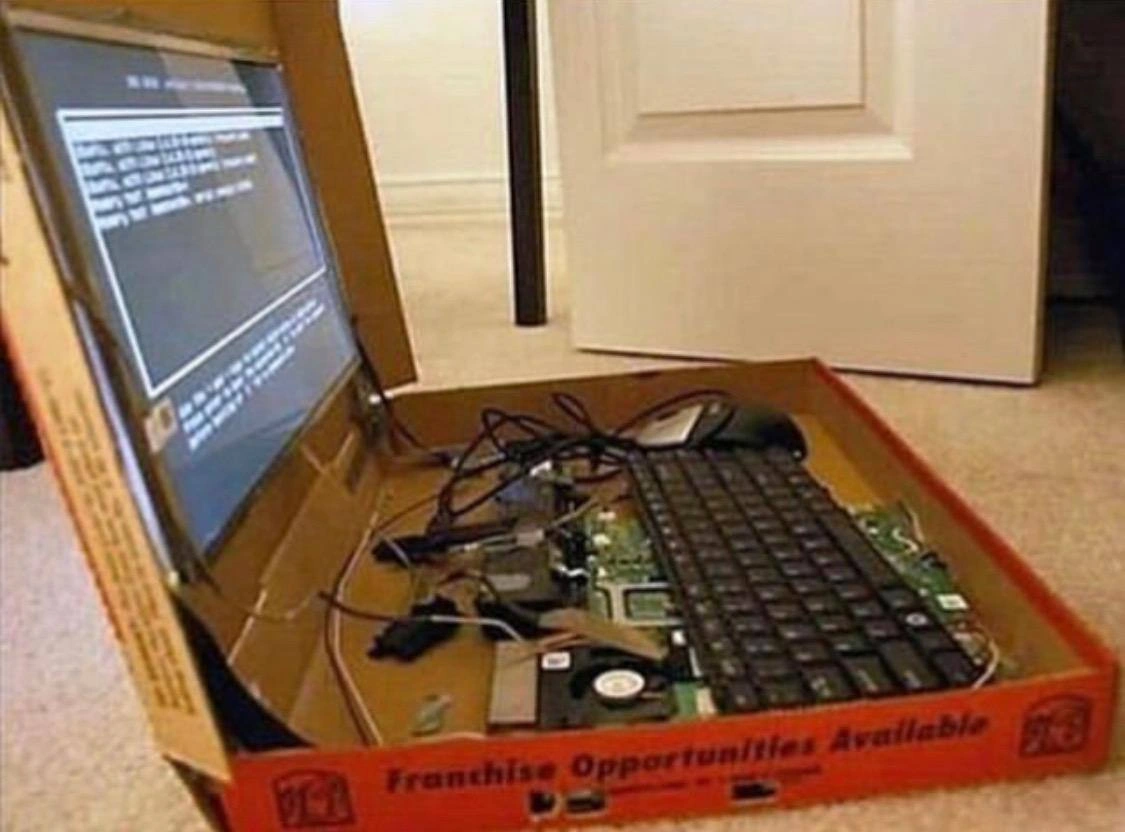
Strip away the cardboard and what's in this pizza box is a complete and apparently booting computer: a bare LCD panel mounted in the lid showing white-on-black startup text, a motherboard lying naked in the base, a 2.5" or 3.5" hard drive, a loose cooling fan, a salvaged laptop keyboard resting directly on the electronics, a mouse tucked in the corner, and a wiring harness with the topology of dropped spaghetti. The poster's caption — "Finally some proper edge computing" — works on at least two levels, since the machine literally lives inside crust-adjacent packaging and would die at the network edge the moment someone closed the lid.

What makes this genuinely interesting rather than just janky is that it accidentally demonstrates a truth the laptop industry spends billions obscuring: a "laptop" is just a desktop wearing a very expensive suit. The actual engineering value in a real notebook isn't the components — it's the integration: a chassis that provides grounding and EMI shielding, a thermal solution where the fan, heat pipes, and vents form a designed airflow path, a display hinge that survives ten thousand cycles, and a frame that keeps board flex from cracking solder joints. This build replaces all of that with corrugated cardboard, which is, notably, an insulator — both electrically (mildly reassuring) and thermally (deeply alarming). That lone fan is moving air inside a closed box made of the same material we use to keep food warm. The hard drive, a mechanical device sensitive to shock and vibration, is resting unsecured next to it. Every component here is one enthusiastic lap-adjustment away from a head crash.

And yet — it boots. That's the part every hardware tinkerer respects. This is the purest expression of the minimum viable product ethos applied to physical computing: identify what's load-bearing (board, storage, display, input, power), discard everything that isn't (dignity), and ship. The same instinct that produced this pizza-box laptop produced the original Apple I (sold as a bare board; wooden cases were the customer's problem) and a thousand homelab servers zip-tied into IKEA furniture. The orange rim's printed slogan, "Franchise Opportunities Available," elevates the whole thing into satire nobody had to write: yes, please, scale this. Open a second location.

The cable management deserves its own incident report. Nothing is strain-relieved, the display cable drapes across the board, and the keyboard sits directly on top of components that produce heat and have exposed pins. Anyone who has debugged an intermittent fault caused by a cable resting on a hot heatsink looks at this and feels a phantom pain.

Description

A photo of a homemade 'laptop' assembled inside an open cardboard pizza box on beige carpet, with a white door in the background. The lid holds a bare LCD panel displaying white-on-black boot/terminal text; the base contains an exposed motherboard, hard drive, cooling fan, tangled cables, a loose mouse, and a keyboard laid on top of the electronics. The box's orange rim ironically reads 'Franchise Opportunities Available' with phone icons. A classic example of redneck-engineering hardware hacking - a fully functional portable computer with the structural integrity of a large pepperoni

Comments

6
Anonymous ★ Top Pick Thermal design by Domino's: 30-minute uptime or your kernel panic is free
  1. Anonymous ★ Top Pick

    Thermal design by Domino's: 30-minute uptime or your kernel panic is free

  2. @dude_s7 4w

    Functionable laptop

  3. @Rokannon 4w

    Raspberry Pi...zza.

  4. @SamsonovAnton 4w

    Finally, some real pizza box computer!

  5. dev_meme 4w

    To keep it at the peak?

  6. @selfownson 4w

    Hey, guys Rate my brand new cutting-edge cyberdeck build

Use J and K for navigation