Skip to content
DevMeme
3330 of 7435
The Developer's Dilemma: Bad Salary and No Sleep
MentalHealth Post #3655, on Sep 7, 2021 in TG

The Developer's Dilemma: Bad Salary and No Sleep

Why is this MentalHealth meme funny?

Level 1: Worst of Both Worlds

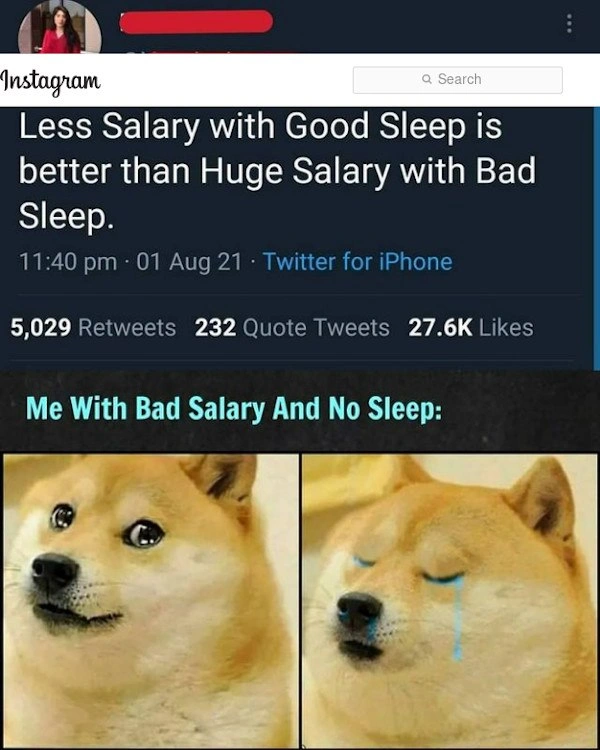
Imagine you have a job of being a night guard for a candy store, but here’s the deal: you stay up all night guarding the candy (so you’re super tired, because you get no sleep), and at the end of the night you’re paid with just one small piece of candy. 😢 That doesn’t sound fair, does it? You’d be thinking, “I missed my bedtime and I didn’t even get a big reward for it!” You’d probably have a tear in your eye, just like the dog in the picture.

This meme is joking about a very similar feeling. Grown-ups sometimes have jobs where they must be awake or available even during the night – sort of like being a night guard or a firefighter who can get called anytime. It’s hard because they don’t get enough sleep. Usually, if someone has to do that, you’d hope they get a big reward (a lot of money) so it feels a bit more worth it. But in this joke, the person has a job that keeps them up at night and they get only a small reward (not much money). It’s like the worst deal: no rest and very little prize.

Why is that funny? Well, it’s a bit like a cartoon exaggeration of feeling unhappy but presented in a goofy way. The top part even says, “Less Salary with Good Sleep is better than Huge Salary with Bad Sleep.” That means it’s better to sleep well and maybe not make tons of money, rather than be rich but always tired. The silly twist is our character saying “Haha, I have bad salary and no sleep.” It’s like if someone said, “I’d rather have one cookie and a good nap than five cookies and no naps,” and then a kid in the back says, “I got no nap and only half a cookie!” It’s absurd and unfair, which is exactly why it’s a joke — it makes us laugh because it’s such a terribly bad deal that you can only shake your head and chuckle at it.

The dog image (that cute Shiba Inu dog known as Doge) is used because it’s a popular way on the internet to show emotions in a funny way. In the first panel, the dog looks a bit blank and stunned — like when you realize something bad but true. In the second panel, the dog’s eyes are closed with a tear, showing he’s sad and tired. It’s an exaggerated, funny way to show how a person might feel on the inside. Even if you’re not a developer, you can understand the feeling: it’s like staying up all night to finish your homework and then getting a poor grade. You’d be upset because you didn’t get sleep or a good result. This meme just puts that feeling into a work context and makes it comic with the dog pictures.

So the simple idea is: getting enough sleep is really important, and not getting it makes you feel awful. If you’re not getting sleep or proper reward, it’s the worst! The meme makes us smile a bit at this painful truth. It’s saying, “Isn’t it funny (and sad) how I ended up with a bad combo: no sleep and also not much money?” It’s a bit of grown-up humor about jobs, but even without a job, you know that being tired and feeling under-appreciated is no fun. The humor is in how clearly unfair and extreme it is — so wrong that it becomes a joke image we can share and say “yep, that’s how I feel.” It’s a way to laugh at our troubles, just like a cartoon of someone with a tiny umbrella in a huge rainstorm. Sometimes laughing at a tough situation makes people feel a little better, and that’s what this meme is doing. It’s pointing at the situation and saying, “This is so bad, it’s kinda funny, right?”

Level 2: On-Call, Off Sleep

Let’s break down the scenario in more straightforward terms. This meme highlights what happens when a developer’s work life is all stress and no reward. The tweet at the top says: “Less Salary with Good Sleep is better than Huge Salary with Bad Sleep.” In normal English, that means it’s better to earn a bit less money if you can have a healthy amount of sleep, rather than earn a ton of money but be exhausted all the time. The meme-maker’s twist is to show themselves in a situation with low salary and no sleep – basically the worst of both worlds.

The bottom half uses the popular Doge meme. Doge is that famous Shiba Inu dog image that the internet loves for jokes. Here it’s presented in two panels: the first panel Doge has a blank, slightly disturbed look, and the second panel Doge has its eyes closed with a blue tear rolling down. The caption says “Me With Bad Salary And No Sleep:”. So the meme is saying: This is me, poorly paid and sleep-deprived. The two Doge images convey a kind of stunned sadness – first the shock of realizing “wow, I’m really getting a bad deal”, and then the exhausted tear of someone who’s accepted that harsh truth. It’s an exaggeration for effect, but not that far-fetched for many folks in tech.

Now, why would a developer have “no sleep”? Enter the concept of being on-call. Many software teams, especially those running websites or online services, have an on-call rotation. If you’re on call, it means if something breaks in the middle of the night, you get paged (alerted) to fix it. There’s even a service named PagerDuty (widely used in IT) which will literally send a loud alert to your phone if your system at work has an issue. Picture your phone making a siren noise at 2 AM because the website you maintain just went down – that’s the life of an on-call developer. PagerDuty fatigue is the burnout and chronic exhaustion that happens when those alerts happen too often. It’s like firefighter duty, except for websites and servers. You’re expected to jump up, clear-headed, and solve problems at any hour. Needless to say, this wrecks your sleep schedule. If on-call shifts aren’t managed well, you might have several nights of disturbances, leading to serious sleep deprivation.

Now pair that with “bad salary.” In tech lingo, a FAANG-level salary refers to the high salaries paid by big tech companies like Facebook, Apple, Amazon, Netflix, Google (FAANG). Those jobs can be demanding, but at least they pay top-of-market. On the other side, many startups or smaller companies might offer a much lower salary, sometimes with the promise of equity (shares in the company) or just the allure of doing exciting work. The meme points out a common complaint: some workplaces will give you startup compensation (comparatively low pay, maybe long-shot stock options) and still put you through extreme workload or on-call duty that wrecks your sleep. There’s an implicit expectation that long hours and late-night emergencies are easier to swallow if you’re getting a “huge salary.” You can imagine someone saying, “Well, they pay me a ton, so I’ll put up with the 3 AM calls.” But if you’re not paid much and you’re still up at 3 AM fighting fires, you feel pretty exploited.

A few technical terms appear in the meme’s description: SLOs and SLAs. These come from reliability engineering. An SLA (Service Level Agreement) is basically a promise a company makes to its customers about uptime or performance – for example, “our service will be available 99.9% of the time.” If the company fails that (too much downtime), there might be penalties. An SLO (Service Level Objective) is an internal target to help meet those SLAs – like “we aim for 99.95% uptime each week.” These numbers sound small, but 99.9% uptime still allows about 8.8 hours of downtime per year. The pressure to meet SLOs and SLAs means engineers have to respond very quickly to any outage, often regardless of the hour. In a well-resourced team, you’d have enough people to share on-call duties, and maybe automation to handle minor issues. In a strained team (or one with poor processes), a single developer might end up carrying the pager frequently and dealing with every hiccup. That means broken sleep and a lot of stress.

Let’s connect this to MentalHealth and DeveloperProductivity. Consistent lack of sleep isn’t just a minor annoyance; it can seriously affect mood, cognitive function, and overall health. Developers who are perpetually tired will likely feel DeveloperFrustration – easy tasks feel hard, creativity drops, and impatience rises. Over time, this can lead to DeveloperBurnout, a state of physical and emotional exhaustion. Burned-out developers sometimes become cynical, disengaged, or even quit their jobs or the industry. It’s a well-known issue in tech, which is why Work-Life Balance has become such a hot topic. Work-life balance means having enough time for work, rest, and personal life. Sleep is a huge part of that balance – it’s literally recovery time for your brain. The meme’s joke is effectively saying: “I have no work-life balance: I’m not getting the pay (work reward) or the rest.” That’s why it falls under Deadlines and OnCall_ProductionIssues in the categories – these are often the culprits behind those all-nighters and weekend emergencies. Tight deadlines can force developers to work late (sacrificing sleep), and on-call production issues wake them up unexpectedly. When combined with a culture that doesn’t compensate or give time back for those sacrifices, it feels very unfair.

To a junior developer or someone early in their career, the meme is both a warning and a wry piece of humor. It’s saying: be careful of situations where you’re working crazy hours (“high pager-duty”) but not seeing appropriate rewards (financial or even just acknowledgment and time off). Many of us learned about this the hard way: the excitement of a job can wear off fast if you’re perpetually exhausted. A common WorkLifeBalance tip you might hear is “Don’t check your work email or Slack after hours,” but if you’re the on-call person, you often must check, because ignoring an alert could mean real trouble (like the app being down for all users). Another tip is “Use your vacation days,” but if you’re the only one who knows a system, you might get calls even during vacation (yep, it happens!). The meme’s weary Doge with a tear is basically the mascot for those of us who’ve been in that tough spot: doing everything, at all hours, for far less reward than it feels like it should warrant.

In simpler terms: the meme cracks a joke about work stress vs. pay. It uses internet humor (Doge and a trending tweet) to make a point that tech folks instantly understand. Even if you haven’t experienced it yet, you can imagine how rough it is. Picture being woken up multiple times a week to fix things, chugging coffee the next day to stay awake at your desk, and then looking at your paycheck and thinking “Really? All that for this little?” It’s a mix of frustration and resignation. The reason other developers find it funny is because it’s true enough to hurt a little, and laughing is a coping mechanism. Better to laugh with a meme than to just cry alone, right? (Though our Doge is literally crying!).

Level 3: Five Nines, Zero Z’s

In the DevOps world, there’s a darkly comic reality: companies chase five nines of uptime (99.999% availability) while their engineers get zero Z’s of sleep. This meme encapsulates that brutal trade-off. The tweet up top preaches a simple wisdom — “Less Salary with Good Sleep is better than Huge Salary with Bad Sleep.” Yet the weary developer in the meme ends up with neither: a bad salary and no sleep. It’s the nightmare fourth quadrant scenario no one puts on recruiting slides. Experienced engineers wince because it hits close to home: the on-call pager (PagerDuty or its dreaded equivalent) keeps them up at 3 AM for yet another production fire, but the paycheck doesn’t even soften the blow. It’s a perfect storm of corporate dysfunction.

Let’s unpack why seasoned devs find this painfully funny. First, the Service Level Agreement (SLA) for the product is probably sky-high — “must be up 99.99% of the time, no downtime allowed!” Management promises customers near-perpetual uptime (and by extension, promises to wake an engineer at any hour to achieve it). Internally, they set aggressive Service Level Objectives (SLOs) that leave no room for error or restful nights. But here’s the rub: those lofty uptime goals are often supported by a skeleton crew of engineers making far less than their big-tech counterparts. It’s pager-duty fatigue on a shoestring budget. The company is effectively saying: “We can’t pay you much, but we’ll emotionally compensate you by letting you carry the on-call phone 24/7, deal?” 😒

This resonates with every senior dev who’s done tours in startup trenches or understaffed teams. You know the drill: a critical alert goes off at 2 AM (always just when you’ve dared to enter a REM cycle). You rocket awake to triage some database cluster hiccup or mysterious “network glitch” (it’s always DNS, until it isn’t). Your heart’s pounding from adrenaline and that ever-abiding deadline pressure – because of course this happens right before a big release. As you scramble bleary-eyed to get the site back up, a thought crosses your mind: “I’m not paid enough for this nonsense.” That thought is exactly the joke here. The meme exaggerates it by showing our poor Doge-faced developer with a blank stare of shock in one panel and a single tear in the next. It’s the face of someone who just realized they’ve been robbed in both dimensions: no sleep and no jackpot paycheck. The tweet said “choose good sleep over big salary,” but life handed them no sleep and a paltry salary. Talk about a rigged game!

From a senior perspective, the humor comes with a side of bitterness because we’ve seen how corporate culture can create this scenario. Many companies preach “work-life balance” in onboarding slides, but then set up reward structures that quietly glorify burning midnight oil. Young, idealistic devs are told “we’re a family” or “this is your baby”, which is code for brace for weekend deploys and midnight calls. In healthy teams, on-call rotations are rotated fairly and compensated (sometimes with on-call pay, or at least stock grants big enough to dull the pain). In worse teams, carrying the pager feels like a punishment for being competent – if you’re the only one who can fix it, guess who’s waking up every time? Over time this sleep deprivation accumulates into developer burnout. Productivity tanks, mistakes multiply, and ironically those heroic all-nighters cause the very incidents that trigger future 3 AM wake-ups. It’s a vicious cycle: code written at midnight tends to create bugs that blow up at midnight. Senior folks have learned (the hard way) that a sustainable system needs error budgets and backup engineers — basically acknowledging that humans need rest, not just SLAs. The meme hits because it’s highlighting an absurd anti-pattern: sacrificing personal SLOs (like, say, a healthy 7-8 hours of sleep) to meet corporate SLAs, without even the consolation prize of a FAANG-sized salary. That’s the too-real punchline. The Doge’s tear is every veteran engineer’s silent scream of “UNFAIR!” masked as humor.

One more meta twist: notice that tweet was posted at 11:40 pm. The author was literally up late on Twitter extolling the virtues of sleep over salary. Oh, the irony! It’s as if even the person tweeting it couldn’t follow their own advice. Senior devs chuckle at details like that – we live in a world where everyone says “get good rest,” but the system is engineered (or mis-engineered) to disrupt rest constantly. In reliability engineering, we talk about error budgets – a bit of allowed downtime so on-calls aren’t summoned for every blip. But some places blow through those budgets and straight into engineers’ sleep budgets. The meme exaggerates the resulting emotional debt: you’re not just technically in the red; you’re personally exhausted and underpaid. It’s dark humor, a cathartic laugh at our own expense for anyone who’s ever muttered “this job is killing me, and I’m not even getting rich off it.”

Description

A two-part meme contrasting a philosophical take on work-life balance with a developer's grim reality. The top half displays a screenshot of a tweet stating, 'Less Salary with Good Sleep is better than Huge Salary with Bad Sleep.' The bottom half, captioned 'Me With Bad Salary And No Sleep:', features a two-panel image of the Doge meme. On the left, Doge has wide, teary eyes, looking stressed and concerned. On the right, Doge is crying, with a single tear rolling down its cheek. This meme humorously captures the plight of developers, particularly in high-pressure environments like startups or during crunch time, who find themselves in the worst-of-both-worlds scenario: neither the high compensation nor the healthy work-life balance, just the stress and exhaustion
Comments

10
Anonymous ★ Top Pick The classic 'choose two' dilemma: high salary, good sleep, or a working CI/CD pipeline. I seem to have ended up with none of the above
  1. Anonymous ★ Top Pick

    The classic 'choose two' dilemma: high salary, good sleep, or a working CI/CD pipeline. I seem to have ended up with none of the above

  2. Anonymous

    We finally achieved four-nines availability by reallocating the entire sleep budget - turns out circadian rhythms aren’t tracked in the SLA dashboard

  3. Anonymous

    The real senior engineer flex isn't choosing between salary and sleep - it's having automated enough of your job that you can debug production issues in your dreams while your scripts handle the 3am pages

  4. Anonymous

    The real senior engineer move is recognizing this isn't a binary choice problem - it's a distributed systems failure where both your compensation AND sleep availability have achieved eventual inconsistency. The tweet presents an O(1) solution to an NP-complete problem: optimizing career satisfaction. Meanwhile, most of us are stuck in the worst-case scenario with O(n²) complexity - where n is the number of production incidents at 3 AM and our salary is inversely proportional to our on-call rotation frequency

  5. Anonymous

    Bad salary and no sleep: the real CAP theorem of careers - you pick two, but partition tolerance means you're always the one paged at 3 AM

  6. Anonymous

    We hit 99.99% uptime by financing it with 100% of my REM cycles - Procurement calls it pay‑as‑you‑go

  7. Anonymous

    After two decades I’ve learned the real SLO is REM per quarter - every 3am PagerDuty page converts RSUs into sleep debt at a terrible exchange rate

  8. @uberanima 4y

    Me with no salary and no sleep

  9. @furqan 4y

    What development can you do? lets get you some salary

  10. @furqan 4y

    Can't comment on sleep tho

Use J and K for navigation