Skip to content
DevMeme
4345 of 7435
Image not processed
Post #4746, on Aug 9, 2022 in TG

Image not processed

Why is this developer meme funny?

Level 1: All Chores, No Play

Imagine you love playing with LEGO blocks and building cool castles and robots every day. That’s like a programmer loving to write code to build apps and games. Now imagine that suddenly, instead of getting to build things with your LEGOs, you’re told to spend all day organizing the bricks, writing down plans for other kids on how to build things, and sitting in meetings with teachers about why we should build a castle. You hardly get to snap any bricks together yourself. Sounds boring and frustrating, right? You’d feel like, “Oh no, I’ve stopped being the kid who plays and I’m turning into the teacher who just talks about playing!” In this meme, that’s exactly what’s happening to the programmer. Coding is the fun part (the “play”), but they’re stuck doing the “chores” – attending meetings, updating charts and lists (that’s what Excel spreadsheets and JIRA tickets are for in a company). The developer suddenly realizes they’re basically doing a manager’s job (the boring adult stuff) instead of the fun creative stuff they loved. The picture shows a face of pure shock and horror, which is exaggerated and funny. It’s like catching yourself saying something a grumpy grown-up would say and thinking, “Yikes! I’m turning into my boss!” The humor here is that feeling of dread when playtime turns into paperwork, and everyone, even non-coders, can relate to that in some way.

Level 2: No Time to Code

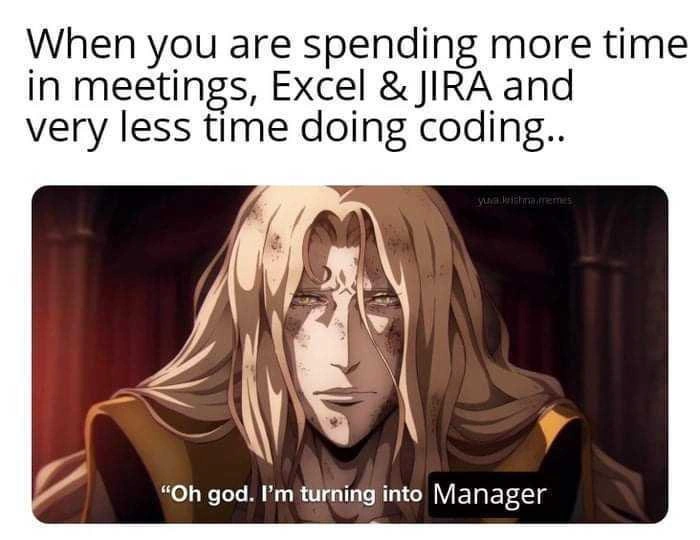
For a new developer, it’s surprising (and frustrating) to discover how much of your workday isn’t actual coding. This meme highlights that shock. The text says you’re spending most of your time in meetings, and updating things in JIRA and Excel, with very little time left to write code. That situation is a common reality in software teams and a big source of developer frustration. Instead of building cool features or fixing bugs, you might be stuck in back-to-back discussions and paperwork (well, digital paperwork). The bottom caption, “I’m turning into Manager,” is the dev’s panicked realization that they’re basically doing a manager’s job instead of coding.

Let’s break down the elements:

  • Meetings: These are gatherings (in-person or on Zoom) where the team talks about plans, progress, or problems. In an Agile team you have things like daily stand-up meetings (each team member says what they’re working on), sprint planning (deciding who will do what for the next two weeks), and retrospectives (talking about what went well or badly). Meetings are useful to coordinate work, but too many meetings eat up the hours of the day. A developer can end up with only small scraps of time between meetings, which makes it hard to get into coding flow. It feels like every time you start writing code, “Ping!” another calendar alert pops up and off you go to yet another discussion. This meeting overload leaves you exhausted with nothing built at the end of the day.

  • JIRA: JIRA is a popular project tracking tool used in software development. Think of it as a giant to-do list for the team. Each feature to implement or bug to fix is a “ticket” in JIRA that moves through steps like To Do → In Progress → Code Review → Done. Developers are expected to update these tickets as they work so everyone knows the status. It’s useful for organization, but it can become tedious. If you spend a lot of time typing updates into JIRA (“changed task status”, “added estimate”, “left a comment for QA”) and less time writing actual code, it starts feeling like bureaucracy. Some developers joke about “JIRA-driven development” where you’re clicking checkboxes on tasks more than you’re solving technical problems. In the meme, the developer sees their JIRA board open more often than their code editor, which is a clear sign something’s off from their perspective.

  • Excel: Microsoft Excel (or Google Sheets, similar idea) is a spreadsheet program. Managers often use Excel to make reports, track project timelines, or manage resources. For example, a project manager might maintain an Excel sheet listing all features, deadlines, and who’s assigned to what. Or a developer lead might have to fill an Excel with time estimates or cost calculations. Excel is powerful, but it’s not usually where developers want to spend their time — they’d rather be in code. When an engineer finds themselves tweaking formulas or making status charts in Excel, it feels like they’re doing a manager’s work instead of engineering. It’s a bit like a chef spending more time on paperwork than in the kitchen.

Now, why does the character say “I’m turning into Manager” with such horror? In tech, a manager (like a Project Manager or Engineering Manager) is someone who plans, coordinates, and tracks the work, rather than doing the hands-on technical tasks. Managers schedule meetings, check on progress, update spreadsheets, and use tools like JIRA all day. They often don’t do the actual coding themselves. Many programmers choose this career because they love coding and building things. So when a programmer finds they’re now mostly coordinating and reporting instead of coding, it can be scary or disappointing. It’s a moment of identity crisis: “Am I even a developer anymore, or have I become one of those people who just talk about the work?” The meme plays on that fear with exaggeration — the anime reaction image is super dramatic to make it funny. Every developer dreads losing their coding time to “managerial” duties, and seeing it happen to you can indeed feel like a horror story (albeit a mundane office-life horror).

In short, the meme is joking that the author’s developer productivity is dropping because of all the meetings and admin tasks. It’s funny to those in the know because it’s a very real trade-off in many tech jobs: too many meetings and tracking tasks = not much time to actually code. Newer devs often learn this the hard way when they enter the workforce — coding isn’t 100% of the job, and if you’re unlucky, it can shrink to almost 0%. That’s when you start joking, “Help, I’ve accidentally become a manager!”

Level 3: Manager Metamorphosis

In the top half of this meme, a blunt realization hits: “When you are spending more time in meetings, Excel & JIRA and very less time doing coding...” For seasoned engineers, this scenario triggers a mix of amusement and dread. It’s the classic slow-motion metamorphosis from developer to manager. The unholy trio of endless meetings, updating JIRA tickets, and tweaking Excel spreadsheets is basically the toolset of project managers and product owners. Over time, a hands-on coder can wake up to find their day consumed by status reports, sprint planning, and backlog grooming instead of writing code. The bottom panel’s anime character, recoiling in horror, perfectly dramatizes that inner scream: “Oh god. I’m turning into Manager.” It’s both funny and frightening because it hits so close to home. One day you’re optimizing algorithms; the next you’re optimizing Zoom calendars and color-coding cells in a spreadsheet.

This meme is hilariously on-point about a well-known industry anti-pattern: the best coder gets promoted (or dragged) into management, and suddenly their coding time evaporates. We joke that in corporate life, coding is what you do in the gaps between meetings. Here the balance has tipped so far that coding barely happens at all. It’s a comedic exaggeration of real life, where processes and “meta-work” (talking about the work, tracking the work) start to eclipse the actual work. In an Agile software team, you might have daily stand-ups, planning sessions, backlog refinement meetings, sprint demos, retrospectives – each is supposed to help the team, but stack them together and half your week is gone. Add in updating JIRA for every tiny task and maintaining elaborate Excel reports for stakeholders, and an engineer’s schedule starts looking indistinguishable from a project manager’s.

There’s also the classic maker’s schedule vs manager’s schedule conflict at play. Developers (makers) need long uninterrupted blocks of time to get into “flow” and write code. Managers operate on a chopped-up calendar of half-hour/hour slots for meetings. When a coder’s calendar starts looking like a Tetris game of back-to-back meetings, it’s a red flag that they’ve been pulled into the manager track. The meme nails this irony: the developer has lost their flow to a flurry of context-switching commitments. They’re spending more time grooming JIRA tickets and updating Excel sheets than compiling code – a true nightmare for someone who lives to build and debug.

The humor works because it’s painfully relatable. The loss of coding time and creeping Excel-and-JIRA overload are almost a rite of passage in big organizations. You know you’re morphing into management when:

  • IDE replaced by Excel – You catch yourself debugging a complex Excel formula instead of a code module. Your once-beloved IDE (Integrated Development Environment) gathers dust while you perfect pivot tables.
  • JIRA-driven development – The highlight of your day is moving a JIRA ticket to “Done”. You get more dopamine from clearing out a backlog column than merging a pull request.
  • Calendar Full of Meetings – Your Git commit graph looks sparse, but your Outlook calendar is a dense jungle of color-coded meetings. (Half of them you silently think “This could have been an email”.)
  • Email and Admin Overload – You’re writing detailed status updates, documentation, and grooming task lists. By evening, you realize you produced more paragraphs in emails and JIRA comments than lines of code in the codebase.

In pseudo-code form, it’s like:

// A tongue-in-cheek detection script for manager metamorphosis
if (calendar.meetings.length > 5 && commitsToday === 0) {
    console.log("Oh god, I'm turning into a Manager!");
}

Experienced devs share this meme with nervous laughter. It captures the career progression panic of accidentally trading a developer’s keyboard for a manager’s spreadsheet. There’s even a sardonic proverb in tech circles:

“You either die a coder, or live long enough to see yourself become a manager.”

In other words, without careful career planning (and a bit of luck saying “no” to meeting creep), any developer can wake up to find they’ve become exactly what they used to dread. The meme hits that nerve in a darkly comedic way, and everyone who’s struggled with meeting overload and JIRA hell can relate to the horror in that anime character’s face. It’s funny because it’s true – many of us have uttered a similar “oh no...” under our breath when our week slips by with zero code written.

Description

This image could not be processed due to an error

Comments

7
Anonymous ★ Top Pick I'd make a joke about this image, but I can't see it. Maybe it's a 404 error?
  1. Anonymous ★ Top Pick

    I'd make a joke about this image, but I can't see it. Maybe it's a 404 error?

  2. Anonymous

    I used to optimize L3 cache misses - now the hardest latency problem I face is finding a 30-minute slot on my calendar that isn’t already labeled “sync.”

  3. Anonymous

    The scariest part isn't becoming a manager - it's realizing your code reviews now consist of approving Gantt charts and your git commits have been replaced by status update emails that somehow always end with "let's take this offline."

  4. Anonymous

    The horror isn't becoming a manager - it's realizing you've spent three hours in sprint planning, two hours updating JIRA tickets, and one hour in Excel reconciling velocity metrics, only to discover you haven't pushed a single commit all week. Your IDE is gathering dust while your calendar is a Tetris game of overlapping meetings. You've become the very thing you swore to destroy: someone who says 'let's take this offline' and 'circle back' unironically

  5. Anonymous

    The real Big‑O shift: from O(1) compile times to O(n stakeholders) approvals - your PRs quietly became PRDs and your IDE is now “Calendar”

  6. Anonymous

    JIRA velocity spiking while git commits flatline: the inexorable approach of the management event horizon

  7. Anonymous

    You know you’ve crossed into management when the burndown lives in Excel, JIRA is your IDE, and the only merge conflicts you resolve are double-booked calendar slots

Use J and K for navigation