A Developer's Scathing Critique of the NFT Hype
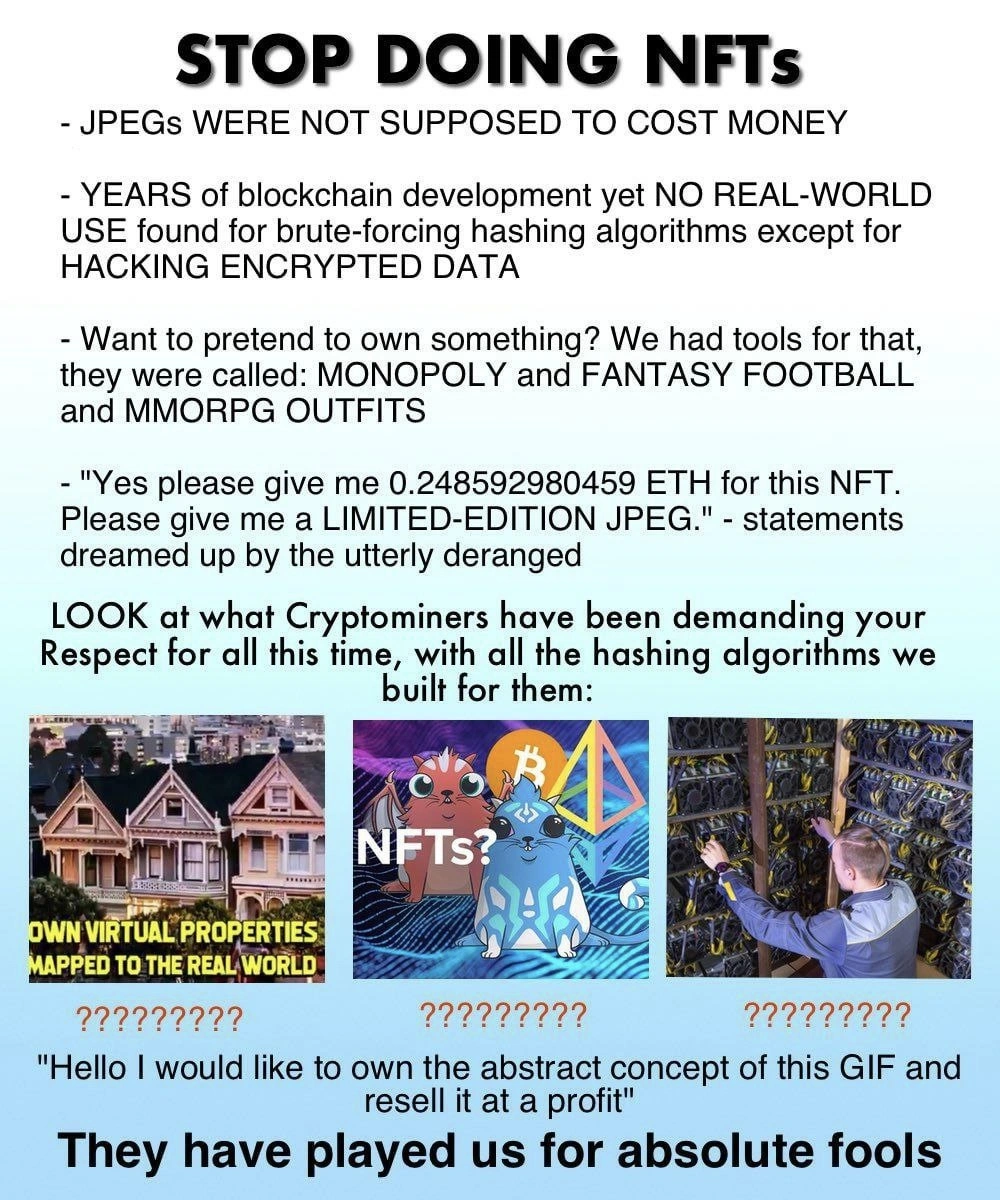
Why is this Blockchain meme funny?
Level 1: The Emperor’s New JPEG
Imagine a friend comes up to you and says, “See this picture? I paid a lot of money so I can say it’s mine.” You look at the picture – it’s just a regular picture on the internet, and everyone else can still see it, copy it, share it. In fact, you have a copy on your phone, and it didn’t cost you anything. Sounds silly, right? It’s like someone buying a fancy certificate that says they “own” a star in the sky: the star is still out there for everyone to see, but they have a paper claiming it. This meme is laughing at that exact idea. People are spending real money (imagine lots of allowance or salary) on digital make-believe possessions – like paying for a trophy that says you own a cartoon, even though everyone can watch the cartoon free. It also jokes about how we already played pretend ownership games as kids (and adults) without real money: think of Monopoly – you use fake money to buy fake property, or collecting cool outfits in a video game just for fun. In Monopoly, nobody would pay real cash for Park Place in the game, because it’s just for play. But with these new crypto collectibles, some folks are paying real cash (well, digital crypto money) for make-believe things, like a digital cat or a spot in a virtual world. The end of the meme basically yells, “They have made fools of us!” — like we all got tricked into thinking this was a smart idea. The funny (and sad) feeling behind it is kind of like when someone convinces you the invisible clothes they’re selling are the hottest new fashion, and you believe it… until you realize you’re basically naked and it was all pretend. In short, the meme is saying: This whole “buying an expensive digital picture” trend is crazy, and we should stop falling for it. It’s pointing out the obvious in a humorous way: don’t let tech hype make you do silly things with your money.
Level 2: Pretend Ownership 101
Let’s break down what’s going on here in simpler terms. This meme is essentially a big rant about NFTs and the cryptocurrency world, using a lot of tech sarcasm. If you’re new to these terms, here’s the scoop:
NFT (Non-Fungible Token): This is a special kind of digital token, usually on a blockchain like Ethereum, that represents a unique item. Non-fungible means it’s one-of-a-kind (unlike a Bitcoin, which is fungible – any one Bitcoin is equal to another). NFTs are often linked to digital art – think of them like a certificate of authenticity for a digital painting or a collectible. Owning an NFT of an image doesn’t stop others from copying the image; it just means your name (or rather, your crypto wallet’s address) is recorded on the blockchain as the “owner” of that token. In 2021, NFTs became super popular (or hyped) – suddenly people were paying crazy money for what basically amounted to limited-edition JPEGs or GIFs. The meme’s first bullet point, “JPEGs were not supposed to cost money,” is expressing disbelief that something as common and copyable as a JPEG image is being sold at high prices. JPEG is a standard image file format – usually free to download or share images in that format – so it feels wrong that a JPEG could be expensive. It’s like being told you have to pay to own a meme that everyone else can still see for free.
Blockchain development & brute-force hashing: A blockchain is a kind of database that’s distributed across many computers; it’s the technology behind cryptocurrencies like Bitcoin and Ethereum. One key part of some blockchains (like Bitcoin and, at the time, Ethereum) is a process called mining which uses a lot of computation. Miners use hashing algorithms in a brute-force way to secure the network and create new coins. A hashing algorithm takes input data and produces a short “fingerprint” (a hash). With brute-force hashing, you keep changing the input slightly and hashing again, millions of times, looking for a hash with specific qualities. This is basically what crypto mining does: it’s like trying billions of lottery tickets per second until one “wins”. The meme says “YEARS of blockchain development yet NO REAL-WORLD USE found... except for HACKING ENCRYPTED DATA.” This is a jab at how, aside from cryptocurrencies themselves, all this heavy-duty math hasn’t given us a cool new app or a cure for cancer or anything – it’s mostly been used for making money in crypto or theoretically could be used to crack passwords/encryption (which is normally a bad thing, associated with hackers). In simpler terms: we built super-powerful computing systems (and spent years optimizing these cryptographic hash algorithms) and the main thing we do with them is either running blockchain networks or maybe trying to break into secure data. The meme writer clearly thinks that’s not a great track record for a “revolutionary” tech.
Pretend ownership before NFTs: The meme lists Monopoly, Fantasy Football, and MMORPG outfits as examples of how people have always enjoyed “pretending to own something.” Let’s decode these:
- Monopoly: the classic board game. Players buy “properties” like Boardwalk or Park Place with fake money, and charge rent, etc. It’s all play-pretend; you don’t really own Times Square just because you have the Monopoly deed. The meme implies: if you like the feeling of owning stuff that isn’t real, you’ve already had Monopoly for ages – no need for NFTs.
- Fantasy Football: a game where sports fans draft real athletes onto imaginary teams. If you “own” Tom Brady in your fantasy team, it doesn’t mean you literally own him (of course not!); it’s just a fun competition. You feel proud if “your” players do well, but it’s not real ownership, just bragging rights. Again, the meme’s saying: hey, we already do this pretend ownership thing for fun (and we didn’t need a blockchain or cryptocurrency to do it).
- MMORPG outfits: In online games (Massively Multiplayer Online Role-Playing Games, like World of Warcraft or Final Fantasy XIV), players can acquire outfits, armor, or skins for their characters. Some are very rare or hard to get, and players might even trade them. These are virtual items – purely digital and have value mostly within the game community. The meme says we had those too – people paying (sometimes real money) for a cool sword or a shiny armor in a game. It’s hinting that NFTs are similar, except with NFTs the items aren’t even used in a game, they’re often just collectibles for the sake of collecting (imagine buying a sword that’s not even usable in any game, just to say you have it).
By listing these, the meme suggests that NFTs are basically another form of pretend ownership/collecting, but now it’s being taken overly seriously and monetized heavily. We used to do it for fun (or small stakes), now people are spending actual Ethereum (ETH) cryptocurrency on it.
“Yes please give me 0.248592980459 ETH for this NFT. Please give me a LIMITED-EDITION JPEG.” – This long quote in the meme mocks the typical transaction language around NFTs. ETH is the abbreviation for Ether, the native cryptocurrency of Ethereum. It’s like saying “Please give me $600 for this NFT” (0.24859 ETH might be around that ballpark, depending on the date’s ETH price). The number has so many decimal places because cryptocurrencies are highly divisible; prices often aren’t round numbers like $20, they’re weird fractions of a coin. The meme is basically portraying someone ridiculously asking for a bunch of crypto money in exchange for a “limited-edition JPEG.” Calling it a limited-edition JPEG is sarcastic – “limited-edition” is a term usually reserved for prints of art or collector’s items that are scarce. But a JPEG is a digital file and can be copied infinitely, so making it “limited” is purely artificial. The meme writer calls whoever imagines saying this “utterly deranged,” showing how crazy they think it is to demand significant money for a digital image. This echoes a common criticism in early 2021: people were shocked at NFTs like a collage JPEG selling for millions of dollars at Christie’s auction. To many, it felt like the world had gone a bit mad with BlockchainHype.
Cryptominers demanding respect & the images with question marks: The meme then shifts focus to cryptominers – these are the folks (or companies) running the powerful computer rigs that do the hashing work for blockchains. Miners often talk about how they are securing the network, being part of a financial revolution, etc. The meme sardonically says “Look at what Cryptominers have been demanding your respect for... with all the hashing algorithms we built for them.” The tone suggests miners have been saying “Hey, respect us (and the blockchain tech) because we’re changing the world!” The meme then shows three examples of what this “world-changing” tech has been used for, each with a big row of question marks as if to say “WTF is this?”:
- Virtual properties mapped to the real world – likely referencing some NFT project or game where people buy digital ownership of real-world locations. Imagine an app where a house on your street is for sale, not the actual house, but a virtual token representing it, just for fun or speculation. The meme finds this pretty ridiculous – why do we need a distributed ledger to “own” a pretend version of a real house?
- NFTs (with CryptoKitties pictured) – CryptoKitties are shown as they’re a known, almost goofy example of NFTs: cartoon cats you can collect and breed. Underneath is just “??????????” because, well, how do you even justify that as a profound use of tech? The meme uses CryptoKitties to stand in for the whole NFT art/collectible craze. It’s not saying CryptoKitties itself is bad, more like “this is emblematic of the kind of thing we ended up with.”
- A man with GPU mining rigs – This is literally a look at the mining operation: shelves of powerful GPUs (graphics cards) all wired up, fans spinning, consuming loads of electricity to mine cryptocurrency. By placing this image alongside the other two, the meme is connecting the dots: all those mining rigs (right picture) enabled these bizarre virtual property and kitty trading schemes (left and middle pictures). Each has the string of question marks indicating bewilderment.
The caption below those images – “Hello I would like to own the abstract concept of this GIF and resell it at a profit” – is the meme mimicking what an NFT enthusiast might sound like. A GIF is an image format, often used for short animated loops (think funny animated memes). Saying “own the abstract concept of this GIF” highlights that buying an NFT of a GIF doesn’t mean you own the actual file exclusively; you own a kind of abstract token associated with it. It’s like saying you own the idea of the thing, which is quite odd. And of course the motive “and resell it at a profit” pokes fun at how a lot of people jumped into NFTs not to appreciate digital art, but to flip it – buy low, sell high, treating memes and art like investments. The meme finds this whole scenario bonkers.
“They have played us for absolute fools.” This final line is strong. “They” refers to the cryptominers/crypto proponents who hyped up blockchain technology. “Played us for fools” means made us look silly for believing them. Essentially, the meme concludes that we’ve been tricked or at least misled. In the context: tech people and the public gave a lot of attention and respect to blockchain and crypto innovations, and now it seems much of it was smoke and mirrors – we might feel foolish for buying into the hype. It’s a very pointed statement, showing just how fed up the meme’s author is with all this.
In simpler terms, the whole meme is a tech satire piece. It’s using humor and exaggeration to express real frustration with the state of the crypto/NFT industry in 2021. It covers concepts from cryptography (hashing algorithms) to industry trends (the NFT boom, cryptocurrency mining, virtual goods) in a way that assumes the reader knows the basics and is ready to laugh at how crazy it’s gotten. If you’re newer: just know that an NFT is like a digital collectible you can buy with crypto, cryptomining is the high-energy process that keeps certain crypto networks running (and earns miners new coins), and there’s a big debate on whether these things are the future of technology or just a speculative fad. This meme clearly takes the side that it’s mostly a ridiculous fad, listing examples to prove the point. It’s basically saying: “All this high-tech wizardry, and what do we have to show for it? Expensive proof-of-ownership for things that used to be meaningless fun.” No wonder the text is in all caps and dripping with sarcasm – it’s an outright tech humor rant.
Level 3: Hashing for JPEGs
This meme hits a nerve with seasoned developers by lampooning the NFT craze and the broader blockchain hype of the past few years. It’s funny in that “so true it hurts” way, pointing out that after all the lofty promises of decentralization and world-changing tech, one of the most headline-grabbing outcomes is people spending small fortunes on JPEG images and cartoon collectibles. The bullet points read like a frustrated engineer’s rant, each one skewering a different facet of the insanity:
“JPEGs were not supposed to cost money” – This line mocks the idea of paying for digital art files that, by their nature, can be copied infinitely at no cost. For decades we’ve shared memes and images freely; the very notion of a JPEG image costing thousands of dollars feels absurd. To an experienced dev, it conjures the memory of the internet’s principle of abundance – information wants to be free – being flipped on its head by artificial scarcity. The meme is basically shouting, “Why on earth are we suddenly treating a
*.jpgfile like a Rembrandt painting?!”“Years of blockchain development yet no real-world use found... except for hacking encrypted data” – Here the meme voice seethes at the mismatch between blockchain’s hype and its tangible benefits. Veterans remember being told that blockchain would revolutionize everything from finance to supply chain to voting. Fast forward, and what do we have widely in use? Mostly cryptocurrencies, speculative ICO tokens, and now NFTs. The line suggests that the monumental computational effort in cryptomining (all those fancy hashing algorithms and massive GPU farms) isn’t solving real-world problems – it’s either serving speculative digital gold or something nefarious like cracking passwords. It’s a jab at how over-engineered the whole thing feels when the outcome is arguably trivial. A senior developer might recall earlier IndustryTrends_Hype cycles – like the dot-com bubble or the 3D virtual world craze – where big promises often led to underwhelming results. This meme slots NFTs right into that pattern of overhyped tech.
“Want to pretend to own something? We had... MONOPOLY and FANTASY FOOTBALL and MMORPG outfits” – This is where the meme’s IndustryIrony shines. It draws parallels between NFTs and long-established forms of make-believe ownership that never needed a blockchain. Monopoly is literally a board game about pretend property ownership with fake money – a playful analog to buying virtual “land” or properties in some NFT metaverse. Fantasy football lets people draft imaginary teams and boast about “owning” top players’ performance stats for a season – all in good fun, and certainly without crypto tokens. And MMORPG outfits (say a rare armor in World of Warcraft or a flashy skin in Fortnite) are digital items that gamers covet and trade. Seasoned gamers and developers know that virtual items can feel valuable in context (who wouldn’t want the Legendary Sword of Awesomeness in-game?), but it’s understood to be within that game’s fantasy. The meme humorously points out that we’ve had these systems of pretend ownership for a long time; nobody required Ethereum or a distributed ledger to enjoy them. Yet now, with NFTs, people are acting as if “owning” a digital item is a groundbreaking idea – except the difference is they’re spending real cryptocurrency (real money) for the privilege. A senior dev chuckles because it’s like we’ve reinvented Monopoly money, except now it’s convertible to real cash and people are taking the game way too seriously. It’s a classic case of IndustryTrends where an old concept gets rebranded with tech jargon and sold as innovation.
The quote about trading 0.248592980459 ETH for a “LIMITED-EDITION JPEG” – This is meme-speak for the absurd negotiations seen on NFT marketplaces. That oddly specific number of ETH (Ether) is comedic because it reads like someone calculating an exchange rate or a precise bid for an exclusive item, when in reality it’s just a fractional cryptocurrency price. In mid-2021, 0.2485 ETH might have been hundreds of dollars (depending on Ethereum’s volatile price). Seeing a random long decimal of ETH for a JPEG highlights how disconnected from normal life this commerce is – can you imagine telling a friend, “I paid 0.24859298 Ethereum for a picture of a rock with sunglasses”? It underscores the CryptoBubble vibe – prices and quotes that sound like gibberish to the uninitiated, used to justify buying what’s essentially a link to an image. The meme calls these statements “dreamed up by the utterly deranged,” a brutal punch that echoes what many tech skeptics were thinking during peak NFT mania: have we all gone a bit insane? Engineers are generally a pragmatic bunch, so seeing huge real-world value assigned to an easily copyable digital file triggers a mix of laughter and facepalming.
Then the meme really drives it home with a visual gut-punch: “LOOK at what Cryptominers have been demanding your Respect for all this time, with all the hashing algorithms we built for them:” followed by images and captions:
On the left, “Own Virtual Properties Mapped To The Real World” under a photo of suburban houses. This hints at projects where people buy virtual tokens corresponding to real-world locations or properties – essentially NFT-based deeds that mirror actual places. It’s a real thing that happened: startups tried selling “virtual real estate” or augmented reality plots tied to real coordinates. To an experienced developer, this sets off alarm bells of déjà vu. Back in the late 2000s, there was Second Life where people bought virtual land, and even earlier, domain name speculation in the 90s dot-com era (buying domain names just to resell). The meme is insinuating that cryptominers – who have gobbled up GPUs and electricity – expect admiration because their blockchain tech enables owning coordinates of your neighbor’s house in a game. The row of question marks “???????????” underneath each image in the meme signifies a stunned, speechless reaction: Why is this even a thing?
In the middle, cartoon CryptoKitties with a big “NFTs?” label. CryptoKitties is an iconic example: a 2017 blockchain game on Ethereum where each digital cat is an NFT. People were breeding and trading cartoon cats, some selling for over $100,000. It was one of the first moments that exposed how NFT mania could clog a network – CryptoKitties famously slowed down Ethereum because it was so popular, consuming so much transaction throughput. By referencing it, the meme is basically saying, “All that advanced hashing and decentralized tech, and what did we get? Collectible digital cats!” It’s hilarious and painful – the kind of irony that makes developers shake their head. The “NFTs?” caption and the question marks resonate with any developer who remembers that craze and wondered, “Really? This is what we’re using our tech for?”
On the right, a photo of a man tending to rows of GPU mining rigs. Those are the heart of cryptomining operations – often warehouses full of graphics cards intensely crunching hashes. Around 2021, many devs and gamers were acutely aware of these because they caused a GPU shortage – graphics cards became scarce and pricey because miners were buying them en masse to mine Ethereum and other coins. The meme shows a miner examining his rig, with “???????????” beneath, implying “What are we looking at here? Racks of hardware burning electricity so someone can claim they own a GIF?” The juxtaposition is powerful: high-end hardware and complex algorithms, all boiled down to enabling these questionable CryptocurrencyTrends like virtual land and kitty collectibles. It’s as if the meme is pointing and laughing at the Cryptominers who often brag, “We’re part of a financial revolution,” while the evidence suggests a lot of it revolves around digital tchotchkes. When it says “Look at what we built for them,” there’s a sense of developer betrayal – like engineers poured sweat into optimizing GPUs, SHA-256, Ethash, and networking protocols, and miners used those gifts to... sell pixel cats and procedurally generated “art.” That’s the cryptomining irony on full display.
Finally, the text “Hello I would like to own the abstract concept of this GIF and resell it at a profit” is printed under the images. This made-up quote perfectly encapsulates the absurdity. It imagines a person walking up and earnestly saying this nonsensical sentence. The phrase “abstract concept of this GIF” highlights that when you buy an NFT of an animation (a GIF), you’re not buying the actual animated image file (anyone can still copy/view that); you’re buying the concept of owning it – essentially a bragging right anchored by a token. It sounds ridiculous because it is a foreign idea outside the crypto bubble. A seasoned developer might chuckle because it’s phrased almost like a bad sci-fi line. It reminds us of dot-com era absurd quotes, like “We don’t sell pet food, we sell the concept of pet ownership 2.0!” – an over-the-top parody of tech speak. And wanting to “resell it at a profit” pokes fun at the speculative nature of NFTs: many buyers in 2021 weren’t art connoisseurs cherishing a piece; they were speculators hoping the price would skyrocket so they could flip it. So this one sentence captures the spirit of the NFT rush: abstract, arguably pointless ownership + profit motive.
The closing punch-line “They have played us for absolute fools” ties the whole rant together with a bow of scorn. It accuses the crypto evangelists and miners of effectively tricking everyone – developers, investors, the public – into taking this stuff seriously. There’s a collective shame implied: we fell for the hype, we respected the buzzwords, and now we realize the emperor has no clothes (or rather, the emperor is wearing a very expensive JPEG). For an industry veteran, it’s a cathartic line. It voices that inner doubt: Have we all been had by this crypto craze? The meme doesn’t hold back – it outright calls it foolish. This resonates strongly in tech circles that grew weary of every startup suddenly adding “blockchain” to their pitch circa 2017-2021 without real justification. How many meetings did senior devs sit through where someone insisted NFTs or blockchain would disrupt X industry, and how many actual useful deployments came out of it? Not many, argues the meme, unless you count exchanging NFT cats as useful.
In sum, the meme’s humor comes from this stark contrast between the seriousness of the technology (hard math, powerful hardware, lots of cryptography) and the silliness of the outcomes (paying real money for pretend ownership of digital items). An experienced developer sees both sides and can appreciate the ridiculous irony. The meme dunks particularly hard on NFTs as the latest BlockchainHype fad: a phenomenon where folks are literally treating a digital picture like a limited-edition commodity. It encapsulates the exasperation many felt: We engineered an entire global distributed network... so someone could buy an NFT of a neon cat for $200k? It’s both hilarious and horrifying. The shared trauma of seeing brilliant tech co-opted by speculative mania makes this meme painfully on-point for those in the know. It validates the skeptic’s perspective with biting satire, saying in effect: “We suspected this was all a bit foolish – and look, it absolutely is.” For any developer who was ever told “you just don’t get how revolutionary this is” by a crypto-bro, this meme is sweet vindication.
Level 4: Proof-of-Work Paradox
In the depths of blockchain technology, we find a curious quirk: the system’s security hinges on performing brute-force hashing computations that are deliberately useless outside the chain. In academic terms, a cryptographic hash function (like SHA-256 or Keccak) produces a fixed-size jumble from any input; it's one-way, meaning it's practically impossible to retrieve the original input from the output. Proof-of-Work exploits this one-way property by turning hash computation into a lottery: miners must find a random input (a “nonce”) that, when hashed with the latest transaction data, yields a result with special properties (typically a certain number of leading zeros). Achieving this is pure trial-and-error – effectively brute-forcing the hash space. This is computationally expensive by design: thousands, then millions, then trillions of hash attempts until a valid solution emerges. The paradox is that this mountainous hashing effort doesn’t calculate anything useful in the traditional sense – it’s not folding proteins, not factoring primes, not rendering Pixar frames. It’s proof of wasted work, which ironically is exactly what makes it secure. Verifying a winning hash is trivial for the network, but finding it is astronomically hard, ensuring no single party can easily fake the solution.
From a theoretical standpoint, this mechanism was a clever way to achieve decentralized consensus (no central authority) – the difficulty puzzle deters abuse by making it costly. But outside of maintaining blockchain integrity, these hash puzzles have almost no real-world utility. The meme’s rant that “no real-world use [is] found for brute-forcing hashing algorithms except for hacking encrypted data” isn’t far off the mark. Indeed, the other context where you’d throw massive computing power at hashes is in cryptanalysis – for example, breaking encryption or cracking passwords via brute-force or dictionary attacks. In security research (or cybercrime), someone might try billions of hashes to guess a secret key or pre-image, which is essentially hacking encrypted data. The meme bitterly points out that after years of blockchain development, the flagship accomplishment for all this advanced cryptographic machinery is… well, computing meaningless hashes to win cryptocurrency, or to secure a ledger that’s now being used to trade digital collectibles. It’s a scathing suggestion that we built some of the most sophisticated cryptographic primitives and high-performance hardware, only to devote them to generating proof-of-work stamps for limited-edition JPEGs. The underlying math (one-way functions, cryptographic hash collisions avoidance, distributed consensus algorithms) is brilliant, but seeing it harnessed so people can claim ownership of a GIF on the internet feels like a bizarre letdown. It’s as if we invented a nuclear reactor and the only thing we power with it is a gigantic neon “OPEN” sign for a casino – technically impressive, but practically absurd.
This Proof-of-Work paradox highlights the dark joke at the meme’s core: a ton of energy and ingenuity is spent solving contrived puzzles (“brute-forcing hashing algorithms”) and the grand prize is a blockchain token saying you “own” an image that everyone else can copy. In theory, a Non-Fungible Token (NFT) is a novel application of cryptographic scarcity – it uses the blockchain’s immutable ledger to prove that a digital item is unique and owned by a certain address. That’s a crafty solution to the copy-everything nature of digital data: NFTs align with the concept of digital signatures and tokens, allowing uniqueness in an otherwise perfectly duplicable medium. But in practice, NFT ownership is purely symbolic; the underlying media (often a JPEG or GIF file) usually isn’t stored in the blockchain – only a link or a hash of it is. So the blockchain confirms that, say, a token ID “XYZ123” belongs to Alice, but “XYZ123” only points to an image that anybody might already have saved on their hard drive. We’ve essentially combined heavy-duty cryptography with digital collectibles and speculative trading. The meme asks pointedly: after all this cryptographic engineering, is this the best use case we found? Owning digital cats and pixel art? To a cryptography expert, it almost feels like watching someone use a particle accelerator as an expensive popcorn machine. The fundamental constraints of cryptographic hashes (like pre-image resistance that forces brute force) have been harnessed to create artificial scarcity – and by extension, artificial value – where none naturally exists. It’s a triumph of math and a bit of a tragedy of purpose, which is exactly why the meme drips with cynicism.
Description
A multi-part, rant-style meme with a bold, black headline on a white background that reads, 'STOP DOING NFTs'. The image lists several arguments against NFTs, starting with '- JPEGS WERE NOT SUPPOSED TO COST MONEY' and criticizing blockchain's lack of real-world use cases beyond hacking. It sarcastically compares NFT ownership to 'MONOPOLY and FANTASY FOOTBALL and MMORPG OUTFITS' and mocks a hypothetical transaction for a 'LIMITED-EDITION JPEG'. Below this, a section reads, 'LOOK at what Cryptominers have been demanding your Respect for all this time, with all the hashing algorithms we built for them:'. This introduces three images: one depicting virtual properties mapped to real-world houses, another showing cartoonish NFT art (similar to CryptoKitties), and a third of a man servicing a cryptocurrency mining rig, all captioned with '??????????'. The meme concludes with the phrases, '"Hello I would like to own the abstract concept of this GIF and resell it at a profit"' and the punchline, 'They have played us for absolute fools'. The meme channels the frustration of software engineers who see the immense computational power and cryptographic innovation of blockchain being used for what they perceive as frivolous, absurd, and valueless applications. It's a direct critique of the speculative bubble and the disconnect between the technology's potential and its application in the NFT space
Comments
18Comment deleted
An NFT is just a pointer to a URL, which makes it the most expensive, non-fungible 404 error in history
Spent years ripping out global locks to make our systems scale, and along comes NFTs saying: “What if the lock cost $300 in gas, burned a megawatt, and protected… a JPEG?”
We spent a decade building distributed consensus algorithms just to discover the hardest problem in computer science is still convincing VCs that a pointer to a JPEG isn't a business model
After years of optimizing hash functions for distributed systems and cryptographic security, we finally found the killer app: convincing people to pay gas fees higher than AWS Lambda costs just to mint a JPEG they could've right-clicked. It's like we built a globally distributed, energy-intensive database with eventual consistency guarantees... to solve a problem that didn't exist. At least when we over-engineer microservices, we can blame Conway's Law - but this? This is just proof-of-work proving we'll work really hard to avoid admitting we built a solution in search of a problem
We burned megawatts for Byzantine consensus and Merkle proofs to own a mutable URI to a JPEG - the link 404s, but the receipt is immutably yours
We spent a decade optimizing PoW hash throughput to anchor a JSON that points to a JPEG on S3 and call it ownership - five nines of immutability, zero nines of semantics
Blockchain perfected Byzantine fault tolerance for the ages - turns out the killer app was auctioning JPEGs with worse UX than eBay
Jeez, those miners and “artists”. This reminds me of the artist who has recently sold the air, as a sculpture) Comment deleted
I am pretty sure most deals in this stuff are just money laundering, pure and simple. Comment deleted
That makes some perfect sense) have never thought about that, but seems like you’ve got the point) Comment deleted
https://t.me/hacker_news_feed/75842 Comment deleted
Money is abstract. Dollars on you saving account even don’t exist, they are just piece of data in bank database. So shut up and admit. Comment deleted
At least those dollars don't need to generate an entire country's worth of carbon emissions to be valuable Comment deleted
Actually it do because you have to produce a bunch of goods to pay all those bankers who process your payments. Comment deleted
in case you haven't caught this: payment fees are minimal when talking about actual money. And bankers mostly live off of loans, not transaction fees. Additionally, even if the transaction fee would be some incredibly high number, like 10%, assuming a transaction of 1000€, you won't even come close to the amount of carbon released by mining one block of Bitcoin, even if you spent all of the money purely on stuff to burn. Comment deleted
What is NFT? Comment deleted
https://en.wikipedia.org/wiki/Non-fungible_token Comment deleted
Nice, ty Comment deleted