When the lone developer joins the polished executive board meeting
Why is this CorporateCulture meme funny?
Level 1: The Odd One Out
Imagine you go to a super fancy party where everyone else is wearing suits and dresses, but you show up in your comfy t-shirt and sneakers. You’d stand out a lot, right? You might feel a little awkward or out of place. That’s exactly the feeling this meme is joking about. It’s like a kid accidentally wearing pajamas to a school event where all the other kids are in their best school uniforms. In the picture, all the important business people around are dressed up very formally (like for a big wedding or a ceremony), and then there’s one guy in the middle dressed like it’s a regular casual day. He’s the odd one out. This looks funny because the difference is so obvious — one person looks totally different from everyone else! The humor comes from that contrast: everyone is fancy, and one person is casual. It’s a bit like if you saw a group of penguins (all looking the same in their black-and-white “suits”) and right in the middle there’s a green parrot. You’d laugh because the parrot clearly doesn’t match the penguins! Here, the developer is like that parrot, unintentionally bringing a splash of casual green into a sea of serious black suits, and that makes people smile.
Level 2: Corporate vs Comfort
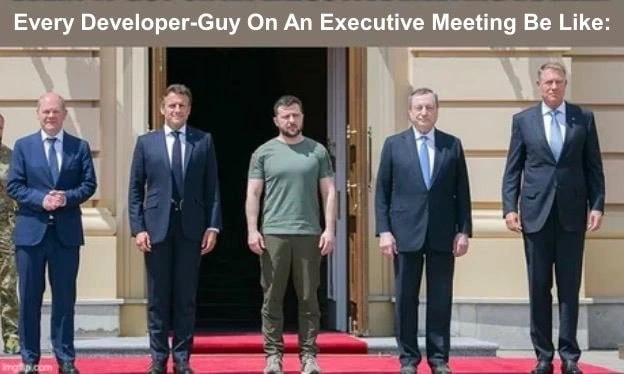
This meme highlights the contrast between corporate culture and developer culture, especially regarding how people dress in important meetings. The image shows a scenario often joked about in tech circles: a single developer dressed very casually (t-shirt, cargo pants, and sneakers) standing next to a group of high-level executives who are all in very formal business suits. The top text “Every Developer-Guy On An Executive Meeting Be Like:” sets the expectation that this is a common stereotype — basically saying, “Any time a developer goes into an executive meeting, he looks like this.”
Why is this amusing? It’s because of the obvious dress code gap between the two sides. Dress code means the expected style of clothing in a situation. Here we have suits_vs_tshirts as the theme: suits represent the executives (business people) who usually wear formal attire, and the t-shirt represents the developer who is super casual. In many companies, especially tech companies or IT departments, the everyday dress code for developers is very relaxed. It’s normal to see programmers in jeans, hoodies, or t-shirts with funny prints (maybe a favorite video game or a GitHub logo) because the focus is on comfort and the work they’re doing on the computer. There’s often no need to dress formally when you’re sitting at a desk writing code for hours.
On the flip side, top executives and board members tend to dress up when they’re in a professional setting. They wear suits, ties, dress shoes — the whole formal outfit, especially at important meetings or when meeting clients, investors, or other stakeholders. This formal dress is a tradition in business environments; it shows respect, authority, and that they’re taking things seriously. An executive board meeting is usually a big deal: it might involve discussions about company strategy, finances, or major decisions. Naturally, the people attending such meetings want to look professional and “on point.” So they come in their best suits, sometimes literally walking down red carpets if it’s a very high-profile occasion (like a meeting at a government building or with important officials).
Now, put a developer into that scene. If the developer doesn’t change how they dress, suddenly you have what we see in the meme: one person looks very out of place. The meme is funny because it’s true to life — developers often either don’t know or don’t care about dressing up for meetings. It might be that nobody told this developer there was an expectation to wear something nicer, or it could be that in his company, generally nobody wears suits, so he just wore his normal clothes by habit. The result is a culture clash right there in the photo: the formality of the executives versus the informality of the techie. We find it funny because the contrast is so clear and exaggerated in the image (it’s literally one casual guy vs four suit-and-tie guys on a stage-like setting).
Let’s break down the two sides in simpler terms:
| Group | Typical Outfit | Why They Dress That Way |
|---|---|---|
| Developers | Casual – e.g. t-shirts, jeans, hoodies, sneakers. | For comfort and practicality. They often work long hours at a computer, sometimes overnight, so they prefer easy, comfortable clothes. Also, tech workplaces tend to be informal about dress. |
| Executives / Board Members | Formal – e.g. business suits, dress shirts, ties, dress shoes. | To present a professional image. It shows respect and seriousness. In traditional business settings, dressing formally is a sign of authority and competence. They often have to impress clients, investors, or partners, so appearance is important. |
In the WorkplaceHumor context, this difference has been a source of jokes for a long time. It’s part of DeveloperStereotypes: the idea that programmers are brilliant with code but maybe a bit oblivious or indifferent to formal norms like dress code. On the other hand, there’s the stereotype that management (the “suits”) care a lot about appearances and protocol. MeetingHumor often plays on the idea that these two groups don’t always understand each other’s priorities. For example, a developer might find a meeting full of corporate buzzwords boring or amusing, while an executive might be a bit shocked by the developer’s Star Wars t-shirt in a serious discussion.
The text on the meme (“Every Developer-Guy on an Executive Meeting be like:”) is written in a casual, tongue-in-cheek internet slang style. That phrasing “be like” is commonly used in memes to describe a typical behavior or situation for someone. It’s not proper formal English, but meme language isn’t formal (quite fitting to the theme, actually!). It’s saying “Whenever a developer goes to an executive meeting, this is basically how he looks.” It generalizes the situation for comedic effect — obviously not every single developer dresses down in important meetings, but it’s often true enough to be recognizable and funny.
For someone early in their career (a junior developer), this meme might also serve as a playful warning or advice: if you ever get invited to present to the board or attend a high-level meeting, you might want to check if there’s an expected dress code! Many of us have had that first experience where we show up to something important and realize, “Oh no, I’m under-dressed compared to everyone else.” It’s a bit embarrassing, but you learn from it. Companies sometimes have unwritten rules — for daily work, sure, wear your comfortable clothes, but for the big meetings (especially those involving people from outside the tech team or outside the company), you might need to step it up a notch.
The meme exaggerates the scenario by choosing a photo where the difference is extreme and very visually obvious. It almost looks like the central guy (the developer figure) was Photoshopped in from a different event, but it’s an actual photo being reinterpreted in a funny way. He’s literally standing on a red carpet, something we associate with VIPs and formal ceremonies, but he looks like he could be on his way to a casual weekend hangout. That image perfectly captures the phrase “under_dressed_dev” — meaning a developer who is not dressed as formally as the situation might demand.
In summary, this meme is all about the humor that comes from mixing two very different workplace cultures. Anyone who works in tech or has seen developers interacting with the business side will get a little chuckle because they’ve either seen this happen or experienced it themselves. It’s poking fun at both sides gently: the dev who doesn’t dress up and the execs who perhaps dress too formally. Neither is portrayed as bad — it’s just funny how visibly different they can be when put side by side. And in the end, it underscores a charming part of tech culture: comfort and results often take priority over formality. The casual guy in the meme might look out of place, but he represents the idea that what you contribute (your code, your ideas) can matter more than looking fancy. Still, if you’re the only one in a t-shirt among suits, expect a few amused glances — exactly like in the meme.
Level 3: Dress Code 404
The meme satirically captures a dress_code_gap in tech CorporateCulture by staging a stark contrast: four polished executives in dark suits flanking a lone developer in a t-shirt and cargo pants. They’re literally on a red carpet, and our casually-clad developer stands out like a missing semicolon in polished code. For seasoned engineers, this image triggers an immediate smirk of recognition. It’s basically the suits_vs_tshirts trope brought to life — a culture_clash_visual that any dev who’s been dragged into an executive boardroom can relate to. One can almost imagine an HTTP error hovering above the developer’s head: 404 Formalwear Not Found.
Why is this so funny (and painfully true)? In many organizations, there’s an unspoken protocol mismatch between developer culture and executive culture. Developers are notorious for favoring comfort and functionality over formality — think hoodies and sneakers as their “uniform”. Executives, on the other hand, often adhere to decades-old business norms of suits, ties, and polished shoes, especially in high-stakes Meetings. When these worlds collide, the result is the visual punchline we see here. The central guy in the olive-green tee (our stand-in for every dev ever in an exec meeting) looks as if he teleported from his IDE directly into a CEO’s world of mahogany tables and PowerPoints. It’s the developer_in_exec_context scenario where two tribes meet: one values cutting-edge code, the other values corporate polish.
Industry veterans have lived this moment. Imagine being a lead dev called on to brief the Executive Board about a critical project update. You rush in late because you were tweaking a last-minute bug fix, still wearing your Dark Theme Coding t-shirt and jeans. You step into a room where everyone’s in tailored suits that probably cost more than your laptop. The air smells of cologne and powerpoint slides. Awkward doesn’t begin to describe it. You feel every eye on you as you shuffle to the projector, acutely aware that your under_dressed_dev self is the only splash of casual green in a sea of navy-blue and black. This meme nails that feeling. It exaggerates it with a literal red carpet setting (just to emphasize how formal the context is) and the developer dead-center, shoulders straight but attire completely at odds with the company of suits. It’s an instant visual joke: one of these things is not like the others.
From a senior dev perspective, this scenario is both comic and emblematic of deeper cultural differences. DeveloperHumor often pokes fun at how software engineers operate on a different wavelength than business execs. Here, clothing is the proxy for that disconnect. The suits might be thinking, “Who let this guy bypass the dress code firewall?” while the dev is thinking, “Why are these folks over-dressed for a code review?” The humor is amplified by the truth that neither side is exactly wrong — they just prioritize different things. The executives dress to impress stakeholders, signal seriousness, and uphold a tradition of formality; the developer dresses for a day spent solving problems at a keyboard, where comfort and focus trump style. As a result, when the dev steps into the executive realm, it’s almost like two incompatible systems interfacing without an adapter. In integration testing terms, this meeting is a formality failure mode. We’ve all joked about how a meeting with upper management can feel like a foreign ritual — this meme takes that to the extreme by making the developer look like he showed up to the wrong ceremony.
What’s particularly great (and poignant) is that this image is actually based on a real-world scene, repurposed for tech humor. It reminds savvy viewers of instances where high-profile tech figures or leaders have deliberately shunned formal attire among suits. (Think of Mark Zuckerberg showing up in a hoodie among Wall Street bankers, or startup founders wearing jeans in a boardroom of investors.) Those real episodes caused a similar mix of raised eyebrows and smirks, just like our meme. The caption “Every Developer-Guy On An Executive Meeting Be Like:” uses a popular meme format to suggest this isn’t an isolated case — it humorously claims every developer in such meetings ends up looking and feeling like this. That hyperbole lands because it contains a grain of truth recognized by the tech community. We’ve seen brilliant engineers present groundbreaking ideas while rocking anime t-shirts and sandals, alongside VPs in three-piece suits discussing quarterly earnings. The juxtaposition is almost a workplace cliché now, one that gets a knowing chuckle.
Now, beyond the chuckle, there’s an undercurrent of why this keeps happening. On the tech side, there’s a bit of pride in disregarding superficial conventions — “I solve complex algorithms before breakfast, who cares if I wear sneakers to the boardroom?” It’s a badge of honor in some circles that merit (code, innovation, results) should matter more than appearance. Many companies, especially in Silicon Valley, intentionally foster this norm: the genius coder in a hoodie is practically an icon (looking at you, Mr. “I wear the same t-shirt every day” developer stereotype). On the flip side, traditional corporate environments see dressing well as a sign of respect and competence. A suit is like armor: executives suit up to signal they mean business. So when a developer wanders in with casual attire, some executives might subconsciously question if the dev grasps the gravity of the meeting. There’s a tension there — a fear that the casual dress might be read as casual attitude. But often, it’s just a different language. The dev is respectful, just expressing it differently (perhaps by the quality of their technical work rather than their attire). Still, a savvy developer learns to navigate this. Some will keep a blazer in the office “just in case” they need to pseudo-conform for a big meeting, much like keeping an emergency try-catch for corporate culture.
A cynical veteran in tech might also read this meme as commentary on the power dynamics at play. The developer in the olive-drab shirt (in the real photo, a very influential figure in his own domain) is physically centered — he is literally the focus — yet he’s the least conventionally dressed. It’s like saying: “Here’s the guy who actually gets stuff done (builds the product, leads the tech), surrounded by guys who talk about moving money or strategy.” There’s a subtext: the dev doesn’t need the suit to have authority in his realm. In fact, in tech, being brilliant sometimes grants you a pass on dress code entirely. Many seasoned devs have experienced this inversion where their expertise is so valued that management says “eh, let them wear whatever, just keep the code rolling.” So the meme can also be read as a cheeky empowerment of developer culture: the lone technical expert holds his own among the suits, without changing who he is. The contrast is humorous but also a little heroic in a rebel kind of way.
Technically speaking, nothing about code or algorithms here — this is pure WorkplaceHumor — but it’s still very much developer humor because it’s about the life of a developer in a corporate setting. The more advanced insight is how attire becomes a metaphor for the broader gap in mindset. It’s reminiscent of the classic dev vs business communication gap: one side speaks in KPIs and ROI, the other in RAM and runtime complexity. Here, instead of language, it’s clothes doing the talking. And they’re speaking very different styles. Fixing this “bug” is non-trivial, because it’s not in code at all — it’s in culture. You can’t just patch a culture clash; it takes understanding on both sides (maybe the execs could dress down a bit for internal meetings, and the dev could throw on a blazer for high-profile ones, meeting in the middle). But where’s the fun in that? The meme chooses the extreme for comedic effect: zero compromise, maximum contrast, maximum laughs.
Ultimately, this meme resonates with developers because it captures an imposter syndrome kind of moment in a lighthearted way. Even the most confident coder can feel a twinge of “Do I belong here?” when standing among a completely different breed of professional. And conversely, it pokes at executives with a bit of cheek: “This is how out-of-touch you look to us, and how out-of-place we feel around you.” It’s a mutual roast in a single photo. MeetingHumor like this works because both sides recognize the absurdity. The developer likely had the same invite as everyone else, but only he interpreted “business casual” as literally casual. It’s a joke at how literal and straightforward engineers can be (requirements said come to meeting, nothing about wardrobe in the spec!).
So, the meme is a hilarious, multi-layered snapshot of tech culture meeting corporate protocol. It says: when worlds collide, be prepared for awkward fashion combos. It’s that moment when you, the dev, realize you’re a Python script running in a COBOL mainframe world for an hour. And hey, maybe the code-savvy among the execs secretly envy that you get to be comfortable. After all, no one ever resolved a critical bug because their tie was perfectly knotted. In the end, the suits need the dev’s expertise, and the dev survives the suits’ world — with a great story to meme about later. Dress code divergence has never been so meme-worthy.
# Quick pseudo-code illustration of the meme scenario:
attendees = ["CEO", "CFO", "COO", "CTO", "Lead Developer"]
attire = {}
for person in attendees:
if person == "Lead Developer":
attire[person] = "t-shirt and jeans" # The developer's casual outfit
else:
attire[person] = "suit and tie" # The executives' formal attire
for person, outfit in attire.items():
print(f"{person} is wearing {outfit}")
# Output:
# CEO is wearing suit and tie
# CFO is wearing suit and tie
# COO is wearing suit and tie
# CTO is wearing suit and tie
# Lead Developer is wearing t-shirt and jeans
# Outcome: The Lead Developer stands out like a penguin in a flock of peacocks (casual vs formal).
Description
Image shows five men standing on the steps of an ornate government-style building. Four of them (two on each side) wear dark business suits, polished shoes, and ties; they stand on a bright red carpet. In the center stands a man in an olive-green t-shirt and cargo pants with casual sneakers, visibly less formal than the others. A grey banner across the top contains white bold text that reads: "Every Developer-Guy On An Executive Meeting Be Like:". The meme humorously highlights how engineers often appear under-dressed or out of place when joining high-level corporate or stakeholder meetings, reflecting cultural gaps between developer culture (comfort, practicality) and executive formality
Comments
6Comment deleted
“Look, the SLAs pass and the KPIs are green - if the board wanted a suit they should’ve set attire: formal in the policy YAML before I triggered the deploy.”
The only person in the room who knows why the quarterly roadmap is technically impossible but has already mentally checked out after hearing "synergy" for the third time
The classic executive meeting paradox: they need your architectural decisions on microservices decomposition and distributed systems resilience, but they're more concerned about whether you're wearing a collared shirt. Meanwhile, you're mentally debugging the production incident from 3 AM while they discuss 'synergies' and 'strategic alignment.' The cargo pants have more pockets for carrying the weight of technical debt than their suits have for carrying actual technical knowledge
Only person without a tie, only person with kubectl - watch the “strategy meeting” turn into a 3am rollback
The dev who bypassed dress code review - straight to main, no conflicts
I’ll wear a suit when the board deck supports tail -f