Skip to content
DevMeme
3654 of 7435
The Siren Call of the DEX Aggregator
Blockchain Post #3992, on Dec 1, 2021 in TG

The Siren Call of the DEX Aggregator

Why is this Blockchain meme funny?

Level 1: Candy Fair Buddy

Imagine you’re at a gigantic candy fair with dozens of stalls, and each stall sells a different kind of candy. It’s exciting but also overwhelming – you want the best candy for the best price, but there are so many options! Now, picture you have a friendly buddy who knows this fair inside-out. They’re wearing a shiny, hard-to-miss outfit (so you can always spot them in the crowd) and they take you by the hand. You tell them what candy you want, and they quickly lead you to the stalls that have that candy, making sure you get a great deal. You don’t have to run around to every stall on your own; your buddy does the tricky part of checking all the stalls for you. In this little story, you are like the Ethereum user, the many candy stalls are like all the different exchanges where you can trade cryptocurrencies, and the helpful buddy in the sparkly outfit is like the aggregator. It’s funny because in the real world that buddy is actually a piece of software doing a lot of math, but we’re imagining it as this glamorous guide at a fair. Just like you’d laugh seeing a friend dramatically dress up to help you shop for candy, people find it amusing to see a high-tech crypto service portrayed by someone in a blue wig and silver costume. But hey, at the end of the day, you’re just glad to have a guide to make the candy hunt (or in the real case, coin trading) easier and a lot more fun!

Level 2: DeFi 101: Aggregators and DEXes

Let’s break down the buzzwords and imagery for someone newer to the crypto developer scene. Ethereum is a popular blockchain platform often described as a “world computer.” It lets developers create and deploy smart contracts – essentially programs that run on the blockchain and self-execute when certain conditions are met. In the context of finance, smart contracts enable Decentralized Finance (DeFi): this means traditional financial activities (like trading, lending, etc.) are done peer-to-peer through code, without banks or centralized exchanges. A DEX, or decentralized exchange, is one key piece of DeFi. It’s a platform (usually a set of smart contracts on Ethereum) where users can swap one cryptocurrency for another directly, without a central company managing the trades. For example, Uniswap is a famous DEX where users trade tokens through an automated system (an Automated Market Maker) that uses liquidity pools and a mathematical formula to set prices. There are many DEXes out there – Uniswap, SushiSwap, Curve, Balancer, and so on – each with different pools of coins and different features.

Now, having many exchanges is both a blessing and a curse. It’s great because there’s competition and a wide variety of tokens, but if you’re an Etherean (an Ethereum user, especially an enthusiast in its community), you face a dilemma: How do you know which DEX will give you the best price for your trade? Checking each one manually is tedious and can cost extra in transaction fees if you try swapping small amounts on multiple platforms. This is where an aggregator like 1inch comes in. In software terms, an aggregator is like a unifier – it aggregates (collects) information or services from many sources and presents a unified result. The Aggregator pattern is common in tech: consider how some travel websites let you compare airfare across dozens of airlines in one search, instead of you visiting each airline’s site. In the same way, a DeFi aggregator queries many DEXes at once to find the best rate for a swap, and can even split your trade across several exchanges in one go. You, as the user, just specify what you want to trade and how much, and the aggregator takes care of finding out, “Okay, you’ll get a slightly better deal if 30% of your coins swap on Uniswap, 50% on SushiSwap, and 20% on Curve” (as an example). Then it typically provides you with a single transaction to execute that plan. It’s one-stop access to a whole bunch of decentralized finance venues — exactly the slogan you see on the poster in the image (“One-stop access decentralized finan…”, presumably “finance”).

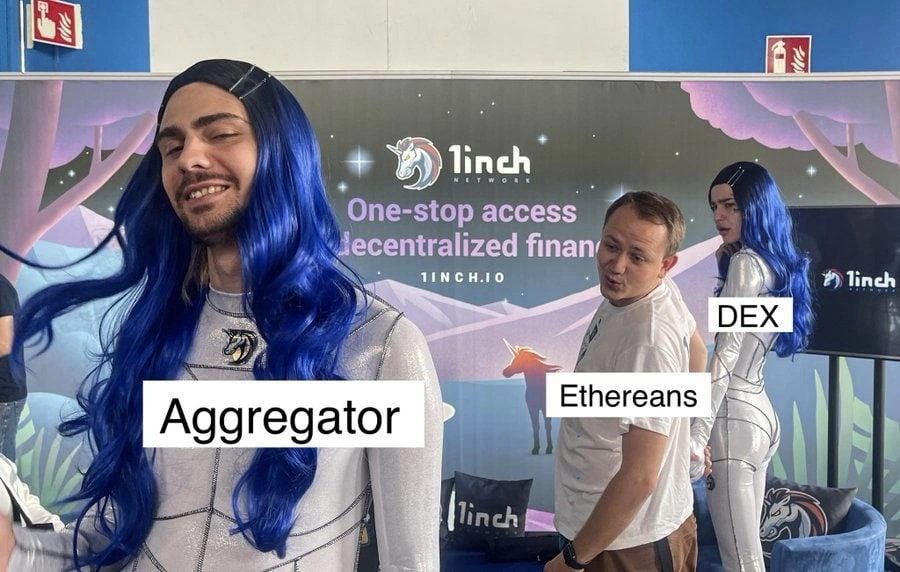
In the meme’s picture, which appears to be taken at a crypto conference, they’ve personified these concepts to make a funny point. The person in the middle labeled “Ethereans” is just an attendee (representing any Ethereum user). On one side, the model labeled “Aggregator” represents the 1inch Network’s service. This model is dressed in a shiny silver futuristic outfit with a bright blue wig – a very eye-catching getup, almost like a sci-fi guide. On the other side, another model dressed the same way is labeled “DEX.” This suggests a generic decentralized exchange (or the whole bunch of them personified as one). The Etherean user in the middle looks a bit like he’s being guided or escorted by the Aggregator model past the DEX model or towards the DEX booths. It’s a dramatization of what happens when you use an aggregator: the aggregator guides you to the best place to trade (or brings the best exchanges to you). In simpler terms, 1inch (the Aggregator) is helping the Ethereum user navigate the sea of exchanges (DEXes) out there. Instead of wandering around the conference (or the DeFi market) alone, the user has this helpful (and flashy) assistant. The humor comes from seeing these abstract software roles played by real people in costume. It’s like if Google Search had a booth with someone dressed as a wizard labeled “Search Engine” guiding you to different library booths – a bit surreal but amusing.

Some key points for a junior dev or someone new to blockchain: Blockchain tech (like Ethereum) often has many independent projects (here, exchanges) rather than one central service. This decentralization is powerful (no single point of control), but it can make the user experience fragmented. That’s why aggregators have popped up as a user-friendly layer. It is similar to patterns we see elsewhere: in microservices architecture, you might have an API gateway or aggregator service to combine many microservice calls so the client gets one response. In fintech, we see account aggregator apps that show you all your bank balances in one place. Here it’s happening in crypto trading. The Cryptocurrency angle means everything is also happening in a highly volatile, hype-driven market – projects like 1inch capitalize on meme culture and branding (note the unicorn theme and playful approach) to stand out. The tag BlockchainHype or IndustryTrends_Hype is reflected in that extravagant booth presentation. But beyond the humor, it’s genuinely useful innovation: using an aggregator can save users money and time. Imagine if you had to manually attempt trades on 5 exchanges to compare prices – you’d pay transaction fees 5 times and lose precious minutes (and crypto prices move fast!). An aggregator like 1inch does all that in a split second via algorithm and you just pay for one transaction (albeit a bit higher gas since it’s doing more under the hood). The trade-off is you’re trusting the aggregator’s smart contract to execute correctly. In general, though, 1inch is a well-known DeFi tool that many Ethereum enthusiasts use regularly. The meme simply captures its role in a funny, visual way, making it easier to explain: “See that guy? He’s all of us crypto users. See the blue-haired space-suited lady? That’s 1inch aggregator, dazzling and leading the way. And that other similar-looking lady is one of the many DEXes out there. This is how we do DeFi trades nowadays!”

Level 3: Bridging the DEXverse

Now, stepping back to a more familiar developer view: why is this meme so relatable (and amusing) to the crypto-savvy crowd? It’s highlighting the Aggregator pattern in the wild world of Decentralized Finance (DeFi), using a bit of conference cosplay humor. In the photo, the guy labeled “Ethereans” (representing everyday Ethereum users) is caught between two shiny beings: one labeled “Aggregator” (our friend 1inch, a DeFi aggregator service) and one labeled “DEX” (a decentralized exchange, think of platforms like Uniswap or SushiSwap). It’s a literal depiction of how an Ethereum user might feel at a crypto conference or in the DeFi market: flanked by a flashy guide on one side and a myriad of towering exchanges on the other. The aggregator (1inch) is metaphorically escorting the bewildered Etherean through a crowded bazaar of DEXs. This is funny because, in real life, using DeFi can feel exactly like that – overwhelming. There are dozens of DEX platforms (each a booth in this metaphorical conference hall), and each promises the best rates or unique coins. The poor user doesn’t know which booth to approach for the best deal. So along comes the DeFi aggregator, acting like a personal concierge with a glittery outfit, saying “Don’t worry, I got you! I’ll check all these exchanges and take you to the best one (or actually, I’ll quietly fetch the best bits from each for you).” The meme visualizes that relationship with a bit of absurdity: instead of software, it’s a blue-wigged cosplay model literally holding court at the crypto conference booth. Anyone who’s been in the Ethereum DeFi scene will smirk at this because it’s a spot-on personification of a very abstract concept.

From a seasoned developer perspective, there’s also an ironic commentary on industry hype. Blockchain conferences in 2021 (the era this photo was taken) were notorious for over-the-top marketing. Projects would have everything from people in mascot costumes to free champagne to attract attention. Here, 1inch leaned into crypto meme culture by using an actual human “Aggregator” with a silver spacesuit and electric-blue wig to dramatize what their product does. It’s tongue-in-cheek: they’re basically saying, “Our aggregator is so good it’s like a dazzling sci-fi bodyguard leading you through the DeFi wilderness.” The unicorn imagery in the backdrop (1inch’s logo and the mythical forest setting) adds to the fantastical vibe – unicorns are a recurring motif in DeFi (Uniswap, one of the biggest DEXs, famously uses a pink unicorn logo). So, this booth is stacking meta-references: a unicorn-themed aggregator guiding users to unicorn-branded exchanges in a magical forest. For developers who’ve lived through various tech crazes, it’s reminiscent of the dot-com era or mobile app gold rush, where every startup had wild booth gimmicks and grand promises. The tag IndustryTrends_Hype fits perfectly: DeFi in 2021 had sky-high hype, and aggregator services were one of the trendiest “must-haves” for traders diving into crypto. The meme pokes fun at that hype by showing how even something as nerdy-sounding as an API aggregator for DEX liquidity gets the glam treatment on the expo floor.

On a more serious note, the humor also touches on the architecture of Web3 and how unintuitive it can be. In an ideal world, you wouldn’t need an aggregator at all – you’d have one exchange or a unified liquidity pool where every trade gets the best price. But the reality on Ethereum is fragmentation: dozens of DEXs each with their own pools of liquidity and tokens. This fragmentation is partly by design (decentralization encourages lots of independent projects) and partly by incentive (each DEX has its own token, rewards, or twist to attract users, leading to liquidity being all over the place). So, the Aggregator pattern emerges as a solution: instead of forcing the user to manually compare prices on 10 different exchanges (which is slow and costly in terms of time and transaction fees), the aggregator does it in one swoop. Seasoned devs recognize this pattern from other domains too – it’s like a smart router in stock trading that splits your order across exchanges, or like Kayak/Skyscanner aggregating airline tickets so you don’t have to check every airline’s site. In software design, we often build aggregator services to wrap multiple API calls behind one convenient interface; here, 1inch is wrapping many DEX smart contracts behind one interface. The meme is funny because it personifies that wrapper as a literal human wrapper around the user, shielding them from the complexity. A veteran developer might chuckle, recalling how many times we introduce a layer of abstraction to simplify things for users... and how that layer then becomes a new crucial component (with its own quirks and bugs!). DeFi aggregators can indeed introduce their own risks – for instance, a bug in the aggregator’s contract or logic could affect trades on all connected DEXs at once. It’s the classic convenience vs. complexity trade-off: we remove the hassle of dealing with each DEX separately, but we place a lot of trust (and load) on the aggregator.

Finally, the meme’s scenario also resonates on the human level. The guy labeled “Ethereans” has this halfway skeptical, halfway relieved expression – a mix of “Phew, thank you for guiding me” and “Do I really need an escort for this?!”. Many crypto users have felt that! DeFi is powerful but not exactly user-friendly; it often feels like you need a guide or you’ll get lost (or ripped off by a bad trade). So there’s a gentle ribbing here: as decentralized as crypto is supposed to be, we still end up relying on expert intermediaries (the aggregators, the wallets, the yield optimizers) to navigate it. It’s a bit like needing a safari guide in a jungle that was advertised as a self-guided paradise. The seasoned crowd knows that pain and finds humor in it – we’ve traded one kind of middleman for another, except this one wears a shiny Web3 jumpsuit. And truth be told, at times the aggregator is a lifesaver (or funds-saver) for even veteran traders, especially when the DeFi ecosystem is crazily busy (dozens of new tokens launching, yields changing daily, etc.). Hence the meme hits home: it captures both the ridiculous hype (blue-wig booth babes for a protocol!) and the real utility (thank god I have a one-stop aggregator) of the DeFi world we navigate. It’s a snapshot of crypto culture blending absurdity with clever tech solutions – a combination any battle-tested developer can appreciate with a smile and perhaps a wary nod to the chaos that necessitated it.

Level 4: Atomic Unicorn Routing

Under the hood of this flashy DeFi aggregator, there’s some serious computer science and blockchain engineering at play. A platform like 1inch Network isn’t just a pretty unicorn logo – it’s running complex algorithms to route trades across many decentralized exchanges in one go. Think of the Ethereum blockchain as a vast graph: tokens are nodes, and each DEX (Decentralized Exchange) is like an edge or pathway that lets you swap one token for another at a certain rate. The aggregator’s job is to perform pathfinding on this graph, finding the optimal route (or even multiple routes) to get you the best price for a trade. This can mean splitting your trade across multiple DEXs or chaining several swaps together. In fact, the 1inch aggregator uses a routing algorithm (aptly nicknamed Pathfinder) reminiscent of shortest-path algorithms in networking. It considers dozens of liquidity pools and trading pairs, solving a kind of optimization problem: how to minimize cost and slippage for a given swap. This is like solving a weighted graph problem where each DEX’s liquidity pool has a price impact curve — taking too much from one pool makes the price worse, so the algorithm may distribute the trade across pools. Determining the perfect split is computationally intense (it’s almost NP-hard when you get into splitting among many pools!), so the aggregator often uses clever heuristics and real-time data to approximate the best solution within the time constraints of a blockchain transaction.

What makes this even more hardcore is that all these multi-DEX trades need to happen atomically in one Ethereum transaction. The aggregator’s smart contract acts as an orchestrator: it calls into Uniswap, SushiSwap, Curve, or whatever DEX contracts are needed, one after the other, all in one execution flow. Thanks to Ethereum’s design, if any part of this multi-swap sequence fails or the final outcome isn’t favorable (e.g., because price moved or slippage is too high), the entire sequence can be reverted as if nothing happened. This atomicity is crucial – it’s like the aggregator saying “I’ll only do this elaborate 5-step trade if every step succeeds; otherwise, forget it.” Implementing that means carefully handling call results, return values, and using Ethereum’s transaction rollback. The aggregator contract often sets a minimal acceptable output for the whole chain of swaps to protect the user – if the result would drop below that (due to slippage or someone front-running the trade), the contract aborts (reverts). This guarantees the Etherean user either gets the promised best rate or nothing changes (aside from a wasted gas fee).

There’s also a dose of cryptography and game theory behind the scenes. Because DeFi is a bit of a “dark forest” (where bots lurk to pounce on your every move), aggregators like 1inch go to lengths to cloak and batch operations. By bundling everything into one transaction (and even using techniques like meta-transactions or private transaction routing via miners), the aggregator tries to prevent MEV (Miner Extractable Value) bots from sniping the trade. These bots might otherwise spot a large multi-step swap in the public mempool and try to front-run or sandwich it for profit. The aggregator’s all-in-one approach, often submitted via systems like Flashbots, helps ensure the user’s complex trade isn’t picked apart by predators mid-way. Moreover, the aggregator pattern here must maintain trustlessness. In traditional finance, you might rely on a broker’s honesty for routing; in DeFi, ideally the aggregator’s smart contract is open-source and non-custodial, meaning you’re not handing over your funds blindly – the contract just automates the sequence of swaps you approved. This blend of smart contract security, algorithmic optimization, and real-time market data is what makes that sparkly “one-stop DeFi shop” actually possible. It’s a beautiful convergence of FinTech and computer science: under all the conference glitz, there’s an engine coordinating multiple liquidity sources, crunching numbers like a mini supercomputer, and executing a symphony of token swaps – all in the time it takes for a single Ethereum block to be mined.

Description

This image is a real-life reenactment of the 'Distracted Boyfriend' meme, set at a cryptocurrency conference. In the foreground, a man with a smiling, confident expression and a long blue wig is labeled 'Aggregator'. In the background, another man in a white t-shirt, labeled 'Ethereans', is looking back admiringly at the 'Aggregator'. Next to him, a woman with a blue wig and a silver outfit, labeled 'DEX', looks on with an expression of disapproval and jealousy. The background features a large banner for '1inch Network', a well-known DEX aggregator, with text like 'One-stop access decentralized finan...' visible. The meme humorously illustrates the dynamic in Decentralized Finance (DeFi) where users ('Ethereans') are drawn away from using individual Decentralized Exchanges ('DEX') by the superior functionality of DEX Aggregators. Aggregators like 1inch find the best trading rates by sourcing liquidity from multiple DEXs, offering a more efficient and cost-effective solution, thus making them more attractive

Comments

9
Anonymous ★ Top Pick Why commit to one DEX's liquidity pool when a good aggregator lets you play the field and avoid getting wrecked by slippage? It's not cheating, it's just optimal routing
  1. Anonymous ★ Top Pick

    Why commit to one DEX's liquidity pool when a good aggregator lets you play the field and avoid getting wrecked by slippage? It's not cheating, it's just optimal routing

  2. Anonymous

    Web3 in 2023: we wrapped the old enterprise ESB in a unicorn bodysuit, called it an “aggregator,” and folks pay gas to rediscover why indirection is the most expensive abstraction

  3. Anonymous

    When you've spent years building sophisticated routing algorithms to find optimal swap paths across 50+ DEXs, but Ethereum maxis still manually swap on Uniswap v2 at 3% slippage because 'decentralization means doing everything yourself' - meanwhile paying $200 in gas to save $5 on price impact

  4. Anonymous

    The perfect visualization of DeFi's abstraction layers: Aggregators are the slick frontend everyone sees, Ethereans are the blockchain purists maintaining consensus in the middle, and DEXs are the actual liquidity providers doing the heavy lifting in the back. It's like microservices architecture, but with more unicorns and significantly higher gas fees - and just like in distributed systems, everyone thinks they're the most important component until the network gets congested

  5. Anonymous

    DEX vs aggregator: choose your AMM yourself, or delegate to a route planner that optimizes for price, gas, and the MEV bot’s sandwich

  6. Anonymous

    Aggregatorator: Routing DEX trades better than manual Uniswap hopping, but still gets sandwiched by MEV bots

  7. Anonymous

    Accurate architecture diagram: users → aggregator → DEXes - Strategy+Adapter with Dijkstra over AMMs and an RFQ fallback; the blue wig is for slippage control

  8. @affirvega 4y

    All I see is org mode

  9. @affirvega 4y

    What's the meme btw?

Use J and K for navigation