Code Review Diff Stats: +534,441 Additions Spark Reviewer Concern
Why is this CodeReviews meme funny?
Level 1: The Homework Wheelbarrow
A student was asked to fix one spelling mistake in their essay. Instead, they show up pushing a wheelbarrow containing forty notebooks, three encyclopedias, and a phone book, and say "here's my correction." The teacher looks at the pile, looks at the student, and says only: "I have a lot of questions for you." Everyone watching bursts out laughing — not at the words, but at the gap between how calm the sentence is and how enormous the pile is. That polite little sentence carrying a mountain of disbelief is the whole joke.
Level 2: Reading the Green and Red
What you're actually looking at:
- Pull request (PR): a proposal to merge a set of changes into a codebase. Teammates review the diff — the line-by-line difference — before approving.
- Diff stats: GitHub's summary of a change: green
+is lines added, red−is lines removed. The colored squares give an at-a-glance ratio of additions to deletions. - Why size matters: reviewers must understand every change well enough to catch bugs and design problems. Good practice keeps PRs small — commonly a few hundred lines — so review stays meaningful. A 534,441-line PR cannot be meaningfully reviewed by a human; it can only be trusted, which defeats the point.
node_modules/ generated code: dependency folders and machine-produced files that should be excluded from version control via.gitignore. Accidentally committing them is the classic way a junior turns a 50-line change into a 500,000-line one. A useful instinct to build early: when your diff stats surprise you, rungit statusbefore pushing, not after the reviewer screams.
The reviewer's "I have a lot of questions" is the professional translation of several phrases that HR would not approve.
Level 3: The Unreviewable Artifact
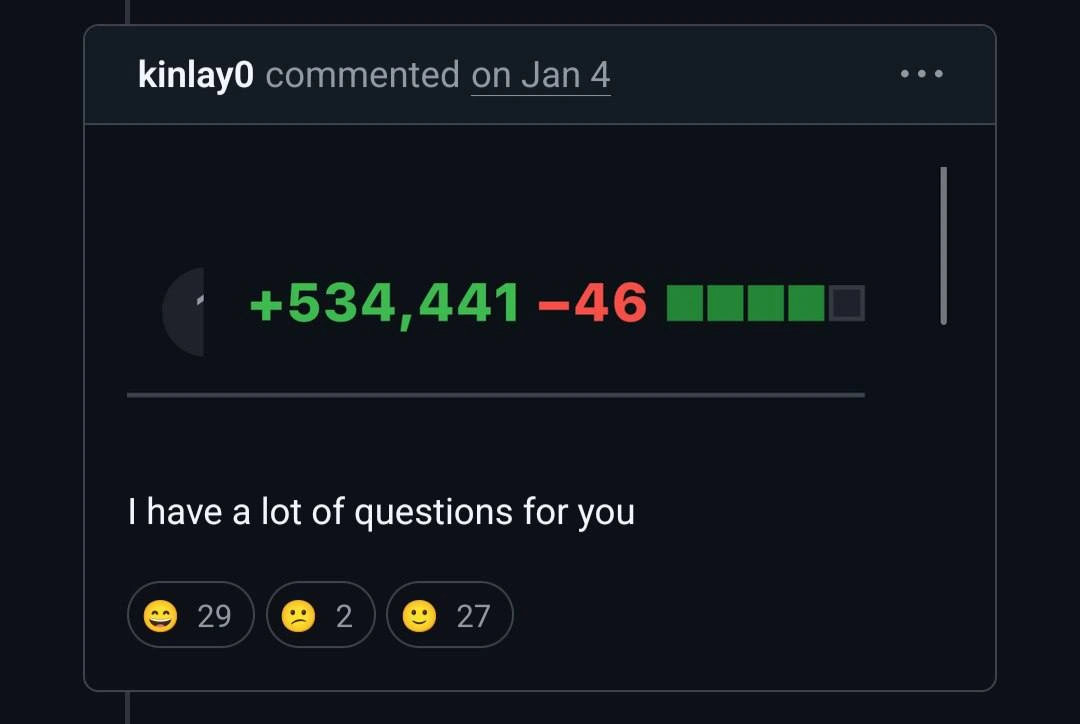
The entire comedy of this screenshot is compressed into two numbers and seven words. The diff stats widget reads +534,441 −46 — over half a million lines added, forty-six removed — followed by GitHub's little ratio squares (four green, one neutral, the UI politely trying to summarize the unsummarizable). Below the divider, reviewer kinlay0 responds with surgical understatement:
"I have a lot of questions for you"
There's an old code-review koan this perfectly embodies: ask someone to review 10 lines and they'll find 10 issues; ask them to review 500,000 lines and they'll say "looks good." The reviewer here is heroically refusing the second path — but the joke works because everyone knows the review is already lost. Cognitive review capacity tops out at a few hundred lines per session before defect-detection rates collapse; at 534k lines, "review" is no longer an engineering activity, it's an archaeology grant. The PR has crossed the event horizon where approval becomes a social ritual rather than a quality gate.
Seasoned eyes also immediately profile what this diff probably is, because the +/− asymmetry is diagnostic. Organic feature work removes and refactors as it adds; a half-million-line, near-pure-addition diff almost always means someone committed node_modules/, vendored an entire third-party project, checked in generated code, lockfiles, or build artifacts — or, in the modern era, let an AI agent run unsupervised over a weekend. The 46 deletions are the tell: somewhere in that avalanche, a human made one small real change, and the rest is payload. This is precisely why .gitignore discipline, lockfile policies, and "no generated files in the repo" rules exist — each one a scar from a PR shaped exactly like this one. The emoji reactions (29 grinning, 27 smiling, 2 confused) are the gallery doing what galleries do: enjoying a disaster that, for once, is not theirs to merge. The two confused reactions are presumably the PR author and their manager.
Description
A dark-mode screenshot of a GitHub pull request comment by user 'kinlay0' posted on Jan 4. The comment shows a diff statistics widget displaying '+534,441' in green and '-46' in red, accompanied by five diff-ratio squares (four green, one dark). Below a divider, the reviewer writes 'I have a lot of questions for you', followed by emoji reactions: a grinning face with 29 reactions, a confused face with 2, and a slightly smiling face with 27. The humor lies in the absurdly massive pull request - over half a million lines added with only 46 removed - and the reviewer's deadpan understatement, a scenario painfully familiar to anyone who has been asked to review an unreviewable mega-PR, likely containing committed dependencies, generated code, or an entire vendored project
Comments
18Comment deleted
Per the well-known law of code review: a 10-line PR gets 10 comments, a 534,441-line PR gets 'LGTM' - this reviewer is bravely violating physics
lgtm Comment deleted
echo venv >>.gitignore Comment deleted
"Small fixes" Comment deleted
average chinese dev Comment deleted
ruff check --fix Comment deleted
experience doesn't matter anymore it seems. no one would ever be able to follow the code changes at this pace Comment deleted
Imo any pr with more then 200 lines of actual logic code should be rejected and split up Comment deleted
Only if you're really comitted to squashing on merge and representing a single logical step as commit. Isn't it easier that all features get their own pulls? Comment deleted
Reviewing a commit that is longer then 200 lines of logic too hard, because you need to keep all of this in your brain while you are reviewing. Unlike the person who actually wrote the commit you need to do this quite fast, making commits bigger the 200 lines of logic is just bad for the review process more bugs will go through Comment deleted
Just squash on merge to main, so your main commit history is clean Comment deleted
that's just not realistic though maybe you can split it into multiple commits in a PR, but often not into different PRs Comment deleted
I misspoke here, I mean commits. But commit is a complete unit of work, so you can review it as a standalone piece of work Comment deleted
Ideally, yes, but practically? Not so much in my experience Comment deleted
It isn't very often that it's not possible to break up a 300+ line commit into more manageable logical chunks Comment deleted
This 500kloc commit surely contains no more than "200 lines of actual logic". It's just enterprise quality what makes it look bigger Comment deleted
"Enterprise Quality" So its all bloat with 5 lines of actual code Comment deleted
Doubt that "enterprise quality" is that bad. In place where I work ratio is near 300 lines / 1 line of payload. Maybe we are not a true enterprise... Comment deleted