Skip to content
DevMeme
5498 of 7435
The Irony of Regulated 'Decentralized' Currencies
Blockchain Post #6025, on May 26, 2024 in TG

The Irony of Regulated 'Decentralized' Currencies

Why is this Blockchain meme funny?

Level 1: Asking for Permission

Imagine a kid who keeps saying, “You’re not the boss of me! I can do whatever I want, no adults needed!” They even start a cool new club with their friends called the “No Rules Club.” Sounds pretty independent, right? But then, picture that same kid waiting for their mom or teacher to give them permission to actually start the club or use the clubhouse. Kinda silly, isn’t it? They claimed they didn’t need any authority, yet they’re standing there, tapping their foot, until an authority figure says “OK, you can go ahead.”

This meme is just like that. It’s funny because one character is basically bragging about how free and independent their new thing (a decentralized currency) is – like a kid saying they don’t need any grown-ups. But the other character sees the truth and asks, “You’re literally waiting for a grown-up (the regulators) to approve your super independent project, aren’t you?” In everyday terms: it’s like someone who says “No one can tell me what to do!” then immediately asks, “Is it okay if I do this now?” The joke makes us laugh because it shows the person doesn’t even realize they’re contradicting themselves. It’s pointing out the awkward truth with a simple analogy: even rebels sometimes line up to get a permission slip.

Level 2: Waiting for Approval

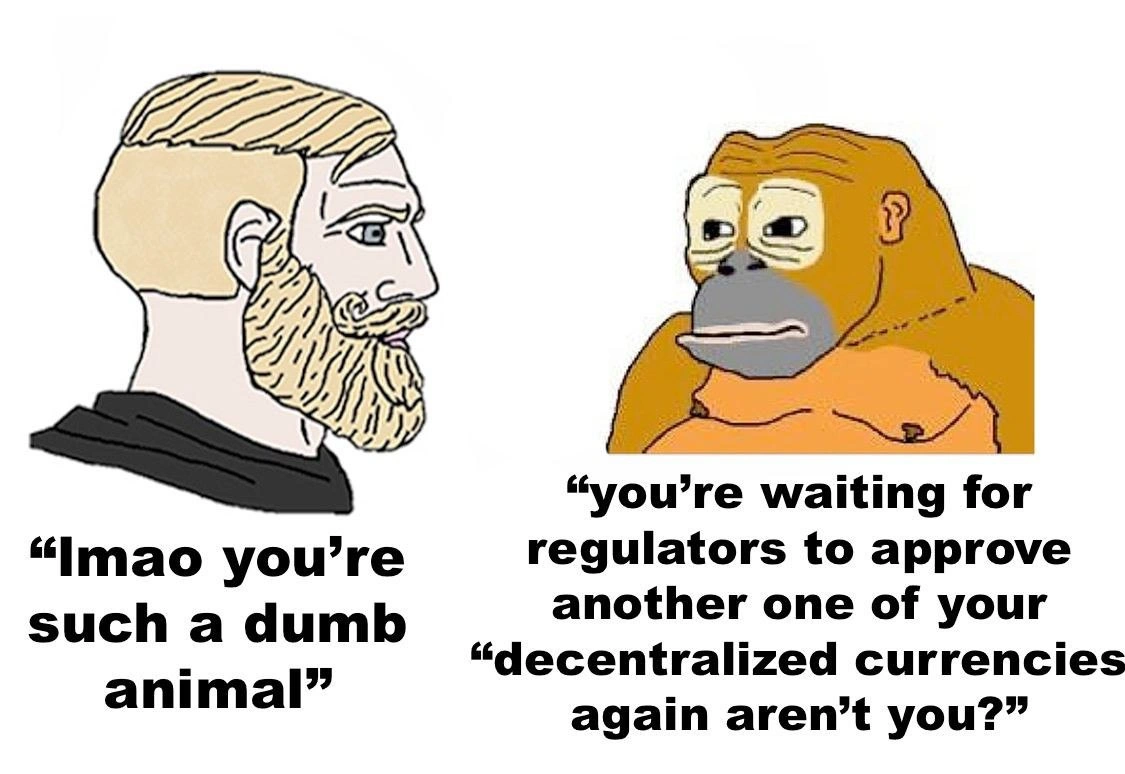
Let’s break down what’s happening in this meme in simpler terms. On the left, we have a cartoon profile often called “Chad Wojak” – basically a confident, maybe arrogant guy. He’s saying, “lmao you’re such a dumb animal”. This is a meme-y way of calling someone foolish without giving any real argument – it’s just an insult. On the right, there’s a hybrid cartoon of an orangutan (a type of great ape) with a Pepe the Frog style face. Pepe is a well-known internet frog character usually used to express various emotions; in this case Pepe is drawn onto an orangutan to create a world-weary, sarcastic look. This right-hand character has droopy, tired eyes and is labeled as saying, “you’re waiting for regulators to approve another one of your ‘decentralized currencies’ again aren’t you?” The tone here is like a tired friend calling out the left character for doing something obviously contradictory or dumb again.

Now, what does that text mean? The key joke revolves around the word “decentralized”. In technology and crypto, decentralized means no single authority is in charge. For example, Bitcoin is a decentralized currency: instead of a central bank or government controlling it, lots of different computers ( nodes ) around the world collectively keep the system running. Decentralized Finance (DeFi) is the idea of financial services (like lending, trading, etc.) running on public blockchains without banks or middlemen. It’s supposed to be open to everyone and not depend on any one company or authority.

However, even though that sounds freeing, in the real world we have regulators – these are government bodies or authorities (like the SEC in the United States, which oversees securities and investments, or central banks, or financial watchdog agencies) that make rules to protect investors, prevent fraud, and ensure the stability of the financial system. FinTech companies (financial technology startups) often have to get approvals, licenses, or follow guidelines from such regulators before they can offer their services legally. For instance, if you create a new cryptocurrency or a crypto exchange, you might need to comply with KYC/AML regulations – which means “Know Your Customer/Anti-Money Laundering” rules that require you to verify users’ identities and report suspicious activities, just like a bank does. Those rules are very much centralized mandates; you can’t just ignore them without risking legal trouble.

So the meme highlights an ironic situation: a team or person who brags about their cryptocurrency being decentralized (implying “we don’t answer to anyone, not even governments!”) is found waiting for approval from the government or regulators to proceed. It’s like saying, “Our rocket ship can fly on its own power, no permission needed — we just need to get permission from the Air Traffic Control before takeoff.” See the contradiction? If you truly didn’t need permission, you wouldn’t be sitting around waiting for an official thumbs-up to launch your coin or platform.

This is actually a common scenario in the industry (hence the meme’s popularity among developers). For example, many crypto companies have had to delay launches or exclude certain countries because they didn’t get regulatory clearance in time. A big real-world case was Bitcoin ETFs (exchange-traded funds) – people in crypto waited for years for regulators to approve these financial products that track Bitcoin, because only after approval could traditional investors buy in easily. All the while, Bitcoin was theoretically a “people’s currency” beyond government control, yet the industry was excitedly holding its breath for a government agency’s yes.

Another example: A startup might create a new token (let’s call it MyCoin). They hype that MyCoin is run by the community, no central authority, etc. But when they want to list MyCoin on an exchange or use it in an app for everyday folks, lawyers step in and say, “Is this token a security? Did you register it? We might need the regulators to sign off or we risk getting shut down.” The developers, who thought they were going to deploy code and let anyone anywhere use it immediately, suddenly find themselves in a regulatory_approval_wait_loop – basically a holding pattern – sometimes for months or more. It’s a bit disappointing and definitely pretty ironic.

The meme uses that Wojak (Chad vs. Pepe-orangutan) format to deliver this point with humor. In these meme formats, typically one character makes a naive or boastful statement (left side), and the other character drops a reality bomb (right side). Here the “dumb animal” insult sets up that the left side thinks they’re superior, but the orangutan-Pepe flips it by pointing out the left side’s silly behavior: calling something decentralized while behaving in a very centralized way (waiting for a central authority’s blessing). The quote marks around “decentralized currencies” in the meme text even emphasize the sarcasm – as if to say so-called decentralized currencies.

For a junior developer or someone new to this area, the take-home is: Blockchain and crypto tech was created to avoid needing permission from big authorities for transactions (anyone can join the network, no bank needed to approve each transfer). But in practice, if you’re launching a real business or project in that space, you often still need permission in a broader legal sense. The IndustryTrends_Hype cycle for crypto has been full of bold declarations of being outside the system, followed by quiet compliance when reality hits. That awkward wait in the meme – essentially a project stalling until it gets regulatory approval – is something many developers have seen in companies trying to navigate between innovative tech and traditional laws. It’s both funny and a little exasperating, which is exactly why the meme resonates.

In short, the meme is saying: “You call it decentralized, but you’re acting like it’s centralized.” It’s a cheeky reminder that no matter how advanced or radical a technology is, the real-world rules (and the rule-makers) can’t be ignored. Even a newbie dev can appreciate that contrast once it’s pointed out: it’s like building a super modern app and then discovering you can’t launch it in the app store until it meets some old-fashioned checkbox – a bit deflating, and a solid setup for a joke among tech folks.

Level 3: Permissionless, Permission Pending

For experienced engineers, this meme elicits a knowing groan and chuckle. It’s poking fun at the BlockchainHype we’ve all seen: startups loudly proclaiming their new coin or DeFi platform will bypass banks and governments – “totally decentralized, bro!” – only to find themselves sitting in endless meetings with compliance officers and waiting on a nod from the SEC or another regulator before launch. The humor comes from this cognitive dissonance. Seasoned devs have lived through product roadmaps where the biggest blocker isn’t writing code or scaling the system, but getting a license or regulatory clearance. The meme’s orangutan-pepe character dryly asks if the Chad on the left is “waiting for regulators to approve another one of your ‘decentralized’ currencies again.” That “again” suggests this isn’t a one-time fluke – it’s a regulatory_approval_wait_loop that the industry keeps replaying.

Why is this so relatable in the FinTech and crypto world? Because it’s true. Think of all the “decentralized” projects that ended up very much entangled with centralized authorities:

  • Crypto exchanges that brag about being independent of banks, yet halt new coin listings until they get legal clearance (or geofence entire countries to comply with laws).
  • Stablecoin issuers who tout their coin as the future of money, but have to regularly prove to regulators that they have real dollars in a real bank somewhere (essentially begging central authorities to trust their reserves).
  • Decentralized apps that quietly add KYC/AML checks (Know Your Customer / Anti-Money Laundering) to onboard users, effectively bolting a traditional compliance checkpoint onto a permissionless system because, well, they want to avoid prison.

We even have the term “CeDeFi” (Centralized Decentralized Finance) floating around now – an acknowledgment that many so-called DeFi products are Decentralized In Name Only. A classic example of this oxymoron is a permissioned DeFi network: imagine a blockchain where only pre-approved institutions can run nodes or validate transactions. It’s basically recreating the old banking system but with extra steps and fancy cryptography. Engineers chuckle (or cringe) at that because it defeats the original purpose. It’s like someone building a distributed microservices architecture and then hard-coding a single point of failure into it on purpose. The tag permissioned_defi_oxymoron nails this absurdity – it’s the equivalent of saying “open secret” or “jumbo shrimp” in tech terms.

The meme format itself – the Chad Wojak vs. the tired Pepe-orangutan – is a popular way in TechSatire to represent overconfident hype meeting reality. The blond bearded Chad character on the left is drawn from the Wojak meme universe, usually depicting a brash or obliviously confident persona (here likely a crypto-bro or an exec hyped on “decentralization”). He smirks and calls someone a “dumb animal,” which sets him up as the ignorant one in context. The right side, an Orangutan-faced Pepe (Pepe the Frog is another meme staple) with world-weary eyes, delivers the reality check. In meme culture, when Pepe is mixed with an orangutan or other Wojak variants, it often represents a kind of exhausted intelligence or a voice of weary reason. The text under him deftly flips the script: it implies the real dumb move is claiming to be decentralized while actually waiting on centralized approval. This IndustryIrony lands because so many of us have seen braggadocious project leads eventually humbled by legal or logistical reality.

From an insider perspective, the dialogue could easily have emerged from a dev team stand-up meeting or a late-night Slack chat. Picture a blockchain startup’s engineer rolling their eyes as the business guy says, “We’re just waiting on the regulators to approve our coin offering.” The engineer is thinking, “Wait, wasn’t the whole selling point that this is permissionless? Why are we asking for permission?” That’s essentially the exchange in the meme. It reflects the burnout and sarcasm of developers who’ve endured one too many regulatory delay in a project that was marketed as moving at the speed of algorithms.

There’s also a nugget of historical truth here. The cryptocurrency movement began, in part, as a rebellion against the financial establishment (remember the Bitcoin genesis block famously contained a headline about bank bailouts). Early adopters loved the idea of being beyond government control. But fast forward a decade, and the big players in crypto are hiring former bankers and regulators, trying to launch crypto ETFs, and testifying in Congress, essentially asking the legacy system for permission to join the club. It’s the “meet the new boss, same as the old boss” scenario. Every cynical veteran developer has seen a once-“disruptive” tech eventually cozy up to the status quo when money and scale are at stake. In this case, the decentralization revolution didn’t eliminate the old governance structures — it’s just anxiously twiddling its thumbs, waiting for those structures to rubber-stamp its existence.

To drive the point home in code humor (because we’re developers, after all), the situation looks like this:

# Decentralized launch process (satire)
while not regulator_approved:
    print("Waiting for regulatory approval... 😑")
    time.sleep(30 * 24 * 3600)  # sleep 30 days, again and again
print("🚀 Launching truly 'decentralized' currency now that we got approval!")

In other words, the decentralized system will be unleashed any month now, just as soon as the very centralized authorities give a thumbs-up. That loop of waiting is the lived reality behind many blockchain hype announcements. The meme gets a laugh (or a pained sigh) from senior devs because it’s a truth we recognize: Decentralization might be a technical feature, but centralization (in the form of laws, regulations, and institutional power) is a social reality. And no amount of clever coding completely sidesteps that reality.

Level 4: Byzantine Bureaucracy Paradox

At the heart of this meme is a clash between distributed consensus algorithms and old-school centralized oversight. Blockchain systems (like Bitcoin or Ethereum) were architected to be permissionless networks solving the Byzantine Generals Problem – meaning they achieve agreement (consensus) without needing a trusted leader, even if some participants (nodes) are malicious or unreliable. In pure theory, a cryptocurrency network uses cryptographic primitives (hashes, digital signatures, Merkle trees) and game-theoretic incentives (like proof-of-work mining rewards or proof-of-stake penalties) to ensure everyone sees the same ledger. No single party should have veto power over transactions; that’s the whole point of a decentralized ledger.

However, the meme’s punchline exposes a Byzantine bureaucracy paradox: even a trustless protocol can stumble when it slams into the centralized regulation wall. All the elegant math and distributed architecture can’t magically bypass governments and compliance departments. In formal terms, we can think of the regulatory environment as an external constraint not modeled in the protocol’s state machine. The blockchain might reach consensus globally in 10 minutes, but a compliance committee or government agency might take 10 months to give the green light. The irony is almost algorithmic: we eliminated the single point of failure in the network, but introduced a single point of failure outside the network – the regulator’s approval. This is a classic example of how FinTech innovations bump up against real-world legal frameworks. It’s like an implicit second consensus layer: the first consensus is all the nodes agreeing on the ledger, and the second consensus (much slower and far less deterministic) is society agreeing that your ledger is legally allowed to operate.

Academic discussions in the crypto space often tout “code is law” – the idea that smart contracts and protocols enforce rules automatically without human intervention. But in practice, actual law still exists outside the code. For example, a smart contract might be unstoppable on-chain, yet if regulators deem the project illegal, they can stop humans from using it (through arrests, fines, or cutting off fiat on-ramps). This contrast highlights a fundamental limitation: decentralized systems excel at reaching technical consensus (e.g., resolving double-spend conflicts, achieving Byzantine Fault Tolerance), but they don’t exist in a vacuum. They operate in a social and legal context that can’t be ignored. In theoretical computer science terms, you might say decentralized networks are solving for consensus in an asynchronous, adversarial environment — a hard problem — yet they haven’t solved the even more complex meta-problem of aligning with external governance (an “oracle problem” of legal compliance, if you will).

Ultimately, this meme underscores a quasi-philosophical irony familiar to blockchain architects: DecentralizedFinance promised to remove middlemen and gatekeepers, but as soon as it touches real money and real people, new gatekeepers appear wearing suits and carrying regulation binders. It’s almost a conservation law of systems design: if you push complexity or control out of the network, it pops up elsewhere (in this case, in regulatory approval processes). In short, the lofty ideal of a purely permissionless financial system meets a hard truth from political and computer science theory: you can’t fully decentralize trust when the physical world still runs on centralized trust systems. The meme captures that tension in one snarky exchange.

Description

A two-panel Wojak comic meme format contrasting a sophisticated critique with a simplistic insult. On the left, the 'Chad' character, a muscular man with blonde hair and a beard, is depicted saying, '“lmao you’re such a dumb animal”'. On the right, a sad-looking orangutan character replies with a pointed question: '“you’re waiting for regulators to approve another one of your “decentralized currencies” again aren’t you?”'. The meme satirizes a central contradiction within the cryptocurrency and blockchain space. It highlights the irony of technologies that claim to be 'decentralized' and free from central control, yet are often heavily dependent on approval from traditional, centralized financial regulators (like the SEC) to gain legitimacy and mainstream adoption. The humor lies in the role reversal: the character portrayed as a 'dumb animal' makes a sharp, insightful point, while the supposedly superior 'Chad' resorts to a childish insult, exposing a lack of substantive counter-argument. This resonates with experienced developers who are often skeptical of the hype surrounding Web3 and can appreciate the nuanced criticism of its philosophical inconsistencies

Comments

10
Anonymous ★ Top Pick The purest form of decentralization is waiting for a dozen people in a room in Washington D.C. to decide if your trustless, permissionless protocol is allowed to exist
  1. Anonymous ★ Top Pick

    The purest form of decentralization is waiting for a dozen people in a room in Washington D.C. to decide if your trustless, permissionless protocol is allowed to exist

  2. Anonymous

    It’s basically the async-await of crypto: you call decentralize(), but the event loop still blocks on SEC.awaitApproval()

  3. Anonymous

    The real consensus algorithm in crypto isn't Proof of Work or Proof of Stake - it's Proof of Regulatory Compliance, where your 'trustless' system requires a trusted third party's blessing before anyone can actually use it

  4. Anonymous

    Nothing says 'be your own bank' quite like anxiously refreshing the SEC website waiting for approval to launch your 'trustless' financial instrument. It's the blockchain equivalent of running a distributed consensus algorithm that still requires a single point of approval from a centralized authority - turns out the real Byzantine Generals Problem was getting past regulatory compliance all along

  5. Anonymous

    Our “permissionless” chain uses BFT for consensus, but the release pipeline blocks on a single manual gate named “regulator” - a 1‑of‑1 multisig with absolute veto

  6. Anonymous

    We solved the Byzantine Generals problem; still failing the Byzantine Regulators problem - finality in 12 seconds, except when the SEC applies exponential backoff

  7. Anonymous

    Distributed ledger where the true consensus algorithm is 'regulatory node approval'

  8. @Jeffeek 2y

    telegram wallet moment

  9. @nllk11 2y

    Fuck around and find out

  10. @Mbabibob 2y

    one more 😁 pls

Use J and K for navigation