When the ‘artist’ on the train is actually sketching microservice boxes
Why is this DesignPatterns Architecture meme funny?
Level 1: Not That Kind of Drawing
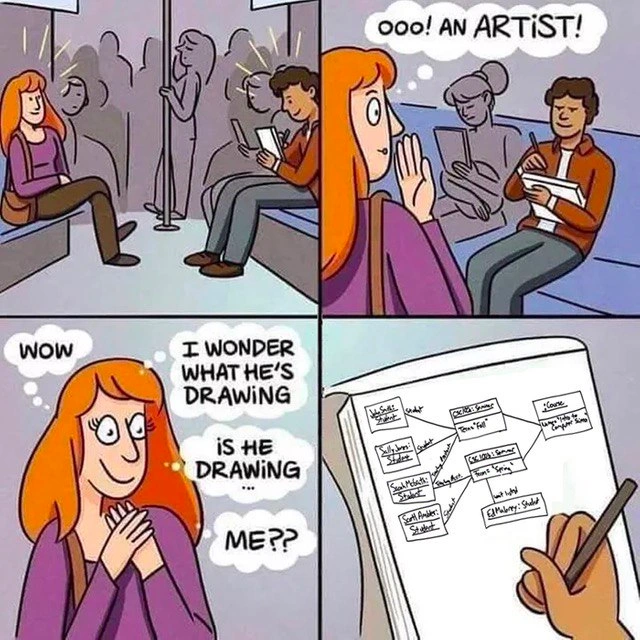
A woman on a train sees a handsome stranger sketching away in a notebook and her imagination takes off: he must be an artist, and maybe — maybe — he's drawing her, like a scene from a movie. She's already blushing. Then we see the notebook: it's full of boxes and arrows, like a seating chart for a school, planning how a computer should keep track of students and their classes. It's funny the way it's funny when you wave at someone who was waving at the person behind you — a big romantic balloon popped by something completely, perfectly boring. He's not dreaming about her at all. He's dreaming about spreadsheets.
Level 2: Boxes, Lines, and What They Mean
An entity-relationship diagram (ERD) is a blueprint for a database, drawn before any code exists:
- Entities (the boxes) are the "things" you store:
Student,Course,Seminar. Each becomes a table. - Attributes are facts about an entity: a student's name, a seminar's term ("Fall", "Spring").
- Relationships (the connecting lines) say how things relate: a student enrolls in many seminars; a seminar belongs to one course.
CREATE TABLE student (id INT PRIMARY KEY, name TEXT);
CREATE TABLE course (id INT PRIMARY KEY, title TEXT);
CREATE TABLE seminar (id INT PRIMARY KEY, course_id INT REFERENCES course(id), term TEXT);
CREATE TABLE enrollment (student_id INT REFERENCES student(id),
seminar_id INT REFERENCES seminar(id));
That last table is the punchline of every first database course: students take many seminars and seminars hold many students, so you need a junction table — something nearly every junior tries to avoid once, by jamming a comma-separated list into a column, before learning why that's a war crime. The notebook in the comic is essentially the homework — or work assignment — version of this exact problem, sketched the way most schemas actually begin: on paper, with arrows, long before a CREATE TABLE is typed. ERDs are cousins of UML diagrams, the broader family of boxes-and-lines drawings engineers use to think before they build.
Level 3: Third Normal Form, Zero Romantic Form
The comic runs a textbook romance-subversion arc — "OOO! AN ARTIST!", then "IS HE DRAWING ME??" — and detonates it in panel four with the least romantic artifact a notebook can contain: an entity-relationship diagram. The sketched boxes are labeled with Student entities, a Course ("Languages Intro to Computer Science"), and Seminar instances tagged "Fall" and "Spring," all wired together with relationship lines. He is drawing, technically. He's drawing a many-to-many enrollment relationship on his commute.
What makes this land for working engineers is how true the underlying behavior is. Data modeling is exactly the kind of problem that colonizes idle time. Unlike writing code, an ER sketch needs no laptop, no IDE, no Wi-Fi — just paper and an unresolved question like "is a Seminar an entity or just an attribute of Course offering?" That question will ride the subway with you whether you invited it or not. The comic's fourth panel is what whiteboard brain looks like from the outside: the engineer has mentally left the train entirely and is somewhere deciding whether Seminar needs its own primary key or can live as a weak entity hanging off Course.
There's also a sharper observation about perception of creative work. The woman's fantasy depends on a cultural hierarchy where sketching = art = soulful, while diagramming = engineering = sterile. But schema design is genuinely a creative act with taste, trade-offs, and aesthetics — a clean model that survives requirement changes is closer to good architecture than to bookkeeping. The classic student–course–seminar domain he's sketching is the canonical teaching example precisely because it's deceptively hard: enrollment is many-to-many, offerings vary by term (hence the "Fall"/"Spring" annotations), prerequisites form a graph, and every naive first draft eventually gets dismantled by normalization. Somebody who voluntarily does this on public transit has either a deadline or a genuine love of the craft. Possibly both; the deadline usually generates the love retroactively.
And the final cruelty: in the engineer's worldview, she could be in the notebook — as a row, not a portrait. Modeling people as entities is the day job. Capturing their likeness is somebody else's department.
Description
Four-panel comic on a subway: 1) A red-haired woman sits opposite a man who is intently drawing in a notebook while other commuters stand. 2) Close-up of the woman waving, thinking “OOO! AN ARTIST!” as the man keeps drawing. 3) She smiles dreamily with thought bubbles: “WOW” and “I WONDER WHAT HE’S DRAWING IS HE DRAWING … ME??”. 4) The reveal: a close shot of the sketchbook shows a hand-drawn architecture diagram - rectangular boxes labelled things like “Web Socket Server”, “Auth Service”, “Load Balancer”, “Cache”, “Fail-over”, etc., connected by arrows - clearly a system design rather than a portrait. The humor hinges on developer reality: even in public, engineers diagram service boundaries instead of making art, poking fun at how software architecture consumes our creative energy
Comments
7Comment deleted
She thinks I’m sketching her profile; I’m actually shading the circuit-breaker between Auth and Payments - working title: “Conway’s Law in charcoal.”
The only thing more romanticized than our architecture diagrams is the belief that this design will survive first contact with production
He was capturing her after all - as a weak entity, existence-dependent on the Commute table, with a many-to-many to Strangers that he'll inevitably normalize away
The real plot twist? He's actually refactoring this monolith into microservices for the third time this quarter because the new architect insists on event-driven architecture, and he's trying to figure out how to explain to the PM why this will take six sprints when they promised the feature 'next week.' The woman's disappointment is nothing compared to what awaits him in Monday's architecture review meeting
She posed for a portrait; he normalized her into an ERD with cascading deletes
She thought he was sketching her; he was sketching a C4 diagram - because in architecture, every arrow is just a future PagerDuty incident
No Wi‑Fi on the train, so he runs offline‑first Jira: a Moleskine Kanban with manual WIP limits and eventual consistency right before standup