The Seductive Trap of Premature Optimization
Why is this Performance meme funny?
Level 1: Dessert Before Dinner
Imagine you’re helping to cook a meal, but you’re so excited about dessert that you gobble up the cake before you even start making the main dinner. 🙈 It’s a fun treat at first (who doesn’t love cake?), but now dinner isn’t done, and you might not even be hungry for the actual food you need. This meme is joking about a similar kind of silly excitement, but with writing code. It’s like someone admitting, “I always skip straight to the fun part I’m obsessed with, even though I’m not supposed to do it first!” In everyday terms: they love making their program super fast before they’ve even made it work correctly – kind of like eating dessert before cooking dinner. We all know you’re supposed to get the main stuff done first, so it’s a goofy, naughty-sounding confession. The reason it’s funny is that the person is treating a nerdy coding habit (trying to speed up their code too soon) as if it’s a secret guilty pleasure. It’s absurd and playful, and even if you’re not a programmer, you can laugh at the idea of someone doing things in the wrong order just because they find it exciting. It’s basically saying: “I know I should wait, but I just can’t help myself – I love doing the no-no thing first!” This mix of surprise (huh, that’s an odd thing to love) and relatability (everyone has a guilty pleasure) is what makes the meme amusing, even in simple everyday terms.
Level 2: Make It Work First
For a newer developer, let’s break down why this meme is amusing (and what it’s talking about):
Premature optimization in programming means trying to make your code super fast or efficient too early – basically before you even have a working version or know what parts of the code really need speeding up. It’s like obsessing over fine-tuning a car’s engine before you’ve finished assembling the car’s wheels and chassis. There’s a famous saying in software development: “Make it work, make it right, then make it fast.” This captures the idea that you should first get your code working correctly, then refactor it to be clean and correct, and only then (if needed) optimize it for speed. Premature optimization skips straight to that last part, which is why senior developers often wave a warning flag when they see it.
Why is jumping into performance tuning too soon a problem? Because you might end up optimizing the wrong thing or solving a problem that doesn’t exist yet. In real projects, you often don’t know what the slow part of your code will be until you actually run it under real conditions (or at least write most of it). Maybe you spend a whole day trying to make one function run in 0.001 seconds instead of 0.002 seconds, only to find out the program spends 5 seconds waiting on a database or network call. All that effort saved you 0.001s in one tiny spot, while 5000× more time was being lost elsewhere. Oops! You’ve optimized a pebble while ignoring the mountain next to it.
This is where performance trade-offs come in. Improving performance often has a cost: maybe you use more memory to get speed, or you write more complex code to handle something faster. Those are trade-offs – you gain something, you lose something. If you make those trade-offs too early (without data), you might sacrifice a lot of code readability or simplicity for a benefit that isn’t even needed. Code that’s been twisted and bent for micro-efficiency can become hard to understand. That’s a hit to code maintainability – which means how easy it is for you (and others) to fix or update the code later. Generally, simple code is easier to maintain. Code littered with weird optimizations (like cryptic bit operations or unnecessary caching layers) can confuse your teammates or your future self, leading to more bugs and difficulty adding new features.
Such messy complexity contributes to technical debt. Tech debt is a metaphor: when you write quick-and-dirty or overly complex code, you incur a “debt” that’ll have to be paid off by someone refactoring or cleaning it up later. It’s like procrastinating cleaning your room – the more you shove under the bed now, the more painful the clean-up will be eventually. Premature optimization can create tech debt because you might have to rewrite that overly optimized code when it causes problems or when requirements change. In other words, you’ll “pay back” that debt with interest (extra work) down the line.
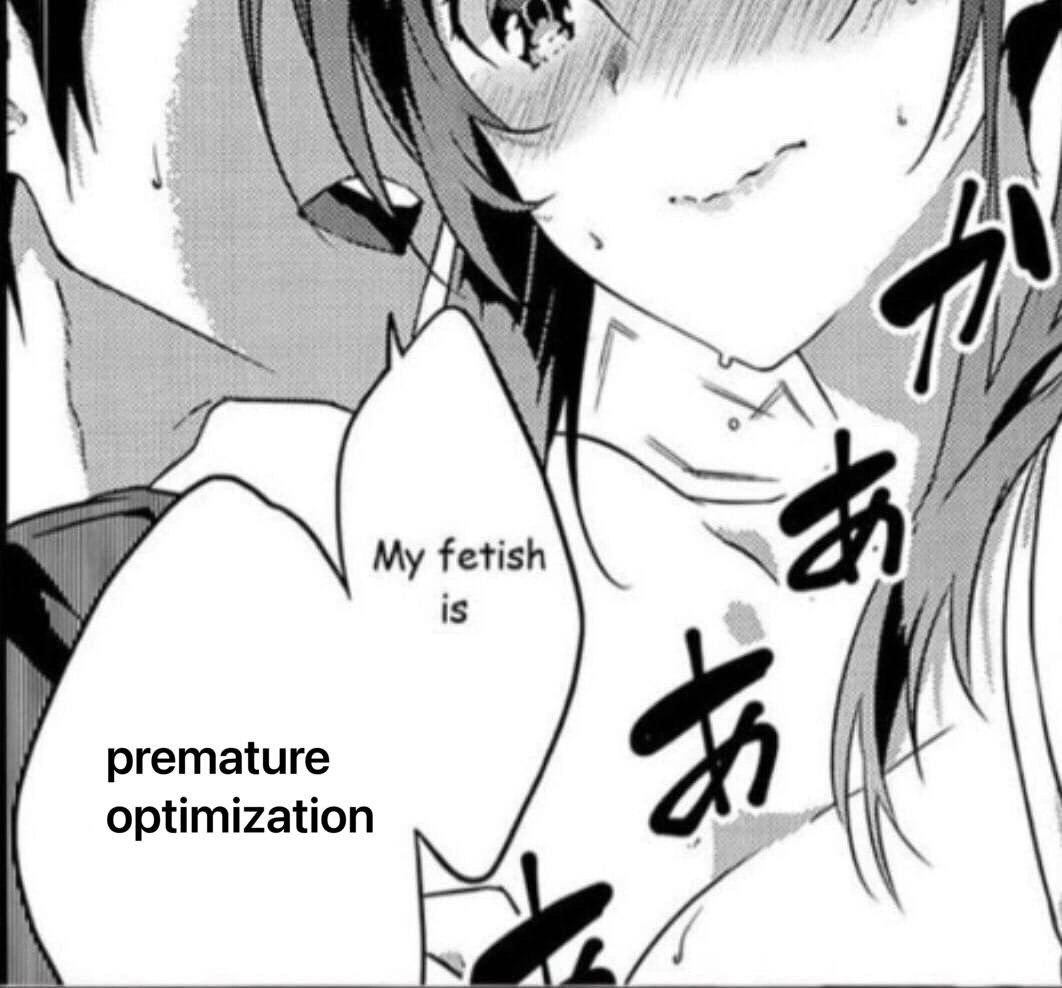
Now, the meme itself: it uses a black-and-white manga (Japanese comic) panel to deliver the joke. In the image, you have an anime-style character with flushed cheeks and a shy expression, and big stylized text in the background. In actual manga, a scene like this would typically be a dramatic confession – maybe a character admitting a crush or revealing an embarrassing kink (something they’re oddly obsessed with). The text in the speech bubble here says: “My fetish is premature optimization.” They’ve basically taken a romantic/risqué setup and replaced the dialog with a nerdy programming confession. This contrast is what makes it funny. It’s the performance_vs_readability dilemma reimagined as a steamy secret.
To unpack the language a bit: saying “my fetish is X” is a joking way to say “I’m weirdly into X.” A fetish, in non-programming terms, is an unusual obsession or strong liking for something, often something not typically seen as exciting. So the character is mockingly claiming they get turned on by over-engineering their code for speed way too soon. It’s a hyperbolic (exaggerated) way to poke fun at that behavior. Developers often joke that some of us have a “thing” for certain tech practices – for example, “he has a regex fetish” might be said about someone who overuses regular expressions for everything. Here it’s about performance tuning mania.
For a junior dev, it helps to know the cultural reference: Donald Knuth (a famous computer scientist) once said “premature optimization is the root of all evil.” This quote is regularly dropped in conversations about writing clean code. It warns not to obsess over speed too early. So if someone says they love premature optimization, it implicitly means they’re ignoring Knuth’s advice – almost like saying “I love doing the ‘evil’ thing.” It’s a sarcastic, self-deprecating humor that experienced programmers use. We know it’s usually a bad idea, and that’s why it’s funny to confess to liking it.
Newer developers might relate if they’ve ever tried to optimize something before finishing it. Maybe you tried to use a very fancy algorithm or micro-optimized some Python loops with list comprehensions and generator tricks before confirming your program even produces the right output. Later, you learned it’s better to first write a clear, working solution, then optimize if profiling shows a real need. Most of us have had that moment where we optimized some code, and then our mentor or senior colleague asked, “But was this part even slow?” or “Could we get the feature working correctly first?” That’s essentially the lesson this meme is built on.
So, in simpler terms: PerformanceOptimization is cool and all, but OverEngineering too soon can lead to headaches. The meme jokingly personifies the overzealous optimizer as someone with a naughty secret. It’s making fun of that impulse to tweak and polish code for speed before it’s time. By picturing it as an intimate confession, it amplifies how out-of-place and comical that obsession is. The CodingHumor here comes from recognizing that truth: focusing on speed when you haven’t even finished the basics is as absurd (and humorous) as the scenario in the image. Seasoned devs laugh because they’ve felt that temptation and juniors learn that hey, maybe doing dessert before dinner isn’t the best idea after all!
Level 3: Root of All Evil
Premature optimization is a concept every seasoned developer knows, largely thanks to Donald Knuth’s famous admonition that “premature optimization is the root of all evil.” This meme takes that grave software wisdom and flips it into a cheeky confession. In the black-and-white manga panel, a blushing character shyly murmurs “My fetish is premature optimization.” It’s a hilariously risqué juxtaposition: mixing a taboo from programming culture with a tongue-in-cheek anime trope of confessing an embarrassing kink.
At its core, the humor targets a well-known developer anti-pattern: obsessively tuning code for speed before the requirements are fully understood or the code even works. To experienced engineers, premature optimization means spending time on micro-level performance tweaks far too early. We chuckle because we’ve all seen it (or done it): chasing microseconds and CPU cycles in a vacuum. Knuth’s warning has become a mantra precisely because early optimizations often backfire. You end up with convoluted code and negligible real gain – essentially over-engineering a solution without evidence that those changes matter. Seasoned devs recognize this as the root of a lot of evil in codebases, so someone proudly admitting they enjoy this frowned-upon habit is both ironic and relatable.
Why is it frowned upon? Because premature optimization tends to wreck code quality and breed technical debt. Imagine an engineer spending days refactoring a function to use bit-level hacks, inlining everything, and unrolling loops – all to make it theoretically faster – while ignoring higher-level design. The result might be a few milliseconds saved in one tiny piece, but now the code is harder to read, harder to test, and harder to change. Those clever tricks act like ticking time bombs for future maintainers. It’s a classic performance trade-off gone wrong: you traded away clarity and maintainability for speed you didn’t actually need.
For example, consider a trivial micro-optimization that many C/C++ veterans will recognize:
int x = 42;
int normal = x * 2; // straightforward multiplication
int fancy = x << 1; // bit shift left (×2) - a low-level "fast" trick
Using x << 1 (shifting bits left by one) multiplies x by 2 in a super low-level way. It’s the kind of optimization fetish move an over-eager programmer might indulge in, hoping to save a few CPU cycles. But on modern compilers and CPUs, this hardly makes a difference – the compiler will likely optimize x * 2 to the same single machine instruction anyway. All this trick really does is make the code less obvious at a glance. We chuckle (and cringe) because we’ve met developers who can’t resist such unnecessary cleverness. They’ll gleefully turn clean code into a bit-twiddling maze for the sake of a “performance high,” effectively indulging their optimization kink at the expense of readability.
The trade-off gets even starker in real systems. Often, after all that early fuss, you discover the real bottleneck wasn’t that loop at all – it was the slow database query or the network call or the fact that the whole feature gets scrapped. In other words, the developer spent time polishing the wrong part. Meanwhile the “optimized” code becomes a stubborn patch of complexity you have to work around. That’s how tech debt accumulates: future developers might avoid touching the “sacred optimized” code, or spend extra hours deciphering it when a bug appears. The irony is rich: the fetish for speed can actually slow down development in the long run.
So, why frame this as a fetish in an anime-style confession? The meme’s genius lies in exaggeration and contrast. In manga art, romantic or illicit confessions are shown with dramatic blushing faces, sweat drops, and bold motion lines – exactly what you see here. Instead of confessing love or a bizarre real fetish, the character breathlessly confesses to premature optimization. It’s an absurd collision of worlds: a steamy, emotionally charged visual paired with a dry, nerdy topic. This contrast is funny on its own (the manga_panel_meme vibe of overdramatic visuals for a trivial geeky joke), and it also symbolizes how tempting yet shameful this habit is in programming culture. By calling it “my fetish,” the meme acknowledges that some devs secretly get a thrill from over-optimizing, even though they know it’s “kinda wrong.” It’s a guilty pleasure. Seasoned engineers are laughing (and maybe groaning) because the scenario is all too familiar: we’ve either been that person tweaking code inappropriately early, or we’ve had to clean up after someone who was. The meme strikes a chord precisely because it’s a shared inside joke – taking the famous “root of all evil” warning and turning it into a saucy, self-deprecating admission. In the end, it’s both a playful poke at those who can’t resist premature optimization and a wink to Knuth’s sage advice that we all pretend to follow (except when we just can’t help ourselves).
Description
This meme uses a sexually suggestive, black-and-white manga panel of a character in a moment of passion or intimacy. A speech bubble, clearly edited, has been placed over the original text. The character is confessing, 'My fetish is premature optimization.' The humor arises from the stark and absurd contrast between the romantic or erotic tone of the image and the dry, technical, and universally recognized anti-pattern from software engineering. 'Premature optimization is the root of all evil,' as famously stated by Donald Knuth, is a principle well-known to experienced developers. The meme personifies this bad practice as a guilty, forbidden pleasure, which is relatable to engineers who have felt the irrational temptation to over-engineer a solution before its performance characteristics are even known

Comments
13Comment deleted
Some junior devs think premature optimization is their fetish. Wait until they discover the thrill of debugging someone else's bit-twiddling hacks on a feature that was never a bottleneck
Nothing spices up a code review like someone unrolling loops for branch-prediction bliss - right before the PM pivots and their micro-benchmark masterpiece turns into dead-code erotica
The real fetish is spending three weeks optimizing a function that runs once at startup while ignoring the O(n³) algorithm in your hot path that's actually melting the production servers
Every senior engineer knows Knuth's warning that 'premature optimization is the root of all evil,' yet here we are at 2 AM, refactoring a function that runs once at startup to save 3 microseconds, convinced that *this time* it's justified. The real optimization would be optimizing our ability to resist optimizing - but measuring that would require profiling our decision-making process, and suddenly we're six layers deep in meta-optimization hell, exactly where we feel most alive
Premature optimization: hand‑rolled lock‑free queues and custom allocators for a path that spends 99% of its time waiting on Postgres over a VPN - the microbenchmark sprints, the user crawls
Premature optimization is microbenchmarking a constructor while your P99 is a cross‑region join; passion without profiling
Premature optimization: shaving nanoseconds off uncalled paths while the real bottleneck laughs in prod
Nice Comment deleted
Disgusting Comment deleted
Both answers are right Comment deleted
THIS ONE I FOUND IT Comment deleted
premature optimization is my fetish (gave it a title so we can search it up next time) Comment deleted
thanks Comment deleted