Developer Evolution: Now with RGB!
Why is this Hardware meme funny?
Level 1: Same Kid, Shinier Crayons
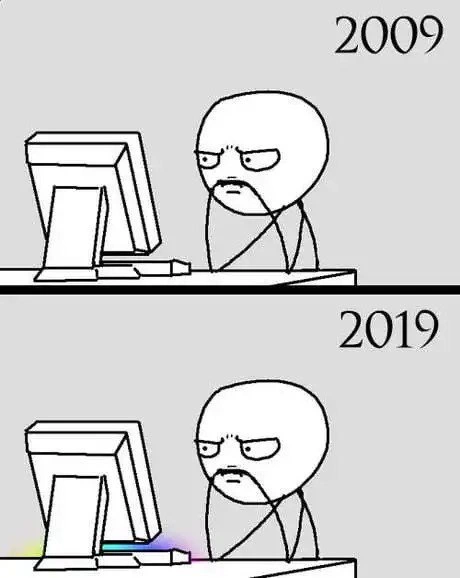
Imagine two photos of the same kid doing homework at the same desk, taken ten years apart. In the new photo absolutely everything is the same — same slouch, same grumpy face, same pile of homework — except his pencil case now has blinking rainbow lights on it. It's funny because photos taken ten years apart are supposed to show how much someone's life changed, and the only thing this person changed was buying a glowing toy. The lights are cheerful; the face says the homework never ends.
Level 2: Rage Comics, RGB, and the Upgrade That Isn't
The reference inventory, for those who joined after the fossils formed:
- Computer Guy is a stock character from rage comics — crude MS-Paint stick figures that dominated internet humor circa 2008–2012, each face encoding one canonical emotion. This one encodes "staring at a computer, unimpressed, forever." Using him is the 2009 authenticity.
- The 10 Year Challenge was a viral format from January 2019: post your 2009 self vs. 2019 self. Meant for glow-ups; instantly repurposed for jokes about stagnation.
- RGB refers to multicolor LED lighting on PC peripherals — keyboards, mice, fans, RAM. Functionally it changes nothing about performance; culturally it became the signature look of late-2010s gaming and dev setups, complete with the ironic community claim that the lights add frames per second.
- The humor mechanic is a spot-the-difference with exactly one difference, placed in a format designed to showcase many. Comedy by diff minimization.
If you're newer to the field, the relatable kernel is this: gear upgrades feel like progress and rarely are. Your first mechanical keyboard, second monitor, or glowing mousepad will not change what the work is — reading, thinking, being confused, fixing it. The meme is a gentle warning that the dopamine of customizing the setup is a different resource than the satisfaction of growing in the craft, and only one of them shows up in a ten-year retrospective.
Level 3: A Decade of Disruption, Rendered in One Light Strip
The format is the 10 Year Challenge — the early-2019 social media ritual of posting a 2009 photo next to a 2019 one to showcase transformation. The meme weaponizes the format by refusing it. Top panel, "2009": the classic Computer Guy rage-comic figure — bald stick-figure head, heavy-lidded eyes, permanent unimpressed scowl — hunched at a chunky monitor. Bottom panel, "2019": identical figure, identical hunch, identical scowl, identical monitor. The single delta in the entire image is a faint rainbow glow bleeding out from under the keyboard. Ten years of progress, one RGB backlight.
That tiny diff is a surgically precise satire of what the 2009–2019 decade actually delivered at the desk. By any industry-trends accounting, those were the most transformative ten years computing ever had: the cloud went from curiosity to default, smartphones ate the world, DevOps and containers rewrote deployment, machine learning went from grad-school topic to product requirement. And yet the phenomenology of the job — a tired human staring at a rectangle — is bit-for-bit unchanged. The meme is doing what a good regression test does: ignoring the marketing changelog and asserting on observable behavior. Observable behavior: same posture, same eye bags, same stare. Test passes. Nothing changed.
The keyboard choice is the sharpest part. RGB lighting is the decade's perfect emblem of aesthetic progress substituting for substantive progress — the "gamer-ification" of hardware where the upgrade path stopped being faster, more capable and became more illuminated. The community even has the self-aware joke baked in: RGB makes it faster. It's cosmetic differentiation in a market where the actual experience plateaued — the same dynamic as adding a dark theme to the issue tracker instead of fixing the issues, or rebranding the same architecture diagram with new logos every re-org. The light strip is a UI skin over an unchanged backend, and the backend is a man's life.
There's a quieter, darker read available too, which is why the figure's fatigue matters and not just his position. Rage comics themselves date from roughly 2008–2012; using this fossil of a character in 2019 is a deliberate archaeological touch — the meme's medium also hasn't changed. The eye bags drawn in both panels suggest the unchanged thing isn't only the desk setup but the sustainability of the lifestyle: a decade in, the burnout iconography is identical. Careers were supposed to compound — seniority, leverage, maybe stepping away from the screen. Instead the honest self-audit many developers performed during the 10 Year Challenge trend was exactly this: I bought peripherals. The industry's incentive structures changed everything around the chair and nothing about being in it.
Description
A two-panel meme using the 'Stare Dad' or 'Computer Guy' rage comic character to show the evolution of a developer's workspace over a decade. The top panel is labeled '2009' and shows the character with a stern, focused expression staring intently at a plain, grey computer monitor and keyboard. The bottom panel, labeled '2019,' depicts the exact same scene with the character maintaining the identical intense stare. The only difference is the keyboard, which is now illuminated with colorful RGB backlighting. This meme humorously points out that while technology trends and aesthetics change (like the prevalence of RGB lighting on peripherals), the fundamental nature of a developer's work - intense focus and long hours in front of a screen - remains unchanged. It's a relatable observation for veteran developers who have seen many fads come and go while the core challenges of coding persist
Comments
8Comment deleted
The biggest performance gain I've seen in the last decade wasn't from multicore CPUs or SSDs; it was my keyboard's RGB strobing in sync with my CI/CD pipeline finally turning green
A decade, two architecture rewrites, and a migration from bare-metal to Kubernetes later - I’m still waiting on the same CI build, just with RGB LEDs to illuminate the existential dread in 16 million colors
2009: "We're going to build it right this time." 2019: Still maintaining the same monolith, now with 47 authentication middlewares, three deprecated ORMs, and a Kubernetes cluster that exists solely to run the jQuery frontend we swore we'd replace in 2012
Ten years of industry transformation, and the only thing that got illuminated was the keyboard - the requirements are still as dark as ever
After a decade of Moore's Law, we've successfully miniaturized the desktop tower into a dongle that costs $79 and requires three more dongles to actually use. The developer's expression remains constant because while the hardware got smaller, the frustration scaled linearly with the number of adapters needed to connect a single external monitor
A decade, three rewrites (SVN→Git, monolith→K8s, jQuery→React), and the only benchmarkable gain is the keyboard’s RGB - finally shipping more lumens per sprint
2009: waiting for a full rebuild; 2019: waiting for Docker to pull 3GB of “latest” - same stare, now with RGB
A decade later: same legacy monitor, but now the keyboard visualizes my merge conflicts in 16.8 million shades of regret