
Number Plus String Coercion Meme Explained
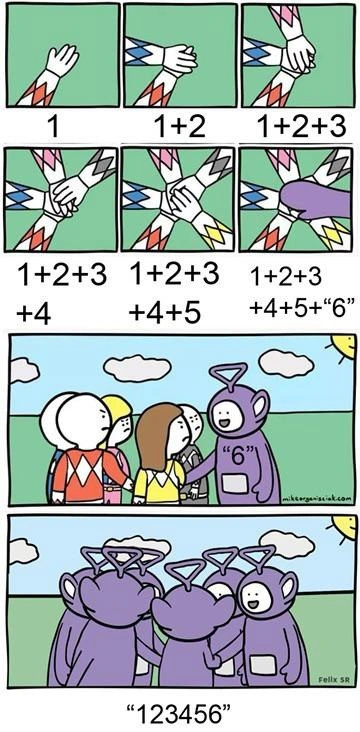
Hands stack into 1+2+3+4+5+"6", then everyone becomes purple "123456". The dive explains type coercion and why + can mean math or string join—while noting real left-associative JS would yield "156".
Level 1: Number Costume Party
Imagine five kids are doing math, and then one kid shows up wearing a sign that says "I am text." Suddenly everyone stops acting like numbers and joins together like words on a page. The meme is funny because one quoted "6" changes the whole group from math into text.
Level 2: Strings Join Late
For a newer developer, a type describes what kind of value something is. 1 is a number. "6" is a string, meaning text. Even though "6" looks numeric to a human, the quotes tell the programming language to treat it as text.
In many languages, adding numbers gives another number:
1 + 2 + 3 // 6
But adding a string with + may concatenate, which means join text together:
"hello" + "world" // "helloworld"
The meme shows the danger of mixing those worlds. The first hands represent numbers adding together. The purple "6" represents a string. Once it joins, the final group becomes a string result. This is why TypeSystems matter: stricter languages may reject mixed operations, while dynamic languages often try to be helpful by converting values automatically. Helpful automatic conversion is wonderful until it quietly helps you into a bug.
Level 3: Coercion Team-Building
The comic builds a stack of hands labeled like an arithmetic expression:
1
1+2
1+2+3
1+2+3 +4
1+2+3 +4+5
1+2+3 +4+5+"6"
Then a purple character labeled "6" joins, and the final panel shows everyone transformed into matching purple characters with the output:
"123456"
The joke is about type coercion, especially the kind associated with JavaScript and other dynamically typed languages. The + operator can mean numeric addition or string concatenation depending on operand types. Once a string enters the expression, the rest of the operation can become string-building instead of math. In visual terms, the number team touches the string teammate, and suddenly everyone becomes string-shaped. Corporate offsite complete; all integers have been rebranded.
There is a delightful technical caveat: for the exact JavaScript expression 1 + 2 + 3 + 4 + 5 + "6", evaluation is left-associative. The numeric additions happen first, then the string concatenation happens at the end:
console.log(1 + 2 + 3 + 4 + 5 + "6"); // "156"
So the meme's "123456" is more of a conceptual cartoon than a precise JavaScript trace. To get "123456" in JavaScript, the string has to enter earlier, or the numbers need to be explicitly converted:
console.log("" + 1 + 2 + 3 + 4 + 5 + "6"); // "123456"
That minor inaccuracy actually makes the senior-developer reading better. The meme is satirizing the broader LanguageGotchas experience: you think you are doing arithmetic, but the language silently changes the rules because an operand has a different type. The code still runs, nobody gets a compiler error, and now your invoice total is not a number; it is a tiny novel written in digits.

In JavaScript this team-building exercise returns "156", which is how you know the meme forgot left associativity before it forgot types.
javascript be like -1232.5
Hopefully XD
Exactly, this meme makes no sense
Beautiful
👍👍, stop making fun of JS, it’s a cool language
Greate calculation 😂