
EU Copyright Upload Filters Meme Explained
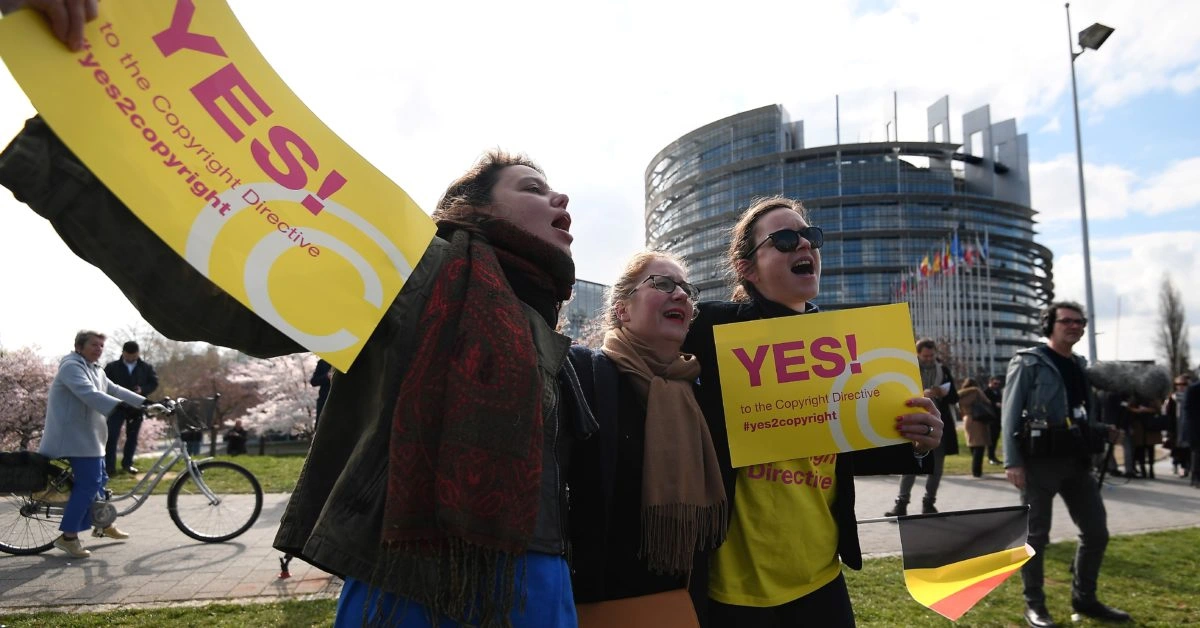
Pro-Copyright Directive signs outside the European Parliament meet the caption “But… MEMES, NOOO~.” The dive explains Article 13/17 upload liability fears: content fingerprinting, false positives on transformative memes, and law becoming platform architecture.
Level 1: The Joke Tax
Imagine kids make silly collages by cutting tiny pieces from magazines. Then a new school rule says every collage must be checked to make sure no picture belongs to someone else. The rule might be trying to protect artists, but now every joke picture has to pass through a serious inspection line. That is why the meme reacts with panic about memes disappearing.
Level 2: Copyright Meets Uploads
Copyright protects creative work such as music, images, writing, video, and art. A platform is a website or app where users can post content. Content moderation is the process of deciding what content is allowed, blocked, removed, or reviewed.
The visible signs support the Copyright Directive. The meme caption worries about memes because many memes reuse pieces of movies, shows, news photos, music, or other copyrighted material. Even when a meme is funny, critical, or transformative, an automated system may only see that a known image or clip has been reused.
For developers, this kind of rule can become a product and engineering problem. A site might need upload checks, rights databases, complaint handling, audit logs, regional rules, and human review. That is much harder than simply adding an "upload image" button. The meme is joking that a political copyright reform could turn casual internet culture into a compliance workflow.
Level 3: Upload Filter Panic
This meme is not a normal caption-over-template joke; the image itself is a news-adjacent artifact. It shows people outside a European Parliament-looking building holding bright yellow signs that read:
YES!
to the Copyright Directive
#yes2copyright
The post message adds the developer-community panic line: "But... But... MEMES, NOOO~" That matters because this was posted on March 26, 2019, the day the European Parliament approved the EU Copyright Directive. At that moment, the internet argument was not just "copyright good" versus "copyright bad." The real technical anxiety centered on what was then widely discussed as Article 13, later known in final form as Article 17: platform responsibility for copyrighted material uploaded by users.
For web developers and platform engineers, the nightmare scenario was simple to describe and miserable to implement. If a site hosts user uploads, how does it avoid liability for copyrighted content at scale? One answer is licensing. Another is takedown handling. The feared answer was automated content filtering, where every image, clip, remix, reaction GIF, and meme gets compared against rights-holder material before or after upload. That is where the meme panic comes from: memes are often transformative, clipped, remixed, captioned, and context-dependent. Machines are famously bad at understanding context, which is unfortunate when the context is the entire joke.
The pro-directive signs make the image funnier because they are earnest and clean, while the post text imagines internet users melting down over meme supply. Both sides can be understood: creators and publishers wanted leverage against giant platforms monetizing their work, while critics worried that smaller communities would inherit compliance burdens they could not afford. The developer angle is that law becomes architecture. A political vote turns into upload pipelines, fingerprint databases, appeals queues, false positives, moderation dashboards, and someone being asked whether isProbablyParody() can ship by Friday.
Nothing says open web like replacing community norms with a liability model that turns every upload endpoint into a copyright risk engine.