
Vim vs Modern IDEs Meme Explained
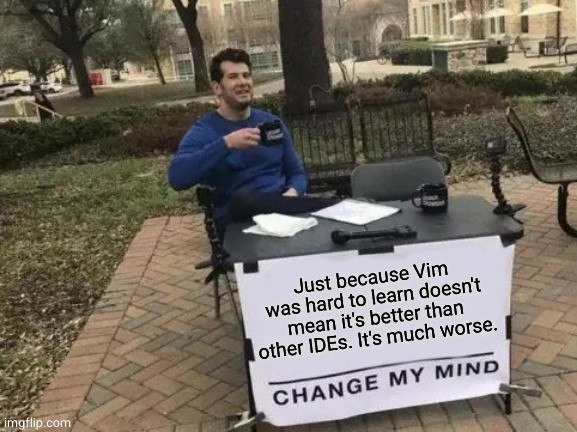
A Change My Mind sign argues that Vim being hard to learn does not make it better than other IDEs—it is much worse. The dive unpacks editor wars, sunk-cost loyalty, and IDE convenience versus modal CLI editing.
Level 1: Harder Isn’t Better
Imagine you have two ways to get your chores done. One way is super complicated – like trying to ride a unicycle to school because it looks cool but it took you weeks to figure out how not to fall. 😅 The other way is simple – like riding a regular bicycle with training wheels that you learned in just one afternoon. Now, the funny thing would be if the kid on the unicycle bragged that their way is better just because it was harder to learn. In reality, both the unicycle and the bicycle get you to school, but the bicycle is a lot easier for most people, right? The meme is joking about the same idea: some programmers learned to use a really tricky old tool (called Vim) and are proud of it, but that doesn’t automatically make it better than the easy, modern tools other people use. It’s poking fun at the silly idea that “if it was painful to learn, it must be the best.” In plain terms, just because something was harder doesn’t mean it’s better – sometimes it’s just harder, and that’s the joke!
Level 2: Editor Wars 101
So, what’s all this fuss about Vim and IDEs? Let’s break it down in plain terms. Vim is a text editor that runs in the terminal (command line). It’s famously old-school — descended from an even older editor called vi from the early Unix days. Vim is super powerful and lightning fast once you know how to use it, but it’s incredibly confusing for newcomers. For example, when you open Vim, you can’t just start typing normally. You might poke at the keyboard and nothing happens or weird things happen. That’s because Vim has modes: one mode for navigating or giving commands, and a different mode for inserting text. You have to press i (for “insert”) just to start writing, and hit the Esc key to switch back to command mode. Even something as simple as quitting the program requires a special command (:q or :wq to save-and-quit). This steep learning curve — basically a high barrier to entry — is why people joke about “How do I exit Vim?!” being a top search on Google for frustrated beginners.
On the flip side, an IDE, or Integrated Development Environment, is like a one-stop-shop application for programming. Think of Visual Studio Code, IntelliJ IDEA, or Eclipse – these are popular IDEs. They provide a graphical interface (with menus, buttons, and often the ability to use your mouse) and come packed with features to help you code. An IDE typically has things like syntax highlighting (colorful code), auto-complete suggestions as you type, debuggers, and integrated build tools. Basically, an IDE tries to make the developer’s life easier by putting everything you need in one place, often with a more intuitive point-and-click approach. If Vim is like a powerful classic car that you have to manually operate, a modern IDE is like a comfy modern car with power steering and GPS – it’ll handle some of the grunt work for you.
Now, the meme text on the sign says: “Just because Vim was hard to learn doesn’t mean it’s better than other IDEs. It’s much worse.” This is a cheeky statement, essentially calling out a mindset some people have: the idea that if you worked hard to learn something (like Vim), you might assume it’s superior to the tools that were easier to pick up. In developer culture, there’s an ongoing tooling debate often called the editor preference war (or simply EditorWars). Developers love to playfully argue about their favorite text editors or IDEs, almost like sports team rivalries. Vim versus anything else is a classic matchup. You’ll hear jokes and arguments at meetups or online like “Vim forever!” and “No, VS Code is the future!” but usually it’s in good fun. The meme uses the popular “Change My Mind” format (where someone sets up a sign with a controversial opinion and invites others to argue) to stir the pot in this debate. By saying “Vim is much worse,” the meme is intentionally trolling a bit – it’s bait to get die-hard Vim users to react.
For a newer developer, here’s why this is humorous: often beginners are told by seasoned pros that command-line tools like Vim are worth learning because they’re powerful. That’s true to an extent, but it can lead to a kind of elitism where people act like using a hard tool makes you a better developer. This meme basically laughs at that attitude. It’s reminding everyone that a tool should be chosen on merit and personal comfort, not just because it has a legendary difficulty. Developer Experience (DX) is important – that’s a term for how pleasant and efficient it is to use a tool. Modern IDEs focus a lot on good DX (like being user-friendly and helping you catch mistakes), whereas Vim demands more from the user up front (lots of memorization and practice). The meme’s bold claim is a light-hearted way to say “Don’t fall for the hype that hard = best.” If an IDE lets you write code faster or with less headache, there’s no shame in that! In summary, at this level: Vim is a powerful but tricky editor from the CLI world, IDEs are easier, full-featured coding environments, and this meme jokes that enduring Vim’s learning curve doesn’t automatically trump the comfy features of an IDE. It’s a classic case of techie humor wrapped in an editor preference war.
Level 3: Sunk Cost Editor Fallacy
In the pantheon of dev debates, Vim vs. modern IDEs is a saga as old as time (in tech years, at least). This meme plants a provocative flag in that endless war. It uses the familiar "Change My Mind" setup to proclaim: just because Vim was hard to learn, it isn’t magically superior to today’s IDEs – in fact, the sign-toting provocateur insists “It’s much worse.” This is a classic hot take that pokes fun at the sunk-cost bias many developers feel about Vim. We’ve all seen it: someone spends weeks mastering Vim’s archaic key combos and :commands, and suddenly they’re convinced that suffering = superiority. The meme calls out this logical fallacy with a healthy dose of sarcasm. It’s basically saying, “Hey, enduring Vim’s steep learning curve doesn’t earn you any special crown. You don’t get +10 productivity just because you memorized :wq.” In other words, pain is not a feature.
For seasoned engineers, the humor cuts deep because we’ve been on both sides of this. There’s the veteran who proudly touts their .vimrc configuration like it’s a Medal of Honor, and there’s the rest of us quietly thinking: “You know, VS Code has those features out-of-the-box, right?” The meme’s Change My Mind format invites Vim devotees to defend their honor. It’s an open challenge to the tribe who treat text editor choice like a religion. Historically, these editor wars go back to the days of vi vs. Emacs (a rivalry so storied it’s practically developer folklore). Back then, debates raged in Usenet forums over which was the one true editor. Today’s battlefield might be Vim vs Visual Studio Code or Vim vs IntelliJ, but the passionate rhetoric is the same. The meme zeroes in on a key irony: a tool’s difficulty level isn’t a measure of its goodness. Vim’s legendary learning curve has created a kind of elitist mystique — “I struggled through it, therefore I’m a 10x developer now.” This image bluntly satirizes that attitude by flat-out calling Vim “much worse” (with a smug grin and a coffee mug, no less). It’s as if the meme is daring ardent Vim users: Prove us wrong. Change our mind.
Why does this joke resonate so well with experienced devs? Because it captures a real culture clash in our field: effort vs. convenience. Vim enthusiasts often argue that its modal editing and keyboard-only workflow make them ultra-efficient. And yes, watching a Vim guru zip around a codebase with a few cryptic keypresses can be impressive — they’ll delete 10 lines with 5dd or do a project-wide refactor with a regex in a blink. But the meme wryly points out the other side of that coin. Modern IDEs offer amenities like intelligent code completion, inline error squiggles, one-click debugging, and a UI that doesn’t require a 50-page cheat sheet. Sure, you can turn Vim into a pseudo-IDE with enough plugins and .vimrc tweaks, but at some point you’re reimplementing features that an IDE gives you by default (and probably with better UX). The Developer Experience (DX) of a tool matters. Vim’s minimalist design was born in an era of slow terminals and 256 KB RAM limits — it’s a marvel of efficiency for its time, but it doesn’t automatically make it the most user-friendly choice in 2023. There’s a reason so many people who “try Vim” end up googling “how to exit vim” in a panic. 🤦♂️
The meme’s comedy comes from this grain of truth: mastering a difficult tool can create blind loyalty. We’ve all encountered the colleague who spent a month learning Vim only to evangelize it as the one true way, implicitly knocking those using “simpler” GUI editors. It’s a bit of gatekeeping masked as pride. This image flips the script – it’s the GUI/IDE user taking a tongue-in-cheek jab, essentially saying, “I know you poured blood, sweat, and tears into Vim. That doesn’t automatically make Vim better… maybe you just like pain.” It’s hyperbole, of course (Vim isn’t actually worse than every IDE at everything), but exaggeration is the point. It’s cathartic for developers who have felt silently judged for preferring a more intuitive tool. And it’s a poke at the old-school mentality that suffering for your tools is somehow a virtue.
To illustrate the tongue-in-cheek contrast this meme highlights, consider some expectations vs reality when it comes to Vim mastery versus modern IDE ease:
| What Vim Proponents Boast | The Reality for Many Devs |
|---|---|
| “Once you learn Vim, you’ll code at the speed of thought!” 🤯 | “Wait… how do I save and exit again?” :wq 😅 |
| “No mouse needed, I stay in flow with pure keyboard shortcuts.” ⌨️ | Hits an unintended key combo and yeets half the file. Oops. |
| “Vim is lightweight and runs on a potato. 🥔 Less bloat than IDEs.” | True, Vim’s footprint is tiny… but that also means no fancy UI to guide you. |
| “It’s infinitely customizable, I bent Vim to my will!” 😎 | Spent a day tweaking plugins and .vimrc just to get code highlighting and line numbers. |
This lighthearted table isn’t to say Vim has no merits — it has plenty, especially for power users, remote editing, or slow systems. But it underscores the meme’s point: the effort one puts into a tool doesn’t automatically translate to a superior experience for everyone. A modern IDE might feel like driving an automatic sports car with GPS, while Vim can feel like driving a stick shift on a vintage race car you rebuilt yourself. Both can get you to the finish line, but one has a gentler learning curve and cushier seats. 😁
Ultimately, the senior dev perspective here chuckles at how tribal we can get about text editors. The sign in the meme is intentionally blasphemous to the Vim faithful, and that’s why it’s funny. It jabs at the pride and sometimes ego tied up in one’s choice of tools. We’ve all been in tech long enough to know that no tool is perfect. Each has trade-offs: Vim’s power vs. an IDE’s convenience, CLI nostalgia vs. modern polish. The meme’s bold claim gets us laughing because it satirizes the irrational side of those “EditorWars” — reminding us not to confuse difficulty or tradition with better. Sometimes, enduring a painful learning curve is just… painful, not a badge of honor. Change my mind. 😉



Vim’s real killer feature is the sunk-cost fallacy - once you’ve spent a decade curating a 700-line .vimrc, you’ll defend ‘hjkl’ like it’s a legacy prod database nobody dares migrate
The real reason we defend Vim isn't the productivity gains - it's that after spending 6 months learning to exit it properly, we need to justify the Stockholm syndrome to our therapists
Ah yes, the classic Vim paradox: spending 15 years mastering an editor to save 3 seconds per file operation, then spending another 5 years in online debates defending that investment. The real productivity gain isn't the modal editing - it's the sunk cost fallacy keeping you from admitting that maybe, just maybe, your IDE's integrated debugger and LSP support might have been worth clicking a few buttons for
Vim zealotry is sunk‑cost optimization: after 200 keymaps and a 1,000‑line .vimrc to graft on LSP and Treesitter, switching editors feels like a migration with no rollback
Vim isn’t better than IDEs; it’s just the only editor already on the prod box you’re patching while your IDE is still “Indexing…”
Vim: Earn your saves with :wq. IDEs: Ctrl+S and pretend you're productive - until the monolith needs remote editing
If you use vim for programming something is wrong with you
what ide is safer and more reliable than vim?
"well perhaps programming should be done with extreme reliability, security, quality but definitely not extreme speed", how it's vim related then?
they do, and there are cases when it's needed
basically my comment was about vim, and your comment was off top, right?
What makes vim good is the part that comes after the difficulty. You could make the same argument about all non-corporate software that isn't made for retards. "Being harder to use makes it worse". I don't think so.
Vim lovers are just snobs and tryhards
You can't compare vim and IDEs. Vim is an editor, IDEs are IDEs. I prefer control over what's happening on my computer when I code (especially when I learn something, so that autocompletions wouldn't just make me YOLO it all the time), so Vim is a very valuable tool for me. Idk it's super stupid to compare those...
Omg... Don't like it => don't use it. It's that simple.
>other IDEs vim isnt an ide 💀
idiotic meme
Vim is so comfortable to use for navigation it's automatically better. And it's not an ide lol, tho you can make one from it.
VSCode is a browser that somebody forced via JS to pretend to be an IDE.
leftist tactics: do not understand it == lets hate