
Vibe Coding vs Development Meme Explained
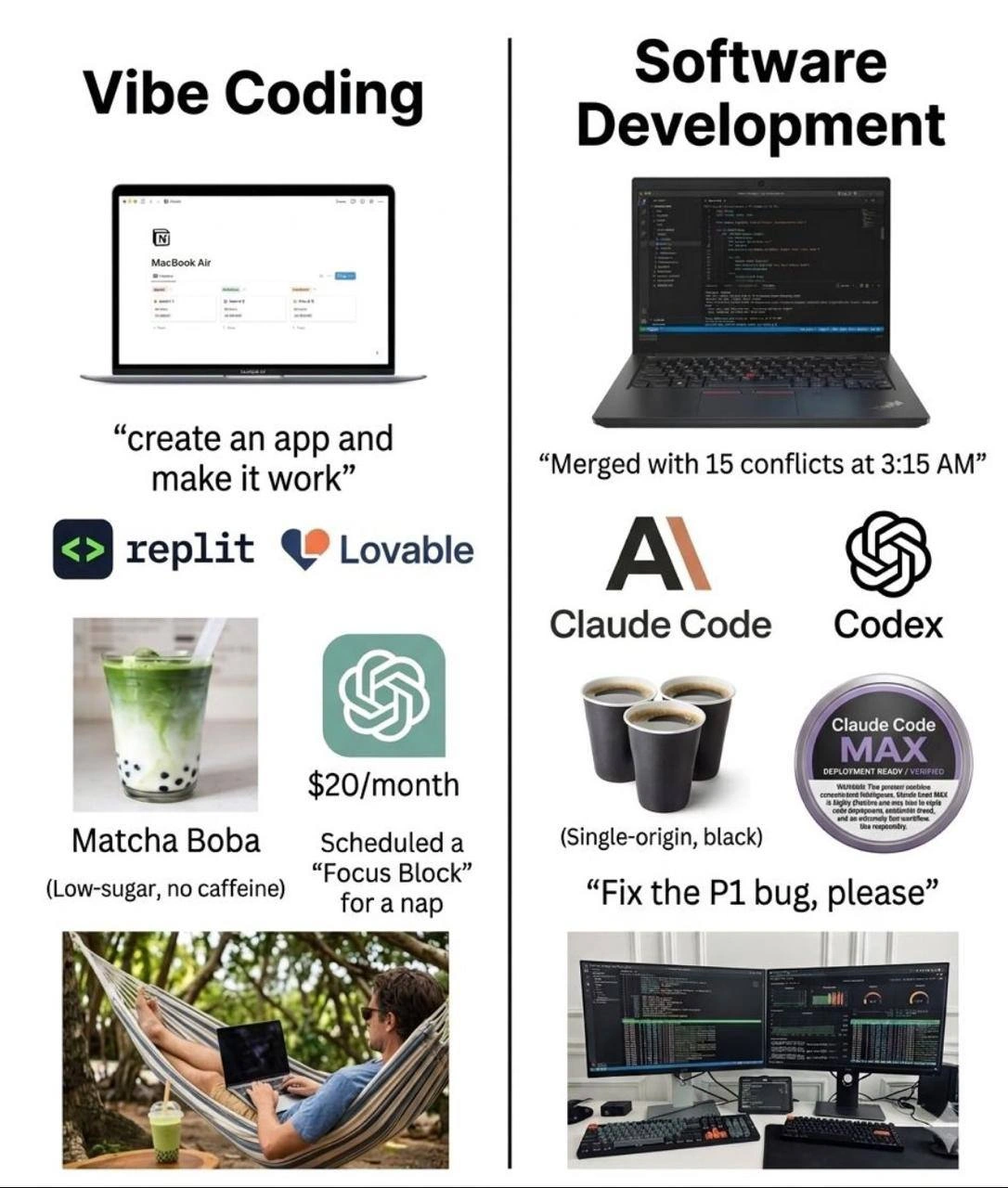
A two-column starter pack contrasts vibe coding (matcha, hammock, Replit) with professional software development (black coffee, 3 AM merges, Claude Code). The dive argues the split is not AI vs humans but accountability for what agents ship to production.
Level 1: Playing Restaurant vs Running One
One person is playing restaurant: they tell a magic helper "make me a lemonade stand," sip a fancy green drink in a hammock, and schedule a nap. The other person runs an actual restaurant: same magic helper, but now the kitchen catches fire at 3 in the morning, three cups of strong coffee are lined up, and someone keeps saying "fix it, please" in a way that isn't really a question. The joke is that they look like they have the same hobby — but only one of them gets woken up when something breaks.
Level 2: Decoding the Starter Packs
- Vibe coding — describing what you want in natural language and letting an AI build it, without reading the code. Platforms like Replit and Lovable package this end-to-end: prompt in, deployed app out.
- Claude Code / Codex — terminal-based AI coding agents used by professionals inside real codebases; they edit files, run tests, and create commits, but a human owns the result.
- Merge conflict — when two sets of changes collide in
gitand someone must manually decide which lines survive. Fifteen of them at 3 AM means a long-lived branch met reality. - P1 bug — priority-one defect; the "please" is decorative, the deadline is now.
- Notion board vs terminal logs — planning aesthetics vs operational telemetry; one shows what you intend, the other shows what's currently on fire.
The early-career rite of passage encoded here: your first weekend project feels like the left column, and your first week of on-call teaches you why the right column drinks its coffee black — there's no time for milk during an incident.
Level 3: Same Models, Different Pager
The sharpest thing about this starter-pack diptych is that both columns are using AI coding agents. The left side has the OpenAI logo at "$20/month" next to Replit and Lovable; the right side has Claude Code and Codex rendered like rival cigarette brands, plus a tin parodying chewing tobacco labeled Claude Code MAX — DEPLOYMENT READY / VERIFIED. The meme isn't "humans vs AI" — it's a class portrait of two cultures that emerged after everyone adopted the same tools. The differentiator is no longer whether you use an agent; it's whether you're accountable for what it ships.
Left column: MacBook Air showing a Notion board, the prompt "create an app and make it work," an iced matcha boba ("Low-sugar, no caffeine"), a calendar that says Scheduled a "Focus Block" for a nap, and a man typing from a hammock. Every artifact signals consequence-free building. The vibe coder's feedback loop terminates at "it renders." There is no on-call rotation in a hammock.
Right column: a ThinkPad (the choice of laptop is its own sociological essay) full of dark-theme code, the caption "Merged with 15 conflicts at 3:15 AM," three black coffees "(Single-origin, black)," and a multi-monitor battle-station drowning in terminal logs and dashboards. The kicker is the politely radioactive Slack message:
"Fix the P1 bug, please"
That "please" is doing what "per my last email" does — it's the corporate courtesy wrapper around an alarm bell. A P1 means customers are bleeding and someone's incident channel is filling up. The professional's relationship with AI tooling is therefore fundamentally different: the agent is a power tool aimed at a production system, and every suggestion it makes is something you will be paged about later. Hence "Deployment Ready / Verified" styled as a nicotine warning label — the joke being that heavy agent use among professionals has the phenomenology of a dependency: dosage tiers (MAX), daily ritual, and the slow realization you can't quit.
The structural insight worth keeping: the meme documents the bifurcation of "coding" into two industries. One sells the feeling of building software (low-sugar, no caffeine, no merge conflicts); the other remains the unglamorous discipline of keeping software alive, where version control still ambushes you at 3:15 AM with fifteen conflicts because two agents and one human all touched the same file.
Both columns use the same model; the only real differentiator is whether 'production incident' appears in your calendar or someone else's
Vibe coding ends the moment the first bug acquires a severity, an SLA, and a customer.
why does this look like a can of vaseline?
> claude code MAX
no difference at all
Single origin? You meant cheapest blend actually
lacks "MAKE NO MISTAKES"