
Integer Negation Clever Code Meme Explained
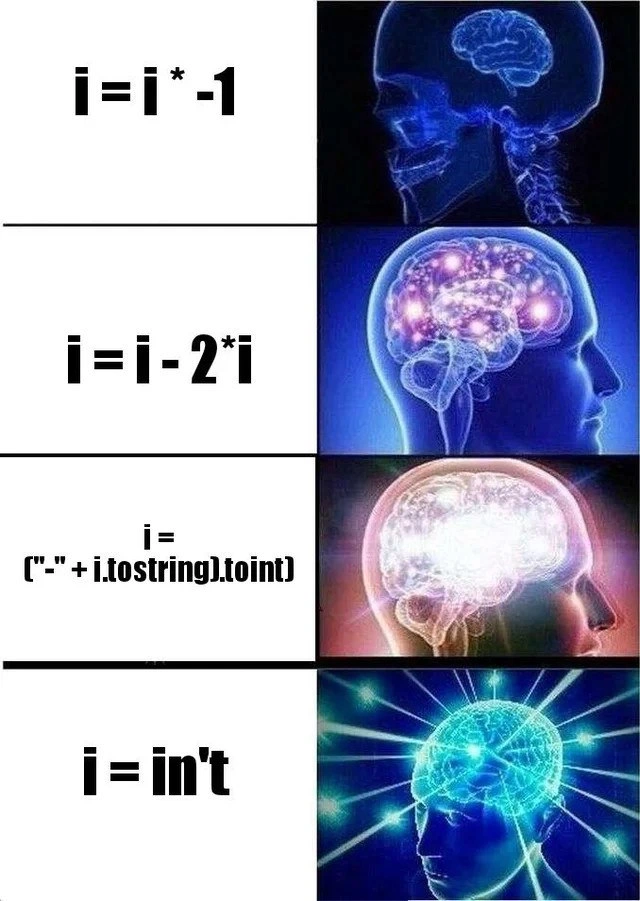
An expanding-brain ladder shows four ways to get a negative integer, from i * -1 through algebraic and string-coercion detours to the pure pun i = in't. The dive teaches that languages allow many equivalent expressions, but the clearest negation is usually best.
Level 1: Making Simple Hard
This is like needing to turn a toy car around and first spinning it by hand, then measuring angles with a ruler, then mailing it to yourself with a note that says "face backward," and finally declaring that the car "isn't." The joke is that every row acts smarter than the last, but the job was easy from the start: just make the number negative.
Level 2: Minus The Easy Way
An integer is a whole number like 4, 0, or -12. To get its negative value, most languages let you write something like i = -i. If i is 7, it becomes -7; if it is already -7, it becomes 7.
The meme shows four ways to do that same thing, each one more ridiculous than the last:
i = i * -1multiplies the number by negative one.i = i - 2*isubtracts twice the number from itself, which also flips the sign.- The string-conversion version turns the number into text, sticks a minus sign in front, and turns it back into a number.
i = in'tstops being real code and becomes wordplay onint.
This is why the expanding-brain images fit. They usually pretend that stranger ideas are more advanced. Here, the "advanced" versions are worse because they make a basic operation harder to read. New developers often learn this lesson after writing a clever line, coming back two weeks later, and realizing they have created homework for their future self.
The relevant Language humor is that programming languages often have many ways to express the same result. The CodeQuality lesson is that the clearest version is usually the best version unless there is a real reason to do something else. Code is read many more times than it is written, and a tiny negation should not require a math proof, a parser, and a pun dictionary.
Level 3: Galaxy Brain Negation
The expanding-brain format is doing precise work here: every row claims to be more enlightened while the code becomes less defensible. The first row shows the normal-ish arithmetic version:
i = i * -1
That is already slightly more verbose than the usual unary negation i = -i, but it is readable. The second row escalates to:
i = i - 2*i
Mathematically, that is equivalent because i - 2i = -i. It also has the flavor of code written by someone who just discovered algebra and immediately deployed it to production. The operation is still simple, but now the reader has to pause, simplify the expression mentally, and wonder whether there was a hidden reason for avoiding -i. There usually was not. There was only confidence.
The third row goes fully into type coercion theater: it visually builds a string by prefixing "-" to i.tostring, then converts it back with .toint. That is the kind of "solution" that crosses language boundaries for no reason. Instead of staying in the numeric domain, it allocates text, depends on formatting behavior, parses the result, and invites bugs around signs, locales, nulls, overflow, and whatever a particular language means by toString this week. It is the coding equivalent of mailing yourself a note to remember where your desk is.
The final row, glowing with maximum enlightenment, says:
i = in't
The joke pivots from syntax abuse to pure technical pun. int is the common name for an integer type, and in't sounds like a contraction of "isn't." So the integer becomes "isn't" itself: no longer positive, no longer negative, just semantically negated by apostrophe. This is not optimization. It is a crime scene with good typography.
What makes it especially familiar to experienced developers is the satire of cleverness as a maintenance hazard. A readable one-character operation gets replaced by progressively more "interesting" alternatives. In real codebases, that same instinct creates utility wrappers for built-in behavior, abstraction layers that hide nothing, and performance "improvements" that allocate more memory than the original problem. The meme is not saying clever code is always bad; it is saying that cleverness without purpose turns CodeReadability into archaeology.


The third line allocates a string just to flip a sign, which is how you know the fourth line is the real performance optimization.
x = (x ^ -1) + 1
i=-i;
Perl: $i =~s/^/-/;
i = (int)((uint)(i ^ 0xFFFFFFFF) & 0x80000000);
just yell at it...
i*=-1
j = 0 - i; i = 0 + j;
i = -(2*i-(i - i*2))
i = sqrt(-1)
i = (opposite_sign(i)) * i; where int opposite_sign(int x) { return x > 0 ? -1 : 1; }
i=-i Easy-peasy
i=√-1
Pardon
i *= -1;