
Vague Bug Reports Doesn't Work Meme Explained
A developer tries to write a program that erases the Unsettled Tom meme; it fails, and their face becomes the meme. The dive unpacks self-reference, vague failure reports, automation hubris, and why deletion at internet scale is a negotiation.
Level 1: The Joke That Fights Back
Imagine being so tired of a song that you build a machine to erase it from the world — and the machine breaks, and the clunk it makes while breaking plays the exact song you hate. That's this meme: someone tried to destroy a picture of a very tired, wide-eyed cartoon cat, the plan failed, and now their own face looks exactly like that tired, wide-eyed cat. The harder you fight it, the more of it you make. It's funny the way quicksand is funny when it's not you in it.
Level 2: Why "Doesn't Work" Is the Hardest Bug Report
Pieces worth unpacking for anyone early in the journey:
- "Program: doesn't work" — the least actionable phrase in software. Real debugging starts by converting this into specifics: What did you expect? What happened instead? What's the error message? You'll spend a surprising fraction of your career performing this conversion — on users' reports and on your own vague despair.
- Recursion / self-reference — when a thing is defined in terms of itself. Here the joke loops: the reaction to the meme is the meme. In code, recursion is powerful but needs a base case — a stopping condition. This meme deliberately has none; that's the gag.
- Why you can't delete things from the internet — once content is copied to thousands of servers, phones, and screenshots, there's no central "delete" button. Distributed copies mean durability — great for backups, terrible for embarrassments.
- Debugging emotional stages — confidence ("simple script, 20 minutes"), confusion ("why is nothing happening"), bargaining ("maybe if I just rerun it"), and finally the Tom face. Recognizing the stages doesn't prevent them; it just lets you laugh at the meme harder.
The relatable rookie moment: the first time you announce a small automation project to friends ("I'll just write a bot for that!") and three hours later you're not sure the language you're using has ever worked for anyone.
Level 3: The Quine of Despair
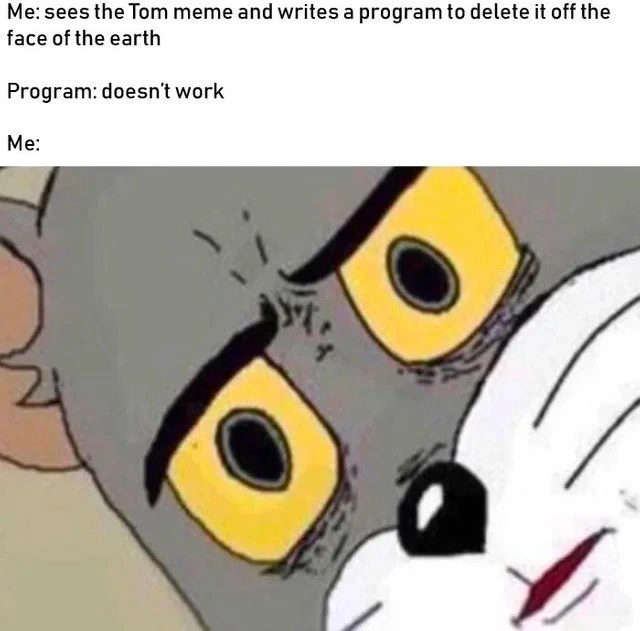
"Me: sees the Tom meme and writes a program to delete it off the face of the earth" "Program: doesn't work" "Me:"
— followed by the Unsettled Tom image itself: Tom from Tom and Jerry, eye-bags rendered in loving detail, staring with the thousand-yard expression of someone whose worldview just segfaulted, while a serene white face smiles beside him.
The structural elegance here deserves credit: this is a self-referential meme with a genuinely recursive payload. The author's reaction to failing to destroy the meme is the meme. The eradication attempt didn't just fail — it produced a new instance of the target. In CS terms it's adjacent to a quine (a program whose output is itself) crossed with the classic fork-bomb dynamic: every attempt to handle the object spawns another copy. Memes, like well-replicated data, have absurd availability guarantees — content distributed across millions of independent caches with no single writer cannot be deleted, only resented. Anyone who's filed a DMCA takedown, tried to scrub a leaked API key from forks, or invoked the GDPR right-to-erasure against the realities of CDN caches and backup retention knows: deletion at internet scale is a negotiation, not an operation.
But the line that carries the developer pain is the middle one: "Program: doesn't work." Four words containing an entire career. Not "throws NullPointerException on line 247," not "fails for inputs over 4GB" — just doesn't work, the same diagnostic granularity as every bug report ever filed by a non-engineer and, if we're honest, most of our own 2 AM commit messages. The meme's emotional engine is that gap between ambition ("delete it off the face of the earth" — note the grandiosity; we never scope small) and outcome (silent, unexplained failure). The face isn't anger. It's the specific unsettled hollowness of staring at code that should work, has no obvious reason not to work, and simply... doesn't. Every senior carries that face in muscle memory; this template just gave it fur.
There's also the gentle self-own about automation hubris: the instinct, upon encountering any annoyance, to write a program about it. Annoying meme? Script it away. The universe's response — making your failure indistinguishable from the annoyance — is the kind of poetic judgment usually reserved for Greek myth and production deployments.
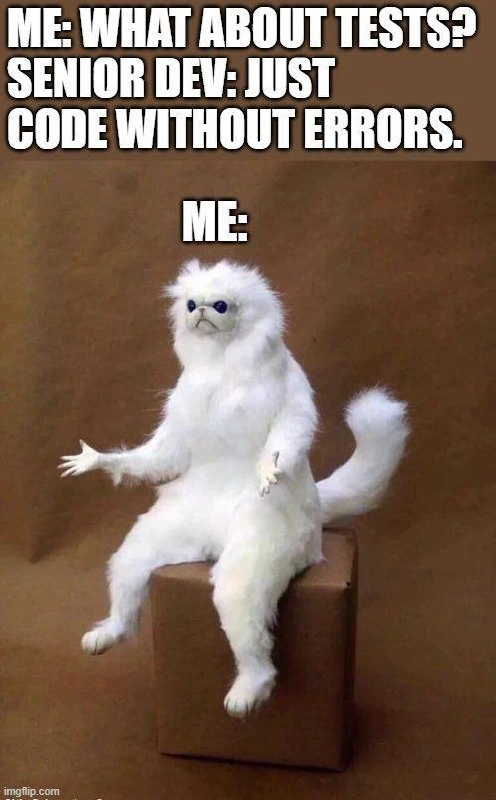

Some developers see a problem and think 'I'll write a script to automate that.' Then they have two problems, and one of them is a recursive loop of self-loathing perfectly captured by a cartoon cat
I wrote a Lambda to nuke every last Tom.jpeg from S3, but between eventual consistency and 200 edge caches I basically open-sourced the meme - turns out “delete” is just another replication strategy
Writing a distributed cache invalidation system to purge memes globally, only to discover you've created an eventually consistent system where 'eventually' means 'never' and 'consistent' means 'Tom's face is now everywhere.'
Classic distributed-systems lesson: you can't delete content that replicates faster than your script fails - the meme has better availability guarantees than your prod cluster
The real tragedy isn't that the program failed - it's that you now have to manually delete the Tom meme, which means opening the file, which means seeing Tom's face again, which triggers you to write another program to automate it, which also doesn't work. Welcome to the infinite recursion of developer hubris, where the stack overflow is emotional rather than technical
Wrote a script to nuke the Tom meme; CDNs, search indexes, Slack reuploads, and S3 Object Lock turned a simple delete into a global tombstone - proof that removal in distributed systems is just eventual regret
Tried rm -rf on the Tom meme; it's a zombie process haunting every feed
Built a job to erase the Tom meme; the CDN, S3 versioning, and Slack exports achieved Raft consensus that it’s immutable