
Game Dev Crunch Culture Meme Explained
The exhausted Coraline father slumped at a CRT becomes the face of multi-year game crunch: 16-hour days for death threats and a 30% Steam rating. The dive unpacks why marketing-driven ship dates, exempt overtime, and the effort–outcome gap keep the cycle alive.
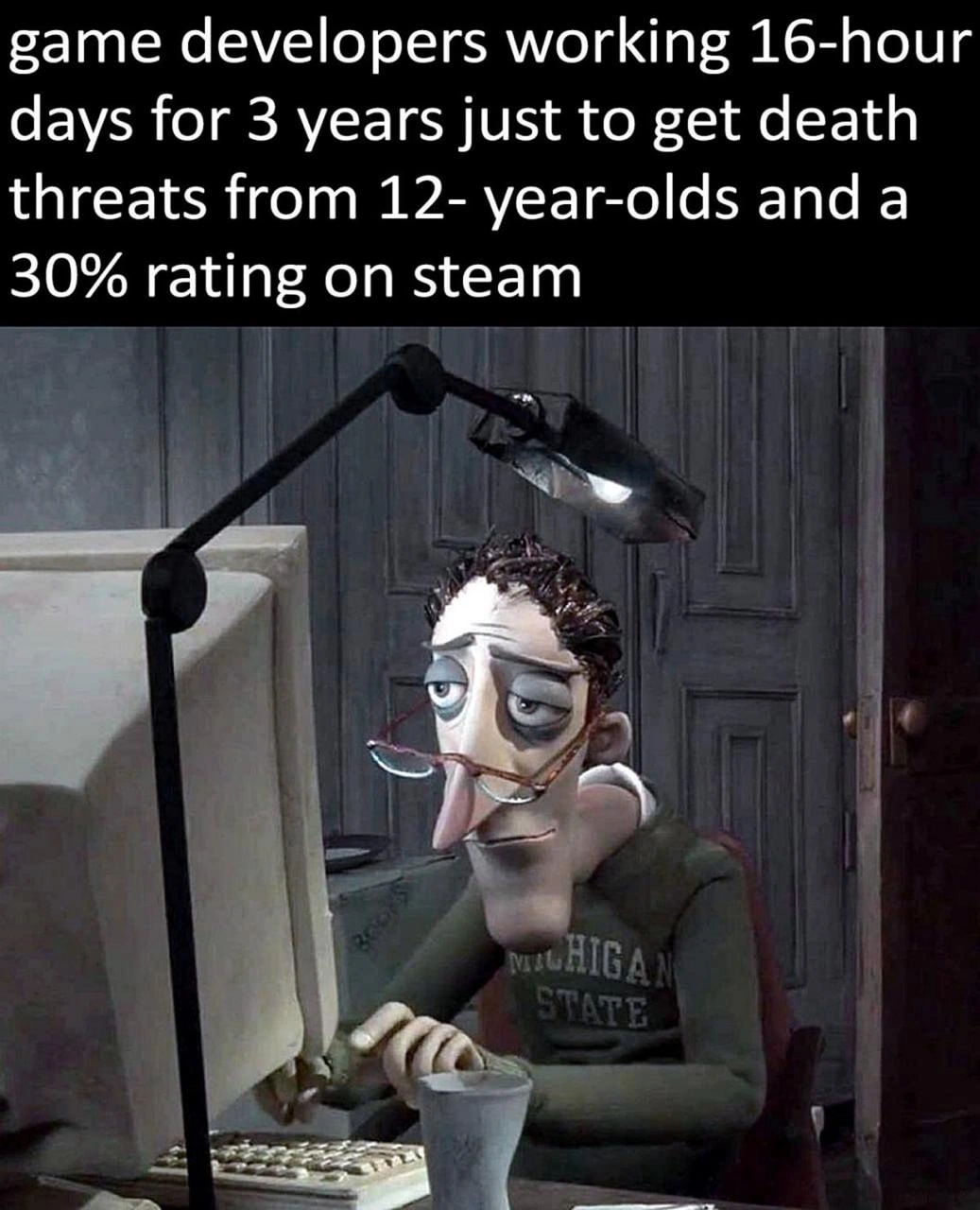
Level 1: The Sandcastle and the Seagulls
Imagine spending three whole years building the biggest, most detailed sandcastle anyone has ever seen — skipping lunch, skipping sleep, missing your friends' birthdays — and the moment you finally step back, a crowd of kids runs up, kicks the towers, throws shells at your head, and holds up signs saying "WORST CASTLE EVER, 3 OUT OF 10." The tired man in the picture is funny because his face is exactly how that feels: too exhausted to even cry about it, just staring while the coffee goes cold. The joke is the unfairness — working the hardest and getting yelled at the loudest — told through the most tired face ever put on screen.
Level 2: Decoder Ring for the Trenches
- Crunch: extended mandatory-in-practice overtime before a milestone or launch — 60-to-100-hour weeks, sometimes for months or years. Common across GameDev because release dates are marketing commitments, not engineering estimates.
- Steam rating: the percentage of user reviews marked positive. Bands range from "Overwhelmingly Positive" down to "Overwhelmingly Negative"; 30% lands in Mostly Negative, which actively suppresses sales through store algorithms and screenshots of shame on social media.
- Review bombing: coordinated negative reviews, frequently about pricing, politics, or publisher decisions rather than the game itself.
- The empathy gap: players review the product; the product embodies decisions devs didn't make. The QA tester who filed the bug that shipped anyway gets the same Reddit flaming as the executive who cut the schedule.
If you're early-career and a studio recruiter says "we work hard and play hard" or "we're like a family," understand the exchange rate being offered: your evenings, weekends, and wrists, for the line "shipped AAA title" on a résumé — payable whether the Steam score is 30% or 95%. The coffee cup next to the keyboard in the still isn't set dressing. It's load-bearing.
Level 3: Shipping Is a Postmortem You Attend Alive
The character doing the emotional heavy lifting here is the father from Coraline — Laika's stop-motion masterpiece — slumped at a CRT under a swing-arm lamp, glasses sliding off his nose, eye bags rendered in lovingly hand-crafted silicone. The animators built that puppet to depict a writer so drained he's barely operating the keyboard, and the meme repurposes him without changing a thing, because no one has ever produced a more accurate portrait of month thirty-four of a thirty-six-month crunch cycle. The caption — "game developers working 16-hour days for 3 years just to get death threats from 12-year-olds and a 30% rating on steam" — compresses the entire game-industry labor discourse into one sentence, and every clause is documented reality, not hyperbole.
Crunch persists because of an incentive structure that everyone condemns and no one dismantles. Ship dates are announced at trade shows before the engine port is finished; marketing spend is committed against those dates; delaying costs executives credibility while overtime costs them nothing, since salaried "exempt" developers don't bill extra hours. Studio leadership calls it "passion." The pattern is so entrenched it survived two decades of exposés — from the EA Spouse letter onward — because the industry runs on an inexhaustible queue of young developers who grew up dreaming of making games and will absorb the abuse a senior dev finally refuses. Burnout isn't a side effect of this system; it's the cooling mechanism.
And the reward structure on the other side is just as broken. A 30% on Steam means "Mostly Negative" — a public, permanent, storefront-gating verdict often driven by launch-day server collapse, a controversial monetization decision made above the developers' pay grade, or review-bombing campaigns about something unrelated to the code. The people who chose the always-online DRM are not the people reading "dev team should be ashamed" at 2 AM. Meanwhile community managers forward the actual death threats — a phenomenon so normalized that studios now have security protocols for patch announcements. The grim joke experienced developers recognize: the gap between effort and outcome in games is wider than anywhere else in software. A B2B CRUD app shipped late gets a stern email. A game shipped imperfect gets a harassment campaign with your name in it.

Three years of crunch compressed into one Steam review: 'refunded at 1.9 hours.'
They hit the 16 ms frame budget by moving every overrun into the human sleep budget.
when you join a game company founded through kickstarter thats run by a ceo with no experience
Just to work on hlx that won’t come out
"working 16-hour days to make the game as gay and diverse as possible"
shouldn't have promised them robux if you play the game
tbh most game devs have no choice to choose the game design shown to users,they just have to go with what the shitheads in marketing and stakeholders decide
It is not that serious. It is just a game. That mentality has cost many airheads on the front lines because they falsely thought it is a game.
Well, don't make shitty games