
Poop Emoji as IPv4 Address Meme Explained
A tweet claims there is an IP that can be represented by the poop emoji. The dive shows UTF-8 bytes f0 9f 92 a9 equal 240.159.146.169, and notes that reserved Class E space makes it unroutable public fun, not a real host.
Level 1: One Number Costume
Imagine four blocks in a row. If a teacher looks at them one way, they spell a silly symbol. If a mail carrier looks at the same four blocks another way, they look like an address. The joke is that the blocks did not change at all; only the rule for reading them changed.
Level 2: Same Bytes, Different Meaning
Unicode is a standard for representing text characters, including letters, symbols, and emoji. UTF-8 is one common way to store Unicode characters as bytes. Some characters use one byte, and some, like many emoji, use four bytes.
An IP address is a number used to identify a device or destination on a network. The older IPv4 format uses four bytes, usually written as four numbers separated by dots. Each number is one byte, so it ranges from 0 to 255.
That is why the tweet is funny. The same four bytes that encode one emoji in UTF-8 can also be written as an IPv4-style address:
UTF-8 bytes: f0 9f 92 a9
Decimal IP:  240.159.146.169
This is not a feature someone designed for networking. It is a coincidence caused by both systems using four bytes in this case. Early-career developers run into this kind of thing when they learn that computers do not store "meaning"; they store bits, and programs decide what those bits mean.
Level 3: Four Octets, One Joke
The tweet's visible claim is:
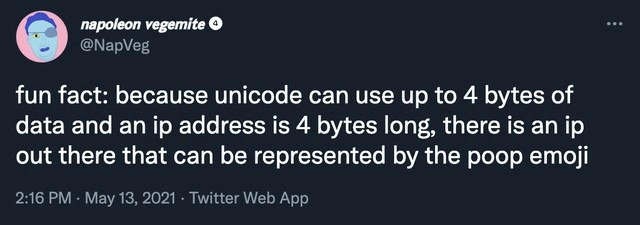
fun fact: because unicode can use up to 4 bytes of data and an ip address is 4 bytes long, there is an ip out there that can be represented by the poop emoji
The joke is a tiny collision between two unrelated conventions that both happen to fit in four bytes. An IPv4 address is 32 bits, traditionally written as four decimal octets like 192.0.2.1. A Unicode character, when encoded as UTF-8, can occupy one to four bytes. The post metadata gives the punchline as 240.159.146.169, which maps cleanly to the byte sequence f0 9f 92 a9, the UTF-8 encoding for U+1F4A9.
That does not mean the internet has a friendly server named after the emoji, and it does not mean Unicode and IP addressing are secretly compatible systems. It means bytes are shamelessly reusable. The same four bytes can be interpreted as text, an integer, an address, a color, a broken file header, or a reason someone in networking sighs into their coffee.
There is also a technical footnote hiding under the joke: 240.0.0.0/4 has historically been reserved IPv4 space, so 240.159.146.169 is not the kind of address you should expect to ping successfully on the public internet. The meme still works because its claim is about representation, not reachability. It is not "this address hosts something"; it is "these four bytes can be read through two different lenses, and one lens is funnier."
The humor is pure data formats absurdity. Engineers spend careers warning that "bytes are not strings" and "strings are not characters" and "characters are not glyphs." Then a tweet arrives and proves that, with the right accident of encoding, a networking primitive can look like a bathroom joke. Standards committees suffered so we could have this screenshot.
Somewhere in IPv4 space, a packet can technically route to U+1F4A9, which feels like the most honest hostname on the internet.
explain please
what is unclear
🤨🤨
why would the poop emoji result in the IP-address 240.159.146.169?
w h a t
🤨
deserved
fine then
research purposes more like shit purposes🤣🤣🤣🤣🤣🤣🤣
that's a shitty research
https://t.me/sendmegifs/282
def emoji_to_ip(emoji): b = emoji.encode() if len(b) != 4: raise Exception('not 4 bytes') #return f'{b[0]}.{b[1]}.{b[2]}.{b[3]}' return '.'. join (map (str, b))
Spoiler: utf-8 isn't just dumping the U+number into however many bytes it requires
*Clicking on random IP adresses*