
AI Bubble and GPU Limits Meme Explained
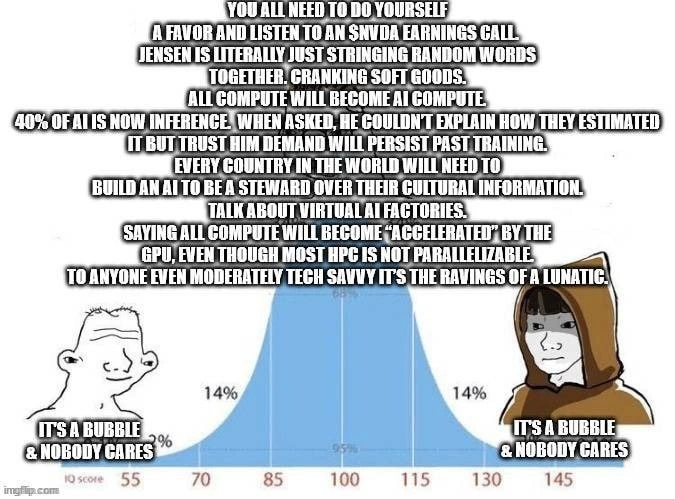
A midwit-meme bell curve has both tails saying "it's a bubble & nobody cares" while the middle rants about Nvidia earnings claims—AI factories, inference demand, and all compute becoming GPU-accelerated. The dive separates real AI hardware demand from hype that ignores parallelization limits.
Level 1: Everyone Buys Shovels
This is like a town hearing there is gold nearby, so everyone buys very expensive shovels. Some people really will find gold, and the shovel seller really is making useful tools. The funny part is that everyone starts acting like every problem in life can be solved by buying more shovels, while the calm people at both ends say, "Yes, this is probably a bubble, and yes, everyone is still going to keep buying."
Level 2: GPUs Are Not Magic
An Nvidia GPU is a specialized chip used for graphics and high-speed parallel math. In modern AI systems, GPUs are valuable because neural networks do a huge amount of repeated numerical computation. Training is when a model learns from data. Inference is when a trained model answers real user requests.
The image jokes about an earnings-call style story where Nvidia's future demand sounds limitless. It mentions AI compute, inference, countries building AI, and "virtual AI factories." These are all ways of saying that more organizations may need more computing hardware to build and run AI systems.
The skeptical part is that parallel computing has limits. A GPU can speed up work only when the work can be split into many similar pieces. If a task must happen one step at a time, adding more GPU power can be like hiring a hundred people to read one book in order. They may be talented, but page two still waits for page one.
For newer developers, this is the same lesson as learning that a faster server does not fix a bad database query, a memory leak, or a network call made in a loop. Hardware matters, but architecture decides whether the hardware gets to help.
Level 3: Accelerated Narrative Computing
The bell-curve format says the quiet part loudly: both the simple face on the left and the hooded cynic on the right arrive at the same caption:
IT'S A BUBBLE & NOBODY CARES
The dense all-caps rant above the curve is the middle of the distribution melting down over Nvidia's AI story. It name-checks the visible claims:
ALL COMPUTE WILL BECOME AI COMPUTE
40% OF AI IS NOW INFERENCE
TALK ABOUT VIRTUAL AI FACTORIES
The post timing matters here: it came on February 23, 2024, right after Nvidia's February earnings report turned AI demand, data-center revenue, inference workloads, and "sovereign AI" into market fuel. The meme is not saying GPUs are useless. That would be too easy, and also wrong. The joke is that real technical demand can coexist with a market narrative so stretched that every workload starts getting painted the same shade of green.
The technical bite is in the line about acceleration. GPU acceleration is powerful because GPUs are good at running many similar operations in parallel. Deep learning training and inference fit that model unusually well: matrix multiplications, tensor operations, batching, and high-throughput numerical work are exactly the kind of jobs that make accelerators look miraculous. But the visible rant says:
EVEN THOUGH MOST HPC IS NOT PARALLELIZABLE
That phrasing is exaggerated, but the underlying criticism is familiar. Not every program becomes faster because a GPU is nearby. Workloads with serial dependencies, irregular memory access, small batch sizes, latency-sensitive control flow, or heavy I/O can fail to benefit from accelerators. This is why performance engineers still mutter about Amdahl's Law while everyone else is naming the next "AI factory."
The market satire lands because AI hype cycles often flatten nuance into a purchasing thesis: training needs GPUs, inference needs GPUs, every country needs GPUs, every company needs GPUs, and eventually your toaster has a total addressable market. The bell curve says the beginner shrugs because bubbles are just how markets behave, while the expert shrugs because the technical overreach is obvious and still does not stop the money. The middle person is stuck doing the doomed thing: insisting that words should mean things.
The market heard `for each workload: buy GPU` and decided type-checking was bearish.
If most HPC is not parallelizable, then why are so many top-rated supercomputers based on GPU nowadays? 🤔
Yes this
It’s a bubble and I haven’t had a job in 9 months and I’m the only one paying for the home :’D