
++i-- Operators Meme Explained
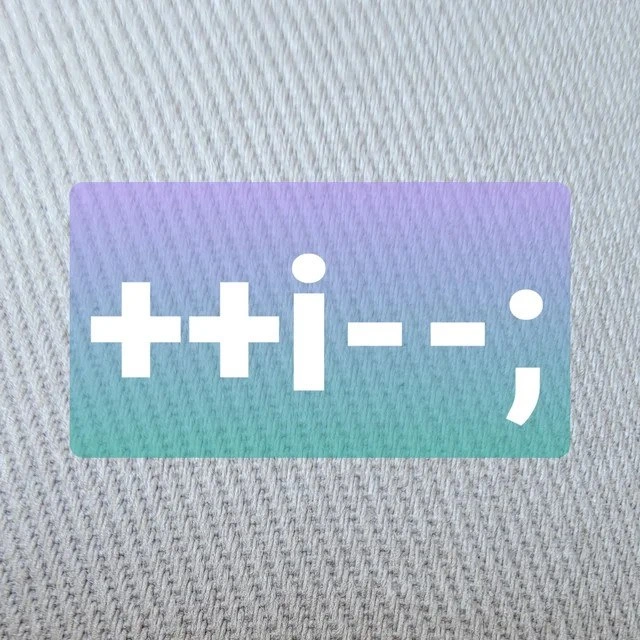
The meme shows ++i--; and invites wrong names like noncrement and less-crement. The dive explains why combining prefix increment with postfix decrement is invalid for ordinary integers in C-family languages: postfix -- yields a temporary that cannot be incremented again.
Level 1: Push And Pull
This is like putting a sticker on a door that says "push-pull" at the same time and then asking what kind of door action that is. It looks like it should mean something, because both words are real instructions. The joke is that combining them this way makes a ridiculous command, so programmers start inventing silly names for the nonsense.
Level 2: Two Operators Collide
The operator ++ usually means "add one." The operator -- usually means "subtract one." They can appear before or after a variable:
++i; // add one before using i
i--; // use i, then subtract one
The image combines them around the same variable: ++i--;. At first glance, a beginner might think it adds one and subtracts one, so nothing changes. That is the "noncrement" idea.
The problem is that programming languages have strict rules about how expressions are grouped and what kinds of values can be modified. A variable like i is a place in memory. But the result of i-- is more like a produced value, not the original place you can immediately modify again. So applying ++ to that result is not allowed for normal integer variables in C and C++.
This is why CompilerErrors and LanguageQuirks fit the meme. The symbols are valid individually, but the full expression is not a useful operation. It is the sort of thing that teaches new developers an important lesson: operators are not just decoration. Their position, precedence, and result type all matter.
Level 3: Preincremental Regret
The sticker shows a huge C-family-looking expression:
++i--;
The caption asks:
What would you call this operation? (Wrong answers only)
noncrement? Ex-crement?? Less-crement???
The joke starts with the fact that ++ and -- are real operators in languages like C, C++, Java, JavaScript, and C#. ++i means "increment i before using its value." i-- means "use i, then decrement it afterward." Put them together as ++i--; and the expression looks like it should perform some elegant net-zero integer ritual. It has the visual confidence of code and the semantic stability of a chair with no legs.
For ordinary C or C++ integers, this is not a clever way to add one and subtract one. It is invalid. Postfix decrement binds tightly, so the compiler effectively sees the inner operation as i-- and then tries to apply prefix increment to the result of that operation. But the result of built-in postfix decrement is not a modifiable storage location you can increment again; it is a temporary value. The compiler is not confused. It is offended in a very specific, standards-compliant way.
That is why SyntaxAbuse is the perfect tag. The expression abuses the surface grammar of familiar operators. It is built from pieces every C-family programmer recognizes, yet the combination crosses from "quirky" into "why are you like this?" The semicolon at the end makes it funnier because it presents the whole thing as a complete statement, as if someone actually intended to ship it.
The deeper developer humor is about readability and intent. Even if a language with overloaded operators could be coerced into making some version of this meaningful, the question becomes: meaningful to whom? Operator overloading can make domain code elegant when the operators match a natural model, like vectors or matrices. It can also create tiny hieroglyphics that require a compiler, a language lawyer, and a team retrospective to understand. There are easier ways to express "do nothing" than making the reviewer reconstruct value categories over lunch.
The "wrong answers only" prompt turns the compiler error into a naming contest. Noncrement captures the apparent net effect: increment and decrement cancel out. Ex-crement abuses the shared suffix with peak immaturity, which is exactly the appropriate level of dignity for ++i--;. Less-crement suggests decrement won the argument. None of these names need to be valid because the expression itself is already cosplay syntax.


It is both pre- and post-regret: the compiler rejects it before code review gets the chance.
экскремент, yeah
Bipolar-crement
Crement
unconfidencremention
the pythonist's nightmare
diversifier
numeric ensurer (ensures that a variable is numeric, and if not, casts it to a numeric value)
peacock operator
Use this when you have to write a statement without necessarily doing anything 😎
Heisenberg-operator
I'd call it i + 1
Thread-unsafe NOPcrement
Remaincrement
Placebo
fapcrement
incrementde
what's the difference with just I then?
Fakerement
Crementcrement