
Favorite Tool Syndrome Meme Explained
A medieval servant proposes a labyrinth for every gift—cheese, regards, then a monster. The deep dive maps that urge to introducing Rust in a C# company: favorite-tool syndrome, real adoption costs, and when overengineering becomes the right call.
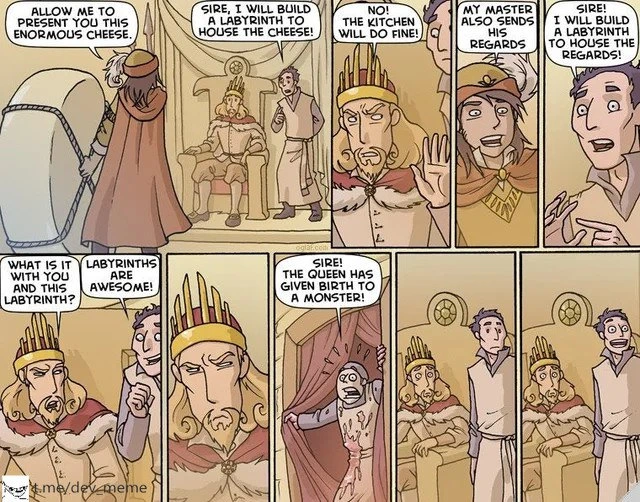
Level 1: Maze for Everything
This is like someone who loves building mazes so much that they want to put cheese in a maze, greetings in a maze, and finally a monster in a maze. The last one actually makes sense, which is why it is funny. In programming, it means your favorite tool might be great, but not every problem needs it.
Level 2: Favorite Tool Syndrome
The key idea is tool fit. Every programming language and architecture pattern has trade-offs. C# is common in business software, backend services, desktop tools, games, and cloud systems. Rust is often attractive for performance-sensitive code, systems programming, safety-critical components, command-line tools, embedded work, and places where memory bugs would be especially expensive.
The meme is funny because the character does not evaluate the situation. Cheese? Labyrinth. Greetings? Labyrinth. Mysterious creature? Also labyrinth, but this time maybe fair. That maps to a developer who wants to introduce Rust into a C# company even when the current problem might be solved more simply inside the existing ecosystem.
This relates to the YAGNIPrinciple, which means "You Aren't Gonna Need It," and the KISSPrinciple, which means "Keep It Simple." Those principles do not say "never use advanced tools." They say complexity should be paid for with a real benefit. A new language can be worth it, but the reason should be stronger than "I want to use it."
Level 3: Labyrinth-Driven Development
The comic keeps escalating the same bad architectural instinct. A servant hears:
Allow me to present you this enormous cheese
and immediately answers:
Sire, I will build a labyrinth to house the cheese!
Then, when told:
My master also sends his regards
he somehow proposes:
Sire! I will build a labyrinth to house the regards!
The visible punchline is that he loves labyrinths so much that every input becomes a labyrinth problem. The post message makes the developer mapping explicit: "Me, looking for an excuse to use rust when everything in the company is C#." In other words, the labyrinth is Rust, the kingdom is an established C# codebase, and the engineer is waiting for any monster-shaped requirement that will justify introducing a new stack.
That is why this is a precise DesignPatterns_Architecture joke rather than just "new tool bad." Rust is a serious language with real strengths: memory safety without a garbage collector, strong compile-time guarantees, excellent performance characteristics, and a type system that can make illegal states harder to represent. There are problems where those strengths matter a lot. But the comic mocks the habit of starting with the preferred tool and then hunting for a problem dramatic enough to fit it.
In a company where "everything is C#," adding Rust is not just choosing syntax. It affects build pipelines, deployment artifacts, debugging, observability, hiring, code review, package management, security scanning, incident response, and the ability of another team to maintain the thing after the original enthusiast moves on. The labyrinth may be beautiful, but now the kitchen staff needs a maze budget, a maze on-call rotation, and a maze migration plan.
The final panels create the best architectural beat. The messenger says:
Sire! The queen has given birth to a monster!
Then the king and servant sit in silence. For once, a labyrinth might actually be appropriate. That is the nuance: OverEngineering is not using powerful tools; it is using them before the problem earns them. When a real monster appears, the previously absurd solution can become reasonable. The hard part of senior engineering is knowing whether you are looking at cheese, regards, or an actual Minotaur-shaped production constraint.
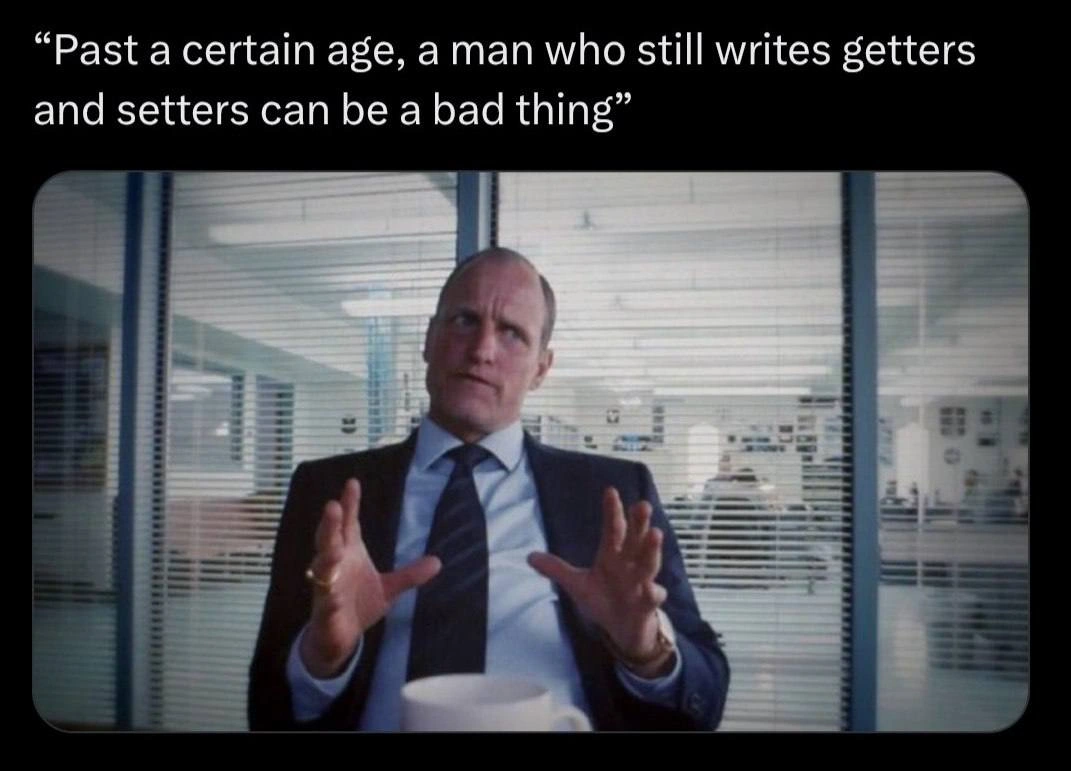

Every platform team has met the engineer who sees a cheese and immediately opens an RFC for service discovery.
What is (or was) special with C# that got it so popular? How is it different from Java?
In fact, BigInteger is internally implemented as BigUInteger + sign logic. (Well, in fact it is more complex than that, but the basic idea is similar.) Unfortunately, with opaque implementation, it is not possible to not use the things you don't need, nor to add advanced functions (operators), nor extract the values that system implementation computes but discards, returning only one of them. So rolling out your own math library (or using third-party one) instead of System.Numerics is the only way to overcome the basic design.
I will still this and Clear Watermark from it
Nobody See me