
Full-Stack Vibecoding Meme Explained
Buzz Lightyear–style bravado claims full-stack mastery and the power to vibecode anything. The deep dive contrasts real full-stack work with cowboy coding, technical debt, and the gap between swagger and competence.
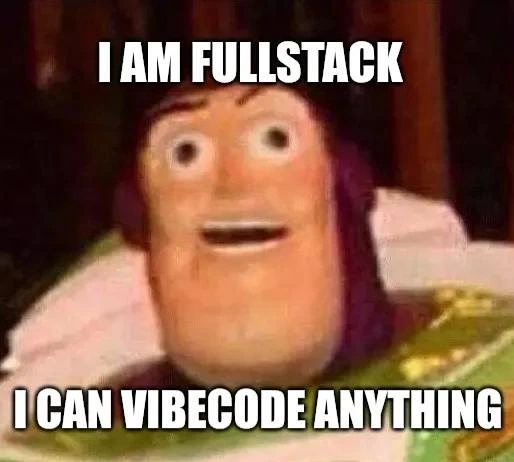
Level 1: All By Myself!
Imagine your friend claims they can build the biggest LEGO castle ever all by themselves, without even looking at the instructions. They just dump out all the pieces and start clicking them together, saying "I got this, I'll just feel it out!" At first, it sounds bold and impressive. But soon you notice the castle is looking a bit odd and wobbly. Your friend was so confident, but building something that complicated needs a plan — you can't just guess where every piece goes.
It's funny because we've all seen someone (or been someone!) who was super sure they could do a hard task without any help or plan. Like trying to put together a new toy or bake cookies without following the recipe, just winging it (making it up as you go). Usually, things end up crooked or burned, and everyone watching kind of knew that would happen. In the same way, the meme shows a developer bragging "I can code everything by feel!" We smile because that big confidence is almost certainly going to run into reality, just like the shaky LEGO castle that might collapse. The joke is really about the gap between saying "I can do it all alone!" and how things actually turn out when you try.
Level 2: Buzzwords vs Reality
In this meme, a developer boldly says "I am fullstack," meaning they claim to handle both front-end and back-end development all by themselves. The front-end is the part of software that users directly see and interact with (think of a website's buttons, text, and layout in your browser). The back-end is what runs behind the scenes on the server (things like databases, user account logic, and APIs that send data to the front-end). A full-stack developer is someone comfortable with both sides – building the user interface and the server logic (the word "stack" here just means all the layers of technology in an application). It's a valuable skill set, but it's also a lot to master.
The meme then uses the funny made-up term "vibecode" — which isn't an official tech word at all. Coding by vibe means coding by intuition or feel, without a clear plan or specification (basically making it up as you go). It's like saying, "I don't need requirements or architecture, I'll just start coding and it will somehow all work out." This is a nod to cowboy coding, where a programmer works solo with no planning, no code reviews, and no process – just riding in and doing whatever feels right in the moment. The meme exaggerates this behavior to highlight how silly it sounds when someone is overly confident about such a chaotic approach.
Why is this funny to developers? Because in reality, building an entire app "by vibe" usually ends badly. Modern software projects have many moving parts. If you skip planning:
- On the front-end side, you might create a web page that looks good on your computer but breaks on other devices or browsers because you didn't test properly. Or your UI code becomes a tangled mess that's hard to update.
- On the back-end side, improvising can lead to security holes (maybe you forgot to check user input, leaving an opening for hackers) or performance issues (like a poorly written database query that makes the app slow). You might also forget to handle errors or edge cases, causing crashes when something unexpected happens.
- Without a spec (specification), which is a clear description of what the software should do, you might build something that doesn't actually meet the user's needs. It's like assembling furniture without instructions – you may end up with missing pieces or a wobbly result.
The phrase "I can vibecode anything" is poking fun at overconfidence. Often, less experienced developers might feel on top of the world after learning a bit of everything – a little HTML, a little database, a little Node.js – and declare themselves ready to do it all. It's natural to be proud of new skills, but it takes years to truly become proficient across an entire stack. The meme reflects a common piece of wisdom: "jack of all trades, master of none." This saying means that if you try to do everything without focus, you might not do any one thing very well.
In developer culture, bragging "I can do anything" tends to get some good-natured eye-rolls. Teamwork, careful planning, and knowing your limits are seen as signs of real maturity. No one really codes a complex system alone by pure instinct — or if they try, it often leads to messy results that others have to fix later. So, this meme is a light-hearted reminder that being full-stack isn't just about tossing around buzzwords. It's about understanding the responsibility of each layer and respecting that real expertise takes time. Plus, it's okay (and wise) to ask for help or plan things out, rather than diving in claiming you're a one-person coding army.
Level 3: Bravado-Driven Development
I AM FULLSTACK
I CAN VIBECODE ANYTHING
These grand proclamations "I am fullstack" and "I can vibecode anything" are dripping with developer bravado. This comedic exaggeration depicts a coder who believes they're a one-person army across the entire tech stack. For seasoned engineers, it immediately evokes the overconfidence bias and the classic Dunning-Kruger effect in action. It's absurd because any real "full-stack" developer knows how deep each layer's rabbit hole goes. The meme satirizes a cowboy coding approach: diving into both frontend and backend with no plan, no spec, and a whole lot of swagger.
In practice, building an application involves multiple layers:
- The frontend (user interface & experience) using HTML/CSS/JS or frameworks like React, each with its own challenges (cross-browser quirks, state management, accessibility).
- The backend (server logic, databases, APIs) using languages like Python, Node, or Java – dealing with data models, caching, concurrency, and security.
- Possibly DevOps or infrastructure, setting up servers and deployment pipelines to support the app.
Each layer has specialists for a reason. The meme's "fullstack vibecoder" waves away this complexity, implying they can handle all of it through sheer instinct.
Seasoned devs cringe-smile at this because we've seen what happens when someone codes by vibe across an entire system:
- Spaghetti code that entangles front-end and back-end logic in weird ways (quick hacks everywhere).
- Lack of separation of concerns – for example, database calls sprinkled throughout UI code, or business logic jammed into SQL queries.
Unit testsand docs mysteriously "forgotten" (the vibe didn't whisper that writing those was necessary).- An avalanche of technical debt left behind for the poor souls who maintain the project.
- Overconfidence masking skill gaps: the dev might use plenty of buzzwords (microservices! NoSQL! serverless!), but only skin-deep understanding, leading to fragile implementations.
There's a dark humor here: production systems can't run on vibes. The "I can vibecode anything" attitude often leads to the infamous "works on my machine" scenario — code that barely holds together in a dev environment but blows up under real conditions. Experienced engineers have inevitably ended up on call at 3 AM, patching a vibe-coded service that is failing in spectacular fashion. This kind of bravado-driven development tends to collide with reality once real users, scale, and edge cases enter the picture.
The meme resonates in dev communities because it's a shared cautionary tale. It's poking fun at the self-proclaimed full-stack rockstar who thinks mastering a couple of tutorials makes them an expert in everything. We laugh (perhaps a bit bitterly) because many of us either were that person early in our careers, or we've had to clean up after one. It's basically the "jack of all trades, master of none" scenario in software form. The humor has a kernel of truth: truly competent full-stack developers exist, but they become that way by humbly learning each layer over years — not by declaring themselves omnipotent coders overnight.
In short, this meme is a tongue-in-cheek reality check. It uses an exaggerated claim ("I can vibecode anything!") to highlight the gulf between confidence and competence. Any senior dev knows that feeling of seeing a newcomer charge in full of swagger and thinking, "This will be… interesting." The image of Buzz Lightyear's gleefully oblivious face fits perfectly here: a would-be space ranger who believes he can literally fly, until reality (and gravity) inevitably kicks in.

My last project was 'vibecoded.' The primary design pattern was 'hope,' the testing strategy was 'thoughts and prayers,' and the only thing it consistently delivered was anxiety to the on-call engineer
Sure, you can vibecode anything - until the vibes hit production and the logs start crystals-aligning at 3 a.m
After 15 years in tech, I've learned that 'fullstack' is just code for 'we couldn't afford separate frontend and backend teams, but we did spring for a ping pong table' - and somehow we all still put it on our resumes like it's a superpower rather than a cry for help
Ah yes, the modern fullstack developer: proficient in React, Angular, Vue, Node, Python, Go, Rust, and Kubernetes - each at precisely the depth of a three-hour YouTube tutorial. 'Vibecoding' is the new paradigm where architectural decisions are made based on which framework has the coolest logo, and 'it works on my machine' has evolved into 'the AI said it would work.' The real fullstack these days is: Stack Overflow for the backend, ChatGPT for the frontend, and sheer audacity for the deployment pipeline
“Fullstack by vibes” is scaffolding Next.js with one prompt, auto-generating Prisma migrations, hitting Deploy on Vercel - then learning your CAP theorem is Copy - Ask - Paste: high availability of confidence, partitioned understanding, and zero consistency at 3am
Nothing says full‑stack like a single PR mixing React state, SQL migrations, and a Helm chart - audited exclusively by autocomplete and kubectl apply
Vibecoding: fullstack superpower for turning every merge conflict into a philosophical debate on monorepo merits
literally me
Back in my day vibe coding just meant trying shit until it worked
I asked a collegue her dev environment recently and she said replit 😭
You when you realize that because you're sole fullstack, you have to vibecode your taxes too
Btw it's a legendary thread and I'd script it into my memory for sure - ty guys for making this half of a year!