
Big Rewrite Impulse Meme Explained
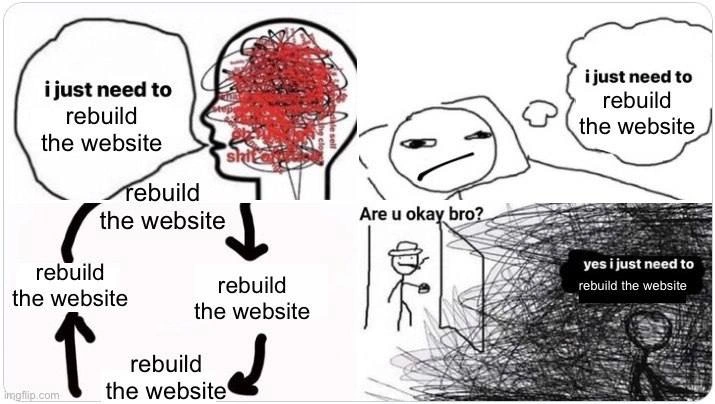
Four panels show a developer whose only thought is “I just need to rebuild the website”—chaos, blank stare, infinite loop, then a worried friend. The dive unpacks technical debt, the big-rewrite myth, and why incremental refactoring usually beats scorched earth.
Level 1: Start Over
This meme is funny because it’s like a kid getting so frustrated with a messy room that they say, “I should just burn down the whole house and build a new one!” Of course, that’s an overreaction – you wouldn’t actually do that just because your toys are everywhere. But sometimes when people (or developers) feel overwhelmed by a big mess, they only think about starting completely over.
Imagine you spent days building a big LEGO city. Over time it got really messy – blocks everywhere, some buildings are crooked, and nothing fits right anymore. You get so upset with the mess that you tell your friend, “I’m fine... I just need to tear it all down and rebuild it from scratch.” Your friend looks at you like, “Are you okay?” because that sounds a bit extreme. In the meme, the developer’s mind is stuck on that extreme idea. They’re so annoyed with their current website (which is like their LEGO city or messy room) that they keep saying the only fix is to rebuild everything from the beginning. It’s funny in a goofy way – we know the person is stressed out and not thinking straight, and the solution is way too drastic, just like demolishing a house to clean one room. The humor comes from that over-the-top reaction to a common problem. So even if you don’t know coding, you can laugh because we’ve all felt like that about something hard: so fed up that we’d rather start over completely than deal with the mess in front of us.
Level 2: Refactor vs Rebuild
For a junior developer or someone newer to WebDevelopment, this meme illustrates a common dilemma: Should we improve the existing code (refactor), or throw it all away and start fresh (rebuild)? The panels show a stick-figure developer whose mind is completely preoccupied with the idea “I just need to rebuild the website.” This is a dramatization of what happens when a codebase becomes hard to work with. Let’s break down the concepts:
Legacy Code: This means the old code that your project is currently running on. It might have been written years ago using older practices or by many different developers. Over time, it can become messy or outdated, especially if lots of quick fixes were piled on. Think of legacy code as an old, creaky house – it’s still standing and doing its job, but the wiring is old, the floor plan is weird, and nobody left a clear blueprint of how it was built. Working on it is scary because you’re afraid to break something unintentionally.
Technical Debt: This is a metaphor for the shortcuts and temporary fixes made in the code over time that you “owe” cleanup for later. Just like financial debt, if you don’t pay it off, interest (problems) accumulates. For example, imagine a developer once said, “I don’t have time to do this properly now, I’ll fix it later,” and then that happened 100 times across the codebase – now you have a debt of messy code. TechnicalDebt makes adding new features or even fixing bugs feel like slogging through mud, because each change is harder than it should be. In the meme, this debt has likely made the code so frustrating that the developer’s brain snaps into thinking a full rewrite is the only way out.
Refactoring: This is the process of improving the code without changing what it does. It’s like cleaning up a messy room: reorganizing, dusting, throwing away junk, but not moving to a new house. Refactoring might mean renaming variables to clearer names, breaking a huge function into smaller ones, or restructuring code modules so they make more sense. Importantly, when you refactor, the user shouldn’t notice any difference – only the developers feel the benefit (cleaner, more maintainable code). It’s a gradual, incremental approach to handling bad code. In an ideal world, developers continuously refactor the code to keep it healthy, which prevents that build-up of technical debt.
Rebuilding (Rewrite): This means scrapping the existing code (or large parts of it) and writing a new system from scratch to replace it. It’s like saying, “This house is too old and crooked; let’s demolish it and build a brand new one in its place.” The appeal is that you get to use the latest tools and do everything “right” from the ground up. The danger is that building a whole new house is a giant project – you might run out of time or money before it’s done, and until then, you still have to live in the old house. In software terms, a rewrite often takes much longer than expected. Meanwhile, the old system (no matter how ugly) is what’s keeping the business running. Rewriting means replicating all the features the old system has (including the obscure ones that took years to get right). It’s easy to underestimate that.
Now, why is the character in the meme stuck thinking about rebuilding the site on loop? This reflects DeveloperFrustration reaching a peak. Maybe this developer spent days trying to fix one nasty bug in a SpaghettiCode mess. (Spaghetti code is a slang for code that’s tangled and twisted in logic – imagine a bowl of spaghetti where pulling one noodle moves others; in code, touching one part unpredictably affects another.) After enough failed fixes or confusing dead-ends, the developer feels hopeless about understanding the current system. The temptation to start over becomes very strong. It’s emotionally satisfying to fantasize about a clean slate: no more weird bugs, no more mysterious functions written by someone who left the company 5 years ago, no more patch on patch. The thought “I just need to rebuild the website” repeats because it’s like a mantra offering hope. It’s the brain’s escape hatch from a tough situation.
The meme’s panels illustrate this in a relatable way:
- In the first panel, the person’s head is filled with chaotic red scribbles along with the text. This represents the mental chaos and stress. Red scribbles = brain fried by messy code. They keep thinking the same thought because nothing else is cutting through the frustration.
- The second panel shows the developer slumped over, blank stare, thought bubble repeating the phrase. That’s the burnout face of a programmer who’s been stuck on a problem too long. It’s like they’ve become a zombie, only able to mutter about rewriting.
- The third panel with the circular arrow diagram is literally an infinite loop drawn out. In programming, an infinite loop is a loop that never ends because the exit condition is never met. Here, the “condition” to stop thinking about rebuilding might be actually solving the problems another way, but that’s not happening. So it loops endlessly.
- The fourth panel has a friend asking, “Are u okay bro?” and the developer standing in a dark scribble cloud, replying monotonously “yes i just need to rebuild the website.” That dark cloud can be seen as the gloom or depression that follows burnout. The friend’s concerned question emphasizes how not normal this behavior is – it’s a gentle poke that the developer has kind of lost it at this point, even though they insist they’re fine (clearly, they are not fine!).
For a junior dev, all this is a cautionary but comical example of what not to do when you encounter bad code. It’s saying: “We know it’s super tempting to chuck out legacy code and start over, but be careful!” Is rebuilding sometimes the right call? Sure, there are cases where an app or site truly is better off being redone (for example, very old systems that can’t meet new needs). But it should never be an impulsive decision born purely out of frustration. Often, incremental refactoring – gradually improving the code – is the safer, more practical path, even though it’s less dramatic. This meme resonates because every developer has daydreamed about a full rebuild at least once, especially when dealing with a gnarly DeveloperPainPoints like code that’s breaking in weird ways. It’s a funny exaggeration of that common internal struggle: to refactor or to rewrite? The best engineers learn to resist the obsessive_rewrite_thoughts seen here and instead chip away at problems, but the fantasy of the perfect rebuild is always lurking in the back of our minds (particularly late at night when a bug is driving you up the wall!).
In simpler terms, this meme is a relatable piece of DeveloperHumor about hitting a wall with your project. It highlights the internal monologue that many won’t admit out loud: “This code is so bad that maybe setting it on fire and starting fresh is the easiest fix.” It’s tongue-in-cheek, of course, showing that giving in to that urge leads to a loop of endlessly redesigning without actually solving anything right now. The next time a junior dev feels this urge, hopefully they’ll remember this meme and have a little laugh – then take a deep breath and maybe tackle one piece of the problem at a time, instead of reaching for the demolition button.
Level 3: Infinite Rebuild Loop
At the senior engineering level, this meme hits on a tragically familiar cycle in software development. The developer’s brain is stuck in an infinite loop of one thought: "I just need to rebuild the website." This loop is depicted literally in the third panel with a never-ending circular arrow diagram labeled "rebuild the website" at every turn. It’s a satirical take on technical debt and frustration so intense that the only perceived solution is a ground-up rewrite. Seasoned developers recognize this as the classic rewrite impulse that strikes when a codebase becomes a tangled mess of LegacyCode and quick fixes. The humor (tinged with pain) comes from how relatable this overreaction is: instead of methodically improving the existing code, the brain goes straight to a scorched-earth solution – throw it all away and start over.
This scenario lampoons what we call the “big rewrite” syndrome. The thought process often goes like: “This code is spaghetti. It’s beyond salvation. If I could just scrap everything and rebuild it the right way, all our problems would vanish.” Of course, every battle-hardened dev knows that’s a myth – a seductive one, but a myth nonetheless. TechnicalDebt accumulated over years can make a system painful to work on; each function is a landmine of half-baked features and odd bugs. In such a state, any minor change feels like defusing a bomb with a blindfold on. It’s no wonder developers daydream about a pristine restart. The meme exaggerates this to absurdity by showing the dev’s brain completely overtaken by red scribbles (chaotic thoughts) and the phrase repeating ad infinitum, as if the poor soul can’t think of anything else.
From an experienced perspective, the dark humor here is also an indictment of overengineering and the pitfalls of the “rewrite mentality.” We’ve all seen the pattern: an ambitious WebDev project that’s been patched too often, or a product stuck on an outdated stack. Instead of incrementally Refactoring the code, someone insists on a full rebuild – perhaps in the latest framework or a different language (“Let’s rewrite it in Rust/Go/NextJS, that’ll fix everything!”). This often becomes an obsession (as illustrated by the friend asking “Are u okay bro?” and the developer lost in a scribbled black cloud muttering the same mantra). The irony is that embarking on a total rewrite is dangerously close to chasing a mirage. It feels like breaking free from all the LegacyCode shackles, but in reality it’s a colossal undertaking fraught with risk. The meme is winking at every senior developer who’s been in that meeting where someone says, “This is unsalvageable, let’s rebuild from scratch,” and you feel both a twitch of excitement and a deep sense of dread. You just know that rewrite could take months (or years), introduce its own new bugs, and possibly never fully replace the old system’s functionality.
There’s also a nod to how DeveloperFrustration can cloud judgement. The panels progressively illustrate a descent into a one-track mind: first the thought in text, then the dev blankly staring, then a full-blown loop, and finally the dev enveloped in a dark haze. It’s funny because it’s true – we’ve all had moments at 3 AM after battling SpaghettiCode where our brain short-circuits to “burn it down, rebuild from ashes.” The RelatableDeveloperExperience here is strong. Even the most battle-scarred engineer might chuckle (or cringe) remembering that one nightmare project where the only comforting thought was nuking the entire codebase from orbit (the ultimate overkill solution). The meme captures that delirious state perfectly.
In practice, experienced devs know that a complete rewrite is a double-edged sword. Legendary projects in tech history have fallen into the rewrite trap and paid dearly. (The tale of Netscape throwing away their web browser code in the 90s for a rewrite is a cautionary horror story passed down in engineering lore – they never recovered their momentum.) This context adds depth to the meme’s humor: it’s not just a personal angst, it’s a well-known industry-wide joke that rebuilding a big system is usually an epic quest with dubious outcomes. The endless loop graphic is a perfect metaphor: once you start the cycle of “rebuild the website,” you might find yourself repeating it over and over as requirements change or the new solution reveals its own flaws. It’s a relentless_refactor_eye situation – an eye twitch of obsession to endlessly chase a “perfect” codebase that likely doesn’t exist.
To sum up the senior perspective: this meme is hilariously on-point because it exaggerates a real coping mechanism (or anti-pattern) in development. It’s poking fun at the rewrite_the_website fixation that developers fall into when dealing with overwhelming TechnicalDebt. The comedic sting comes from truth – everyone who’s maintained a gnarly, old system has heard that little voice saying the same thing as in the image: “Just rebuild it, that’s the answer.” We laugh because we know that feeling too well, even as we also know that giving in to it can lead to an infinite rebuild loop of its own.
// Developer's thought loop in pseudocode:
let solutionFound = false;
while (!solutionFound) {
    // The brain is stuck in this loop of despair:
    think("I just need to rebuild the website");
    // (No exit condition, it's an endless cycle of rebuild obsession)
}

The 'rebuild the website' daemon runs in the background, consumes 90% of your mental CPU, and can only be killed by a product manager with a new, even more urgent feature request
My brain: “Just rebuild the website.” Reality: that’s the same monolith we already “rebuilt” in JSP, then Rails, then Node, then serverless - proving the only truly stateless component in our stack is our collective memory of why it was a bad idea the last three times
After 15 years in the industry, I've learned that 'just a quick rebuild' is the developer equivalent of 'just one more turn' in Civilization - except instead of Gandhi nuking you, it's your own tech stack from 6 months ago that suddenly looks like COBOL
Every senior engineer has been here: that seductive whisper that 'just one more rebuild' will finally make it perfect. Spoiler alert - it won't. The real skill isn't knowing when to rebuild; it's knowing when to ship the 'good enough' version and iterate. Because that 'temporary' solution you shipped five years ago? It's still running in production, generating revenue, while your perfect rewrite exists only in your fever dreams and that abandoned Git branch
“I just need to rebuild the website” - the senior version of clearCache(): flush years of context, warm a shiny Next.js/Tailwind stack, and discover the latency was upstream in governance and content anyway
Just rebuild the website is how you end up with two production systems, the same bugs, and a migration plan called Friday
Seasoned architect's dirty secret: Facing a webpack hydration error? Just rebuild the monolith - until Kubernetes notices and pages you at 3AM
Yesss
yeeeeeeeeeeeeeeeeees it's me
you can use hot reload, bro
"Hmmm today I will replace pandoc with my custom parser" 25.04.25 incident
Same with my homelab
>web-based app bro it's just book in fancy computer format